When our guide picked us up at 7:30 I almost wondered if she was slightly amazed at our willingness to navigate the metro to get home the previous night. She'd offered to get us to our hotel, of course, but we didn't want to force her and the driver to work around our prime-the-pump schedule. Moreover, we crave our independence when traveling, and we felt a little guilty about accepting any degree of hand-holding. That said, we had to admit our appreciation about having a ride this morning. We'd paid for a little convenience and were determined to enjoy it. Gradually, as we motored through those jammed streets under increasingly blue skies, Shanghai landmarks became more recognizable to us. Soon enough we'd be touring the city on our own; it was nice to get a basic awareness of how its structures and spaces fit together.
Returning to the line at the security tent, waiting to enter the fair for a second day, we fell more comfortably into the routine. Our complexions and demeanors continued to attract attention, but we felt the calm of having been here before. We'd tossed our extraneous survival guide notes, we had our plastic folding chairs and cardboard fans. We knew the score. The heat - again, supposedly a lucky break for foreign visitors hoping to avoid the fair's famously protracted lines - inspired the crowd to bubble into tiny cones of community. Nearby, a guy flicked his fan to thump cool air toward an elderly woman. At the same time my own burden of heat lightened a bit when a neighbor lifted his umbrella high enough to cover us both. Whipping out my fan, I waved in broad strokes, making sure to send extra breeze his way. Now and again we would smile at each other in quick glances, advancing in broken waves to the entrance.
After passing through the security queue we took the metro to the Pudong side this time, alighting near the national pavilions. Checking our directions we fast-walked toward our goal: the UK Pavilion. I'm glad we did. The line had already stretched past the 20 minute mark when we arrived, and it quadrupled in size while we waited. We felt pretty good about our progress up until the very last moment when our section of line was set to enter the pavilion, only to be stopped near the door for a maddening delay of 20 minutes. We sat and stewed and then, without a hint of explanation, were finally admitted.
Andy in front of UK Pavilion
Describing the UK Pavilion is just about as difficult as photographing it. A giant cube of waving acrylic tendrils, rising 60 feet over a weirdly curved foundation of "Don't Sue Us" playground-rubber flooring (an "urban park" described in promotional materials as "wrapping paper" for the British gift to China) the thing seems like a blurry vision in even the most sharply focused pictures [Check out the Virtual Exhibit]. The pavilion's centerpiece is something called the Seed Cathedral, though it's more commonly nicknamed "the hedgehog" or, especially by Chinese visitors, "the dandelion."
Seed Cathedral Interior
Wags at the Daily Mail dismiss the thing as a pricy "pin cushion." Yet thoughtful reviewers worldwide have concluded that The Seed Cathedral may be the most impressive exhibit at the fair, not to mention the most impactful. Each of its 60,000 transparent rods, you see, contain seeds. Standing inside the cathedral, you are surrounded by walls of them, all aglow with light streaming from the outside. The scene is almost reverential. And when the expo closes for good, the seeds will be distributed to schools across China and the UK as a sort of distributed bank of biodiversity [Check my blog for more pix].
Receiving henna tattoos at the Mauritania Exhibit
From the UK we strolled a short distance to the Africa Pavilion where 42 countries and the African Union had come to exhibit aspects of their cultures and industrial might (Did you know that Sudan is the world's "prebiotic basket"?). Why were so many nations stuck under one roof? Turns out that many couldn't fund their own buildings. In response, China, determined to make this expo the world's largest, simply footed the bill. Inside the so-called "Gift Box" building, each country got space in a sort of open-bazaar mall filled with trinket tables and passport stations for the fair's tireless stamp collectors.
Shopping in the Africa "Gift Box"
After being stopped by a couple of guys who asked me take pictures with them, Jenny and I took silly snapshots of our own at designated photo-spots: a camel, an ape, and even giant faces of African people, including, supposedly, a version of the famed "Lucy" fossil. At the Mauritania Exhibit, Jenny sat down to receive a henna tattoo, while an endless stream of Chinese fairgoers snapped photos. The Africa building, perhaps being most famous as the one pavilion you could enter without standing in line, satiated our need to visit countries separated by feet rather than miles.
Netherlands Pavilion seen from UK Pavilion queue
Heading back outside, we marched straight to the Netherlands Pavilion, one of the expo's quirkier displays. Known as "Happy Street," the figure-8-shaped exhibit is a walking tour of Dutch culture that rises like a roller coaster of looping pedestrian paths. Happy Street is a collection of houses, each built on stilts, that become peepshows for a cheerily eclectic assemblage displays that range from clocks and Van Gogh artifacts to a purification plant that serves water through fuel pumps and a creepy teddy bear whose eyes follow your movements [That last one is called "Social Eyes" - get it?].
Stairway to Happy Street
Nearby, polyester/fiberglass sheep graze upon fake grass, fascinated visitors peer into a greenhouse packed with tulips, and crowds line up at a Dutch restaurant that distributes tiny wooden clogs with each combo meal. Jenny and I joined a throng of resting, lunching fairgoers among the sheep, appreciating a shady respite from the sun [Some version of the sheep, by the way, is supposed to go on sale sometime in the near future].
Plastic sheep at the Netherlands Pavilion
Departing Happy Street we turned toward the fairground's southern edge in search of the Chile Pavilion. On the way, we were approached by a man who commenced to remind us in broken English that tickets for the China Pavilion are rare, that reservations are required. I knew the pitch, having heard that scalpers were combing the streets in search of suckers, so we ignored this guy and kept walking [That evening I read that fair authorities were beginning to replace paper pavilion tickets with plastic versions, complete with computer chips, to reduce counterfeiting].
Inside Chile we explored a fascinating inquiry into urban life. A rolling view of suburban living is augmented by a disembodied voice that asks, "What is a city?" An upside-down apartment complex invites visitors to consider the koan, "If no one knows anyone… then why live in the same city?" Nearby, a chasm of video monitors creates a Blade Runner vibe. And toward the end of the show, a "Well of the Antipodes" presents viewers a chance to gaze downward onto a video display of life on the other side of the planet.
Looking down the Well of the Antipodes
As afternoon began turning toward dusk we ambled through a few more sites. The Cuban pavilion offered a Mojito bar but otherwise was a disappointment, suggesting (though hardly proving) that the island nation is good for nothing else but rum and cigars. The Pavilion of City Being, another one of the expo's five theme sites, offered an excuse to duck out from the scorching weather with its life-sized rail station (called Vigor Station, for some reason) and a 360-degree cinema vision of how plazas contribute to urban vitality.
Buying trinkets at a souvenir shop
Best of all, a nearby mega souvenir shop fulfilled a world's fair fantasy of mine, the chance to flip through row after row of postcards, booklets, t-shirts, and other collectibles. I can't time-travel back to 1939 to stock up on New York World's Fair baubles. But at least I could bring home plenty of memories from Shanghai for the next generation of expo aficionados.
China Pavilion
Back outside we crossed wide avenues to get closer to the China Pavilion. The streets were thronged with electric buses and small non-electric cars. Pedestrians, in the usual fashion, crossed wherever they pleased. They say that bigger vehicles outrank smaller ones in China, and that pedestrians rank lowest in the urban scheme of things. That's right: You get hit by a car in these parts, it's your own fault. Even so, Jenny and I found ourselves increasingly bold in our excursions, barreling across the broad boulevards with an I-Dare-You glare. The slogan for our crosses, a stupid choice on retrospect, was, "You're not gonna look for me? I'm not gonna look for you."
Expo 2010's "Axis of Evil"
Feeling suitably tough, we boarded an expo bus for the northeast edge of the fairgrounds, headed for the "Axis of Evil." So far no one knows precisely who thought it'd be literally perfect to place the Iran and North Korea buildings next to each other, but the convenience of the choice has surely attracted every American expo visitor. In Iran I felt especially welcome, receiving a piece of rose flavored candy when I handed our passports to the stamper (none of the other folks received a treat for some reason).
Adding to the friendly atmosphere, the exhibit displays Iranian President Mahmoud Ahmadinejad in a smiling pose, professing his love for humankind and his confidence that city life is living for each other, not just with each other. A scale model of a nuclear power plant showcases the country's peaceful application of atomic power, without the tiniest hint of weaponized potential. I joked with Jenny about being a CIA agent and that we were secretly gathering intelligence on Iran's nuke plans.
Iran nuclear plant model
Our next stop, North Korea, presented a more stark mood. The pavilion features a miniature "Juche Tower" (standing for the country's practical necessity of Self Reliance) and some videos illustrating the "Paradise for People" sign that hangs, dimly lit, from the ceiling. Mostly I remember images of North Korean athletes, which, presumably, did not include North Korea's ill-fated soccer team. A guy stamping passports looked almost emaciated. In contrast, the women at the souvenir stand were positively aglow under vertical edifices of hair.
North Korea doesn't quite get the concept of subtlety
Most intriguingly, these folks seemed more focused on selling stuff than almost any other pavilion we'd visited. Shelves offered books containing Kim Jong-il's writings on everything from economics to opera, stamps highlighting stalwart soldiers bayonetting Running Dog Americans, and postcards depicting various heroes of the revolution ("No, that's Kim Jong-il's uncle," I was helpfully informed). The most thoughtful item: cold water that had been once "gushing out from the rock formation of granite on Mt. Kalmae in Onchon County, South Pyongan Province." That's South Pyongan Province - none of that North Province swill!
I packed a spine-bending bag of souvenirs (anticipating a delightful conversation with a San Francisco customs official upon our return) and returned with Jenny outside, where the temperature had dropped to a mere 90 degrees Fahrenheit. We dropped by an information station, though by now we'd long gotten used to the pleasant green-shirted, English-speaking volunteer guides having no clue how to interpret our questions. Having had some luck with the bus getting to the Axis of Evil, we climbed aboard again, anticipating a quick ride to the area where the U.S. Pavilion is lumped.
Haibao reminds bus-riders to be courteous
Yep, Haibao was on the video screen again. And we recognized our general direction. And then we started heading under the river, traveling through a tunnel back to the Puxi side. By this point, we didn't mind. It was a free opportunity to check out the expo's World's Fair Museum. So we exited on the other shore, stopped for a quick bite at a Papa John's Pizza place ("Papa John's" in name only) and joined a queue to take another bus further down the road. A guy tried to cut in front of Jenny, only to be shoved backward, first by Jenny and then by an old guy who started smacking the would-be line-jumper on the arm. We felt almost like locals at this point.
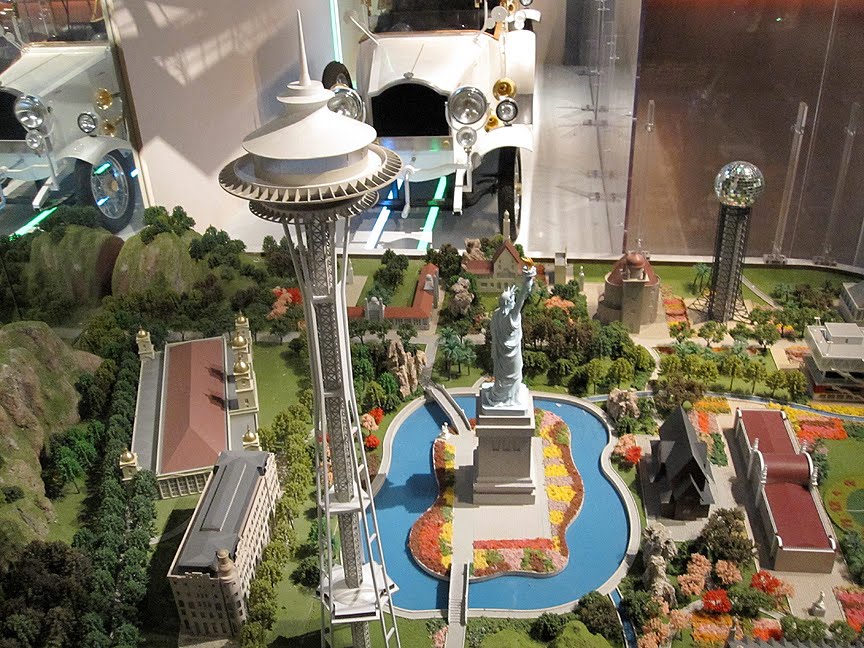
Famous expo theme buildings (and the Statue of Liberty)
The World's Fair Museum was nice enough, though it seemed curated by someone who had only a glancing awareness of the concept. Mostly I was worried that my camera had almost entirely run out of battery power. I tried the one outlet I could see, but it didn't work. I didn't try a second time at the museum because a guard started looking warily at me. Conserving the one or two minutes of power remaining, we toured the largely empty exhibit and then returned back to the boat dock for one last ferry ride.
Our evening would conclude at the China Pavilion, that new symbol of the PRC's 21st-century might. But first, we trudged around the U.S. Building, with no intention of joining the two-hour line for a pavilion universally panned as a disappointment, before catching a bus heading toward that huge, red inverted pyramid. We got close enough, and I sat up the tripod and furiously composed the shot, the camera's power indicator blinking rapidly - and then off.
Frustrated, Jenny and I walked into a tiny mall of restaurants and shops, looking for a power outlet. Nothing, not a single place to power up. We thought about giving up until we stepped into a pleasantly titled Official Merchandise Store. That's where I spotted an outlet behind a display of Haibao dolls. Over the next 20 minutes, Jenny and I "looked at souvenirs," while the camera sucked some juice (how happy I was to have packed a converter this time!). We'd bought so many expo souvenirs over the past two days, I felt OK about the subterfuge.
Finally I got some decent photos and video of that bold, tacky, and gloriously confident China Pavilion. Getting inside was never an option, of course. Lines were said to stretch for hours and hours. You'd have to arrive at the gates earlier than five in the morning just to get a chance to run toward a reservation desk in hopes of snagging one of 30,000 tickets. Yeah, that would happen. No pavilion is worth the eight hours I'd read this one would take to enter. Eight hours!
Last night at Expo 2010
I'd heard that some countries were purposefully stretching their waiting times as a sign of prominence. If it takes a half day to see Saudi Arabia, that country's got to be important, right? Then there's China's ultimate goal of making this the most heavily attended expo in history, with an expectation of 70 million attendees. Some critics whisper that the government is doing more than give free tickets to Shanghai locals, that they're threatening the salaries of regional officials who fail to meet quotas. For China, an economic behemoth still sometimes laughably called a "Developing Nation," Expo 2010 is that big a deal. Nonetheless we were happy to see its signature pavilion from the outside.
We snapped our last pictures, took a walk along the Expo Axis, and made our way to a bus promising a quick ride to a nearby metro station (the wait for the ride to start was interminable, but never mind). Walking under the arched bridge with its animated, blinking colors, our eyes were drawn forward to that city of 20,000,000 people that stretched beyond the fairgrounds. Amnesty International reports that 18,000 households were evicted to make room for the world's fair, but we see no signs of that strife tonight. We only see the towering ambition of a nation shoving the past aside for a glittering tomorrow.
Sometimes we are dubious, sometimes we are amused, and sometimes we are horrified. But always at the fair, always, we are amazed. That night back at the hotel I expect to hear a cacophony of voices in my ears; there's no way I can sleep after our adventures in China's glorious future! Still, I drift away immediately. We've toured ourselves to near-exhaustion in only three days - and our Asian adventures are only just getting started.
Tonight Vienna and I will watch 12 Monkeys (again), and once more I'll likely be struck by that image of a high-ceilinged department store filled with customers fading into a post-apocalyptic future devoid of human life.
Movies like 12 Monkeys call forth a nagging modern fear that we're all sitting precariously atop an edifice ready to collapse into ruin. We keep shopping, keep driving, keep building, and we hope that we're wrong to feel that the center of civilization simply cannot hold.
Then comes a documentary like Crude Awakening: The Oil Crash, and a far more substantial degree of confidence begins to give way.
Crude Awakening gathers together an impressive array of experts ranging from oil geologists and historians to a former secretary general of OPEC, a former energy adviser to the president, the mayor of an oil boomtown-gone-bust, and even a Hummer car salesperson, all to consider the possibility that the world has reached an era of Peak Oil, that we've reached the summit of our production of oil and gasoline and now face a steady decline in our quality of life as demand exceeds supply.
Watching this film, I found it compelling to consider that the creation of oil was a rare and relatively brief set of geological events that, for most of human history, was no more relevant than the birth and death of dodo birds. From this perspective, our oil-based economy, largely born in the 20th century, is a blip destined to fade.
During that blip, though, we've witnessed the explosion of our global population as cheap energy allowed the birth of automobiles, suburbs, interstates, and global trade, the creation of the modern world (and its environmental discontents). Crude Awakening dares us to imagine the fate of the world once the oil runs dry.
In this world, shaky economies propped up by petrodollars collapse and we face the true price for our profligate ways. Prices spiral beyond imagination as the production of once-cheap products, luxuries we take for granted today, become unsustainable. The result is a new Great Depression, but a different one than the struggles we faced in the thirties. This is a Depression built on natural limitations not artificial speculations.
Even more frightening, the film marches through the alternatives to which many of us cling, those bridges to the future of more cars, bigger cities, and unchanged values. With hybrid cars, we hope we can continue to carpool two kids around town in mammoth SUVs. Maybe hydrogen technology will save us, or cleaner nuclear power. And then there's solar!
Crude Awakening argues that these technologies, some of which are genuinely promising in the long-term, are insufficiently developed to make a sizable dent in our energy needs for the next generation, and that the price of peak oil will ravage our societies sooner than that.
Already we're used to gas prices that have spiraled to crazy heights over a matter of months. And we know that it's going to get worse. What we don't know, what we can hardly imagine, is the harrowing reality of a world whose nations must wage perpetual war to secure dwindling oil supplies. We know that Iraq was really about oil. But are we prepared to invade Iran? Saudi Arabia? Iraq now wants us to plan our exit. Will we? With no more validity to our claims that our wars are meant to democratize the middle east, just what kind of country will we become?
And then there's the even bleaker future presented by Crude Awakening: a foreseeable world in which air travel and even auto travel reside beyond the means of those who enjoy those privileges now. How then can we sustain our global economy, our far-flung suburbs, our daily lives? This documentary suggests nothing less than the end of modern civilization, what James Howard Kunstler calls The Long Emergency.
Another piece of dystopian pop culture from my early years, a book by Whitley Strieber and James Kunetka called Nature's End, refers to the last 25 years of the twentieth century as the "joyous sunset." I always found that image to be potent, suggesting as it does the obliviating pleasures of excess and disregard before the night falls.
We soon thereafter got a glimpse of life after those happy years on September 11th. And today our sunsets (in California, at least) are often particularly lovely due to the fires burning throughout the summer. I hope that these images portend only to a momentary fear-mongering that is due a fan of sci-fi such as myself. But a documentary like Crude Awakening calls forth quiet but urgent questions before I head off to sleep.
CBS News reports a White House internal debate, spurred by Israel's warnings, over the wisdom of striking Iran's nuclear weapons program. Here's a snip:
Israel's message is simple: If you don't, we will. Israel held a dress rehearsal for a strike earlier this month, but military analysts say Israel can not do it alone.
"Keep in mind that Israel does not have strategic bombers," Oren said. "The Israeli Air Force is not the American Air Force. Israel can not eliminate Iran's nuclear program."
The U.S. with its stealth bombers and cruise missiles has a much greater capability. Vice President Cheney is said to favor a strike, but both [Joint Chiefs Chairman Admiral Mike] Mullen and Defense Secretary Gates are opposed to an attack which could touch off a third war in the region.
U.S. intelligence estimates Iran won't be able to build a weapon until sometime early in the next decade. But Israel is operating on a much shorter timetable.
Israel recently practiced long-range bombing techniques in what many analysts interpret as preparations to bomb Iranian nuclear sites. Writing in The New York Times, Michael R. Gordon and Eric Schmitt describe the wargames, which took place earlier this month, as designed to both warn Iran about Israeli abilities and prepare for an actual attack: "'They rehearse it, rehearse it and rehearse it, so if they actually have to do it, they’re ready,' [a] Pentagon official said. 'They’re not taking any options off the table'."
While it seems inconceivable now that the U.S. would attack Iran, that nation seems hell-bent on provoking a war with us. In response, Defense Secretary is moving another carrier into the Persian Gulf. According to CBS, "planning is being driven by what one officer called the 'increasingly hostile role' Iran is playing in Iraq - smuggling weapons into Iraq for use against American troops."
I was mildly stressed today that I had nothing to post. I've spent so long working on the Route 66 website that I haven't really resurfaced to think of new ideas. This morning I figured I'd upload some link and commentary about Iran, the "Axis of Evil" member that seems once again to be looming in U.S. military sights. But I just couldn't right something so heavy today. Perhaps I'd post nothing at all. Few people wait urgently for my little missives. That was my thinking anyway.
Then I saw this YouTube video, which is recommended by Diablo Cody in this week's Entertainment Weekly. For folks who remember rockin' in the seventies and eighties, hearing a ten-year-old kid kick ass on Kansas' "Carry On Wayward Son" is just too cool to miss. So here it is.
In today's New York Times [subscription required], Mark Mazzetti writes that a new American intelligence agencies report concludes that Iran placed its nuclear weapons program on hold in 2003. Here's an excerpt:
The finding [comes] in the middle of a presidential campaign during which a possible military strike against Iran’s nuclear program has been discussed. The assessment, a National Intelligence Estimate that represents the consensus view of all 16 American spy agencies, states that Tehran’s ultimate intentions about gaining a nuclear weapon remain unclear, but that Iran’s “decisions are guided by a cost-benefit approach rather than a rush to a weapon irrespective of the political, economic and military costs.”
Gareth Porter writes in the The Asia Times that the September attack against an alleged nuclear site in Syria was, in fact, a message being sent to Iran.
Until late October, the accepted explanation about the September 6 Israeli air strike in Syria, constructed from a series of press leaks from US officials, was that it was prompted by dramatic satellite intelligence that Syria was building a nuclear facility with help from North Korea.
But new satellite evidence has discredited that narrative, suggesting a more plausible explanation for the strike: that it was a calculated effort by Israel and the United States to convince Iran that its nuclear facilities could be attacked as well.
Washington sources say that America has shelved plans for an all-out assault, drawn up to destroy the Iranian nuclear facilities and take out the Islamist regime.
The Sunday Telegraph has learned that President Bush's White House national security council is discussing instead a plan to launch pinpoint attacks on bases operated by the Iranian Revolutionary Guard Quds force, blamed for training Iraqi militants...
Vincent Cannistraro — who served as intelligence chief on Ronald Reagan's National Security Council and then as head of operations for the CIA's counter-terrorist centre — said: "What's on the table right now is tactical strikes."...
The White House and Downing Street would justify such an attack as a defensive move to protect allied troops in Iraq. But moderates in the US government are concerned that the counter-terrorist argument may be used by hawks as a figleaf for military action that could escalate into all out war with Iran.
The Sydney Morning Herald reports escalating interest in bombing Iran. Here's a snip:
AUSTRALIA, Britain and Israel have reportedly "expressed interest" in a US campaign to launch surgical bombing raids on Iran targeting Revolutionary Guard Corps facilities.
A report in The New Yorker by the journalist Seymour Hersh said the Bush Administration had stopped trying to justify a campaign against Iran on the basis of curtailing Iran's nuclear ambitions. It is instead redefining the war in Iraq as a strategic battle between the US and Iran.
Pentagon planners have developed a list of up to 2,000 bombing targets in Iran, amid growing fears among serving officers that diplomatic efforts to slow Iran's nuclear weapons programme are doomed to fail. (para 2)
In a chilling scenario of how war might come, a senior intelligence officer warned that public denunciation of Iranian meddling in Iraq - arming and training militants - would lead to cross border raids on Iranian training camps and bomb factories. (para 5)
Under the theory - which is gaining credence in Washington security circles - US action would provoke a major Iranian response, perhaps in the form of moves to cut off Gulf oil supplies, providing a trigger for air strikes against Iran's nuclear facilities and even its armed forces. (para 7)
Tom Petty's 2006 single "Saving Grace" is a literally perfect addition to my prized roadtrip playlist, one of those rare songs that I know will amp my interstate travels for a long, long time. I must admit, though, I'm a little surprised. Back in the eighties, I never cared much for Petty. His nasally voice and seemingly pedestrian lyrics failed to impress me, a confirmed Genesis fan in those days. Nowadays I don't listen to Genesis that much, but I've come to appreciate Tom Petty. I don't know if he grew up or if I did, or if it's a combination of the two, but his latest album ("Highway Companion") and single have grabbed me.
"Saving Grace" begins with a driving pulse of rhythm guitar and an occasional metallic clatter that reminds me of telephone poles and clotheslines and westbound trains. "I'm passing sleeping cities," Petty says, "fading by degrees, not believing all I see..." Organs and textured guitars roll to the sound of handclaps and the song gathers steam: "And it's hard to say who you are these days. But you run on anyway…" After the first chorus, "Saving Grace" officially becomes an ass-kicker, growling with a primal junkyard saunter that catches me a little by surprise every time I hear it. I flash on tin roof Mississippi juke joints. I remember empty, dusty roads and blue-sky afternoons. And I yearn to hit the highway with a six string of my own.
"Saving Grace" speaks of guilt and the desire to escape the sins you've committed, and I think of my own. To me, road trips have always been about that saving grace, the chance to live simply, without context or memory. They provide opportunities to flee the small places of my life, oddly enough by visiting smaller ones still. Among the broken bottles and grimy windows of an abandoned motel I've always felt some degree of renewal. And yet the road never offers a real escape, only a brief respite. That's what the song means, I think, when Petty sings, "You're confident but not really sure." But I run on anyway.
PS: Listen to the song a couple of times and see if you don't agree: Petty begins with a simple roadtrip anthem, but he seems to conclude with a shove at President Bush's inability to get off that bloody road running through Iraq:
You’re rolling up the carpet Of your father’s two-room mansion No headroom for expansion no more And there’s a corner of the floor They’re telling you is yours You’re confident but not really sure.
It's almost as if a new adventure in Iran may be perceived as some form of "saving grace."
On Tuesday, President Bush dramatically stepped up his war of words with the Iranian president Mahmoud Ahmadinejad, whom the US government accuses of overseeing a covert programme to develop nuclear weapons. In a speech to war veterans, Mr Bush said: "Iran's active pursuit of technology that could lead to nuclear weapons threatens to put a region already known for instability and violence under the shadow of a nuclear holocaust." (para 6)
This was widely taken to mean that he is set on a confrontation with Iran that will culminate in a bombing campaign to destroy Iranian nuclear facilities, just as Israel bombed Saddam Hussein's Osirak reactor in 1981. (para 8)
So the question is: did Mr Bush last week set America inexorably on a path to the next war? (para 10)
For many Americans, such a question seems absurd. Anyone who studies the state of our military -- troops, equipment, morale -- would conclude that the United States has shot its wad in Afghanistan and Iraq, that we'll need a decade to rebuild after our adventures in that part of the world. And yet few doubt our president's stubborn confidence in the rightness of his actions. Mr. Bush, the candidate who once spoke of a humble U.S. foreign policy, may have set us upon a path that has no detours.
Now, let's be clear. The actions and rhetoric of the Iranian government are indisputably threatening. Indeed, I take seriously the claims that U.S. soldiers have been killed due to the proxy efforts of Iraq's eastern neighbor. And I respect Israel's genuine alarm about the prospect of a nuclear-armed Iran. These are dangerous times, and they call for a brave response. But still, I remember those assurances of Iraqi WMD waiting to be uncovered from the desert sands. And I cannot help but be skeptical that, yet again, we are gearing up for another strike in that blood-soaked region.
Did history just catch up with us? Or are we inventing as we go along?
Learn More
Sarah Baxter, The (UK) Sunday Times: Pentagon 'three-day blitz' plan for Iran: "Whether you go for pinprick strikes or all-out military action, the reaction from the Iranians will be the same." (para 3)
Howard A. Rodman, The Huffington Post: How I Learned to Stop Worrying and Love Bombing Iran: "I've been dismissive of these rumors, as have you. Why? Because one would have to be a madman (or Dick Cheney) to start a second war when the first one is going so [kissably] well . . . I was inclined (you were inclined) to dismiss all this bluster as sabre-rattling. Alas, in the past week it has become apparent . . . that those sabres are Tomahawk missiles -- and that they're locked, aimed, loaded. (paras 2 and 6)