The following is a guest post from "Eddy," a friend I met while attending my fourth Salzburg Global Seminar. As you’ll shortly see, "Eddy" offers a practical, personal, and thoughtful form of engagement with the sometime overwhelmingly complex realities of global capitalism. When he shared these notes with me, I asked for permission to repost them here.
I’m currently staying/participating at a squatted site called Grow Heathrow. It is proving to be quite an important time for me. Politically affirming. I came here to learn skills, connect with others who have similar ideas about how we provide for ourselves, and give my support to a cause/project I’m passionate about. The squat originated from a need to confront the proposed plans for a third runway at Heathrow Airport. The government in the UK has been looking at airport expansion for a while now – there’s still talk as to where this expansion will take place. If they opt for Heathrow, they’ll have to remove the squatters from this land and tarmac over the village of Sipson; one of the principal aims of the project is to instill community resistance in Sipson against Heathrow Airport Holdings (formerly British Airports Authority), if they come knocking.
The attitude here is great. People are focused. It's a working squat. People arrive for many reasons. I'm here to work. That’s where my head is at the moment - I want to be productive, to be useful. Other visitors are here to enjoy themselves, relax and talk with others. This is a haven for free thought - a space to breathe for those disillusioned with materialism.
Here there’s no room for the workings of capital - no pressure to work the 9 to 5. It is a kind of political expression that directly challenges labour, the 9 to 5 grind. It is this kind of political expression that interests me at the moment, as opposed to attending the monthly anti-war protest/demonstration. Protest is important, but we must also set the agenda. ‘If all we do is oppose what they are trying to do, then we simply follow in their footsteps’.[1] We need to carry on with our activity that isn’t determined by money. We must dedicate ourselves to what we consider necessary or desirable. We must live the world we want to create.[2] Besides, protesting wipes me out (as I recently experienced at the protest against Fracking at Balcome). Not sure I want to devote my time and energy to protests, where we shout, confront police etc. It's not in my nature to use physical force against other humans. Probably too middle class. It's not in my nature to shout about things, sing chants, etc. Perhaps if it's a cause that really riles me up, then I might reconsider.
At the squat there is a non-hierarchical, anarchistic set up. No one is instructed to work. People work when they feel ready to. There are always tasks to be done. People wake up, a group gets together, starts talking - momentum starts to build and we work on a project. And we work hard. But it doesn't feel like work. Because we’re there at our own will, because it’s a cause we believe in, there’s such camaraderie in our collective work. It’s fun and social. What great conversations emerge during work. Working together on something, where there’s a common goal, an objective, sometimes sparks more interesting conversations than assembling with the intention to socialise. During the summer there seems to be a huge flux of international travellers who have heard about the project. The squat reminds me of travelling in hostels – spaces to socialise, unwind and talk idealistically.
A working mind is a healthy mind. People are happy when they're productive, when they're being useful. Their self-esteem grows, their self-confidence and sense of value to the group benefits. During this first month, I have easily forgiven those who have not managed to work and contribute fully. There will be a long history of reasons as to why some are able to contribute more than others. Those that don't, we should have sympathy for and try to understand why, rather than resent them. I guess I am just grateful I have this working mind, this motivation. I've only been here for a month, and my feelings on this may change. Without special resolve and grit, I imagine it is easy to lose patience over time.
The experience thus far is fulfilling a personal need to experiment with new forms of social relations outside capitalism. Grow Heathrow is an open project with plenty space for people to join the site. Contrary to other squats, it is the project that brings the inhabitants of the site together, rather than a group of friends. This kind of experiment in communal living has its rewards and challenges. There are those that use this space as some kind of refuge from some torment in their lives outside the squat. Although they are often unable to contribute to the collective in a variety of ways, the space must try to accommodate their distress. The community must do its upmost to prevent looking inwards. One older lady, who was previously in a mental institution, has benefitted immensely from gardening, working outdoors and being with people. She tells me how lonely she gets in the evenings on her own in her flat. Living communally trumps any discomfort from sleeping without a mattress.
The squat relies on solar panels and a wind turbine for its electricity, has no running hot water from the tap (although an impressive warm shower wood burner has been built) and there’s a compost toilet on site, minimising water usage. Almost all the food consumed is either grown on site, taken from bins outside supermarkets, or from food wholesalers giving away waste food. I must say, I do get a sense of gladness as I walk about doing my daily activity without barely any ecological footprint.
After 5 months in Salzburg (or rather a lifetime) of talking about the problems of the world, and what needs to be done, I am finally in a living and working arrangement that satisfies my political need to get to grips with the ‘doing’. When I wake up in the morning I feel as though I’m in the right place. At least for now. We’ll see how it goes this autumn.
The land that the community is occupying is up for eviction. So there is that added insecurity that for some residents makes long term-commitment/planning difficult. Indeed, their innate instability and transitory nature is a key criticism of squatted social centres. I seem to forget that bailiffs could start breaking through the gate any minute. Part of me doesn’t believe it will happen: Who would break-up such a peaceful, well-meaning, environmental project? I come across as naïve to some of the old-time squatters, who tell me I’ll soon understand what we’re fighting against when I see the State use its might to destroy any dissenting activity. Property is king. I wonder where I’ll be, what I’ll do when we’re being evicted. I probably won’t know how I’ll react until it’s happening. Can physical force ever be successful against the State? History shows that violence and aggression is what it often does best. Why play them at their own game? But if someone is evicting you from your home - if I develop some emotional attachment to this place - there’s no knowing how one might react.
Describing the strange journey of surveillance whistleblower Edward Snowden, now supposedly holed up in Moscow’s Sheremetyevo International Airport, Washington Post social media reporter Caitlin Dewey describes those omnitopian corridors that connect hotel lobbies to airport terminals without seeming to touch the world outside.
This article describes "the legal limbo between the arrival gate and customs" encountered by some refugees, activists, and other stateless persons, noting the case of Mehran Karimi Nasseri who fled Iran with plans to settle in the UK but ended up living for 18 years in Charles de Gaulle Airport (a story transmogrified by Steven Spielberg into the 2004 movie The Terminal).
Feel-good summer stories aside, Dewey reminds readers that, "the magical-seeming lawlessness of the transit zone can cut both ways: For the political figures that find themselves there, it’s both a sanctuary and a prison."
As part of our European Grand Tour, Jenny and I queued up to see the world's largest model railroad in Hamburg, Germany: Miniature Wonderland, complete with a launching space shuttle, an airport (with flying planes), and even a neon South Beach! We could have stayed for hours, because every square inch seems to be packed with tiny details (Jenny's favorite part was the tiny hot tub at the bottom of a ski slope). And believe it or not, they're not done building this thing!
Over the weekend I attended a lovely gathering of folks dedicated to globalizing our campus. Just the day before, I worked with colleagues helping to plan an international trip, trying to make sure students get a clear sense of their possible leadership roles in an increasingly connected world. Of course my thoughts could never stray from the images and sounds pouring in from Japan. The 9.0 quake threw another sad but essential dimension of our global conflation into sharp relief: nothing more than a flat screen monitor separates us from the pain of others.
When the initial reports began streaming in Thursday night I could hardly sleep. The quake was bad enough, but the subsequent tsunami was worse, wrecking a broad swath of northern Japan and racing toward Hawaii and western North America with the speed of a jet plane. It was about 2 in the morning when newscasters were reading the estimates of impact, just hours away. Eventually I settled into nervous slumber - not expecting waves to crash into my house, of course - but rattled with the anxiety that more bad news was on the way.
I stayed home that Friday (no meetings "over the hill," thank goodness) and I'm glad I did. Pals described an epic traffic jam on Highway 17, a soul-sucking slog exacerbated by gawkers who gathered at the summit to watch the waves roll in. Hawaii was generally spared, but the ports of Crescent City and Santa Cruz (yep, just a few miles away) were hammered. Back in Japan, international shipping container units - that perfect symbol of global modernity - had been tossed around Sendai like Legos. The airport was devastated, and thousands of lives were snuffed out throughout the region.
Then we heard about the nuke plants.
Perhaps four are facing various stages of meltdown. So far we've witnessed one "hydrogen explosion" (a horrifyingly ambiguous term, if you ask me) - and fear that another could be imminent. Experts promise that Japan's nuclear woes do not portend another Chernobyl. But hundreds of thousands of people have been evacuated anyway. As a last ditch effort to contain the damage, at least one two reactor cores have been flooded with seawater. Just in time, because seismologists predict that a 7.5 level aftershock will further shake Japan in a day or two. Oh, and just for good measure, a volcano has erupted in that country's southern region.
Those of us who live in California know that our state is due for similar wreckage (well, maybe without the volcano). Our own customized Big One is deemed a virtual certainty within the next thirty years. One day our friends in Japan will watch, horrified, as we suffer a pain they know all too well. Our two countries are bound together, and they will help us then - even as we try to help them now. That's the face of globalization, too. More than malls stocked with exports, more than movies with globish dialogue, our expanding international network means that we suffer together when bad times come.
Recently a Facebook pal (Michael Hirsch) shared Jeffrey Tucker's blogpost entitled "In Praise of the Tourist Trap." This is one of those essays that grabbed me from the start. I found myself notating phrases from each paragraph until I realized that I must share the whole thing.
Tucker's essay, as the title indicates, recommends that critics of the built environment complain a little less about the ersatz nature of modern places and focus a little more on the pleasures they offer. We may all be tourists in our own worlds, and the fauxcales we inhabit may indeed be fake. Yet we suffer a myopic loss when we fail to account for the momentary smiles they inspire. Thus:
"In the airport, you can stand in one spot and choose to walk twenty feet in any direction and find yourself in a Spanish or Thai restaurant, or grab a book from a literary looking place, or have a Starbucks, or eat a decadent cinnamon roll, or pretend to be on Savile Row at a high end men’s store, or perhaps get a massage or toss down a martini or two, trying on the high life for as long as it lasts."
The alternative, Tucker proposes, is a kind of Bauhausian sterility reminiscent of a DMV office. From this perspective the divide sets bureaucratic functionalism against corporate boosterism. Yet more importantly, the debate calls to mind a question of authenticity.
We presume some value to experiencing things "as they really are" - but what precisely does that mean? Just because a cheesy Texas 10-gallon hat found at a DFW gift shop might force an embarrassed grimace, must we therefore conclude that this ephemeral piece of consumable culture is necessarily less meaningful than a memento earned through some supposedly more authentic encounter with culture? Does dust make it real? Sweat? Pain?
Perhaps the definition of authenticity resides in discursive construction rather than ontological meaning. Put more directly, authenticity might just be a matter of taste.
Over the winter break I enjoyed a brief roadtrip to southern California, focusing my time on Mojave and Fresno. Truthfully I wasn't overly excited about the prospects of a solo driving tour, but Jenny sensed my road fever and recommended that I hit the pavement. Sharing a couple weeks together in the same house - without the necessary diversion of our traditional work schedule - inspires that kind of creative thinking, I guess.
Relic airplanes at Mojave Airport
Gusty rainstorms bracketed my travels. Still I quickly fell into the familiar, happy routine of long distance driving. My daily total would be less than 350 miles, but I could have driving 500 or more with a smile. I had no particular destination in mind when I pulled away from the garage. I just knew that I wanted to head south. Maybe LA to photograph some Dingbat architecture. Maybe further east. Finally as I slotted myself onto the 101 the desert spoke to me. I would avoid the smoggy metroplex and seek solitude.
Semiotic Ghost 17 miles east of Mojave
I searched out shuttered berry stands for some reason, and craned my neck to read the spindling lines of California's irrigation woes. I reached Mojave some time around four. Already darkness had set in. I grabbed a swell room at the Desert Inn and then returned to the highway in search of that old Rocks Cafe sign 17 miles east. I savored the scrape of barbed wire and the chill wind. Later I lit a cigar and posted myself across the highway from a bail bonds office to capture the zippy threads of headlights. I felt renewed. Next morning I would mosey over to the airport to snap one of its famed lines of airplanes that roast under the sun. Perhaps I would also revisit the aging motels of Fresno.
Alain de Botton stole a dream job of mine; he got a gig at Heathrow Airport as a Writer-in-Residence. Even better (or worse) he transformed a week of omnitopian adventure into a book called, reasonably enough, A Week at the Airport. Here's a description (gleaned from a CNN story on his project):
"I had a big desk in the middle of departures, with a screen showing what I was typing and most people didn't bat an eyelid as they walked past. Others quickly assumed that it was very normal that there should be a guy writing a book by the check-in desks and came to tell me how I could improve my book and what anecdotes I would be a complete fool for not including. Then there was also a minority of people who just saw me as a useful conduit to information about the location of the restrooms."
Here's another pithy reply to a questioner's implication that airport research must be boring:
"I was delighted not to be going anywhere and therefore, to be free to actually observe where I was. Part of the problem of airports is that we only go to them when we are off somewhere else, and therefore don't see them as a legitimate destination."
Yep, I've added A Week at the Airport to my wish list.
David Terry, an SJSU colleague, shared this link with me a couple days ago about a fellow named Chadwick Matlin, a guy who responded to the trauma of getting fired and dumped in an particularly odd way. In the tradition of Henry David Thoreau and William Least Heat-Moon, Chadwick (really, sometimes life kicks you in the ass just when you're getting started) began a solitary journey of self-discovery. Only, this guy didn't hike into the woods or search for blue highways. No, he decided to visit 30 airports in 30 days. Since I've slept in a few airports myself, this topic got my attention.
Mercifully, Chadwick doesn't seek much in the way of transcendant wisdom from the experience [not at first]. But he does offer some pithy observations about airport life, initially about a group of nomads who have turned this sort of craziness - using JetBlue's "All You Can Jet" promotional opportunity - into a lifestyle. For a while the piece glosses along the well worn grooves inhabited by airportologists (apparently that's a word): The food is bad. Airports are disorienting. That sort of thing. But Chadwick offers especially thoughtful commentary when we departs the U.S. terminal bubble with a quick stop at the Dominican Republic.
I'm not sure, but I think this may be an ongoing series. You might want to check back sometime…
After more than 20 years of talking about it, Jenny and I went skydiving on Saturday. She got a pretty decent discount deal for an outfit called Skydive Hollister (the ones with the cheesy web address, http://1800funjump.com and a promise for the "cheapest slots in the bay"). That's right, we gleefully invited our own deaths with a discount skydiving company! Actually, from what I've heard - and definitely from what we saw - these folks know what they're doing. The jump was professionally handled, and we were in good hands all the way down. I never felt anything but safe, considering that we purposefully hurled ourselves out of an airplane at 15,000 feet.
So, what's it like to skydive?
Well, it begins with some preparation. Maybe a month and a half before our jump, I was working at home when I got an email from Jenny: "Hey, wanna skydive?" Honestly I was too busy to dwell on the idea. But after two decades of saying we'd have to try it "someday" I couldn't say no. She had a "Groupon" and was willing to handle the arrangements; I had no excuses. The training and jumps themselves would be relatively cheap. Add videos and photos (a much more complex operation for all concerned, since individual jumpers would memorialize our exploits) and the total was around $450.
Waiting for our jump-day to arrive, both of us continued to be inundated with work and travel. There just wasn't any time to contemplate the gravity of our situation (sorry 'bout that). Only in the final days did I occasionally think: "You're really doing this. You know that, right?" I had some trouble sleeping the night before, especially when I did the math and realized: "Dude, you're jumping from 15,000 feet. That's almost three miles!" That morning my joints felt a little creaky, and I pondered, "I'm going to throw this body out of an airplane." Putting on some antiperspirant, I really slathered the stuff on. I figured it could get a little hot today.
Jenny joined me in feeling a little wired about our day's adventure, so she suggested that we pump ourselves up for the drive to Hollister by playing some suitable music. Our trip-list: Foo Fighters' "Learn to Fly," Pink Floyd's "Learning to Fly," along with U2's "Vertigo," "Elevation," and "Beautiful Day." We also downloaded Kenny Loggins' "Danger Zone" but forgot to play that one. Our weirdest but most appropriate choice? Styx's "Come sail away."
Arriving at about ten, we had little clue what to expect. Well, we knew of one thing: We were going to hang around for a while. The Hollister folks had warned us to anticipate a two to four-hour wait from arrival to jump time. Some snippy Yelp reviewers had moaned of daylong drags in a boring facility without much to do. Fortunately the schedule seemed to be moving along smoothly. We paid our fee and were invited to select three pieces of music to accompany the videos they'd make. Not so amazingly (knowing Jenny and I) we chose the same three pieces from their list (Foo Fighters' "Learn to Fly," U2's "Elevation," and some knock-off version of ELO's "Mr. Blue Sky").
We also signed "You can die doing this stuff, but you can't sue us" paperwork, which included an obligation to write out a phrase signifying our knowledge that this activity can end in "injury or death." To reinforce the message, we also sat through a video hosted by tandem parachute equipment pioneer Bill Booth (a guy whose epic beard earned him the nickname of "ZZ Top guy"). Staring into the camera, ZZ Top promised us that litigation is futile even in cases of a staff member's "gross negligence." Reflecting on that warning, I imagined myself in court: "But my instructor held me up at gunpoint. He stole my wallet!" - only to have some smirking defense attorney hold my signed waiver up for all to see: "But you were in a parachute, correct?"
We locked our stuff in the car after being assured that anything in our pockets would be lost in the air, and we waited. I'd dutifully brought some papers to grade, but couldn't muster an ounce of energy for that task. Instead I flipped through a book about surfing and occasionally joined some smalltalk with Jenny and another woman making her first jump. Our new pal's boyfriend was making his eighteenth solo flight, and he projected only the most subtle trace of swagger as he described how he'd advanced through the Accelerated Freefall training program over a few weekends. When one of the jump instructors walked by, he offered a hearty shout-out: "Didya hear about that new suit?" - naming an otherwise random assemblage of letters and numbers. I flashed back to that scene in Star Wars, when one stormtrooper asked another, "Have you seen the new BT-16?" I felt strangely still, waiting.
Right about then, geared-up instructors and googly-eyed jumpers walked past. I knew it: These folks had just gone up and it was our turn next. Like turning a dial to ten, things sped up. I was called by name and directed to a guy wearing an Army t-shirt who looked just like a young Tom Sizemore. Another fellow joined us, describing how he'd be shooting video and reminding me that I might want to grab onto his feet at some point. "Grab onto your feet?" I wondered to myself. My mind spun. I was trying to remember the names of these folks; it seemed like a good thing to know.
I learned that my trainer - the guy who'd be attached to my back the whole way down - was nicknamed "Mr. Rogers." His attitude was reassuringly no-nonsense. He explained the procedure of tandem parachuting and emphasized my role in this relationship: my job was to arch my back and to relax my arms. I didn't feel the slightest desire to point out the contradiction. For good measure Mr. Rogers instructed me to get on the deck and practice. Ever the studious learner, I tried once, got an OK, and then asked if I could try it again. "I'm thinking it, but I'm not feeling it."
"Oh man," my instructor was surely thinking. "This guy's going to be a handful."
Then we got harnessed up. Tight. Tighter than you'd imagine. I looked over at Jenny who was enduring the same process. She was laughing. I just wondered how much more squeezed my jiggly-bits would be with every adjustment. Time was racing now. We were getting suited up. We were walking outside. We were boarding a small plane. We were packed in to a tiny cabin. We were aloft. I was sitting between Mr. Rogers' legs; he was adjusting my gear tighter and tighter. Videographers were asking us questions for the shows they'd later produce, and Jenny and I somehow managed to answer. We were performing our parts: high-fiving, fist-pumping, woo-hooing. All the while my instructor counted off adjustments, hooking us ever closer together. "One. Two. Three. Four." [squeeze, clinch, shove, pull]. "Did you feel those?" Oh yeah. Then he told me on three separate moments, "I'm gonna ask you, 'Are you ready to skydive?' What are you going to say?"
The door was open and I felt cold. We circled higher and higher, watching the blue curve of Monterey Bay arch away from the Pacific. Someone else in the plane had forgotten their antiperspirant. I was focused on the bloody handprint stuck to the window. Halloween is coming, and someone thought it'd be funny to place a plastic reminder on the glass. I realized then that the only truly terrifying part of this adventure was the physical process of jumping. I still couldn't quite fathom what we were going to do. Would we stand up? Does one person go first, followed by the other? What if the wind snaps us against the plane? Oh, and what if all those adjustments fail and I plummet to a fast and violent death?
I reminded myself that I can't control what's going to happen. I'm going to be hurtling toward the ground with only confidence that my instructor knows what he's doing. I could only presume that this dude also, you know, wants to live. As we continued our climb, Mr. Rogers told me about his experience, that he'd made thousands of jumps and was the instructors' supervisor that day. I felt calm enough, I guess, even as I watched Jenny scoot toward the door. She and her instructor were going first. I patted her shoulder and we smiled at each other. They took their positions. They rocked - forward, back, forward - and were gone.
"Are you ready to skydive?" Mr. Rogers asked. "I am ready to skydive," I replied. What else could I say? We edged up to the open door. My feet dangled crazily out of the plane. I thought for a second that we might fall accidentally, just slip off the edge. How bad could that be? We're going out anyway. Then I thought more about what it'd be like to slam against the side of the plane or to cartwheel off into the air due to some micromoment of error. Just a second or two to go. We shifted our position as my instructor made his last adjustments. I thought about all those straps and connections. All that work, just for this. Then we rocked. Forward, back, out.
An explosion of wind blew my mouth open. I didn't feel velocity so much as pressure. The air pounded against my chest and I yelled for the thrill of it all. I knew we were falling at a rate of about 120 miles per hour, but I felt no fear. Nothing but exhilaration. My mouth grew stale with the storm rattling my tongue; I didn't care. We plunged and I shouted "Hell yeah!" I loved the feeling of racing toward the ground, daring it to grab me. I arched my back and held onto the straps when my instructor checked his altimeter. I remembered that he had a helmet, but that I didn't. I wondered why. The wind beat against my goggles. Then, a jolt. The canopy deployed and we hung in sudden stillness.
At this point we had a few moments to enjoy the ride. I looked down mostly, fascinated by the miniature buildings and the grand scale. Mr. Rogers then started teaching me how to turn, and we were soon whooshing left and right. He told me to pull one cable down beneath his knee and we began to twirl in sharp horizontal loops. I guess he felt that I was doing OK, because he let me navigate toward a church. We'd be landing somewhere nearby. I loved the feeling of controlling our descent, maneuvering us toward the ground. I removed my goggles and took it all in. Only at 1000 feet to go did Mr. Rogers regain the controls. The speed had become a tangible thing now. My bones would hit the ground one way or the other.
Mr. Rogers didn't curse, but I could tell he wasn't happy with the speed and angle of our final approach. Something about the wind. We were falling toward a field at a sharp pitch, heading directly for a fence topped with barbed wire. He yelled, "Kick your feet up!" I figured we'd land hard. I thought about speed, time, and direction. I was sure we'd plow into that fence. I wasn't frightened, though, just aware. My job was to kick my feet up; Mr. Rogers' job was to land us. One second, maybe two, and the canopy flared above our heads. We hit the ground and began to slide feet-first toward the fence, unearthing a plume of dust. There was nothing to do but to wait it out. I wondered if we'd get tangled in the barbed wire, how much it would hurt. Then, without so much as a flex of muscle, we stopped - maybe six feet before the fence. My heart was rattling. We didn't get a scratch.
And that was it. I stood up and Mr. Rogers congratulated me on being a good student. We shook hands and I turned to find Jenny. She was thrilled but a little shaky. Her descent had been a little rough on her stomach. We hugged gently. The mood was buoyant as our little group collected the gear and climbed into a tiny yellow bus. Once more we were squeezed in tight for the 20 minute drive back to Hollister. My videographer showed me photos and footage of the flight; I was grateful for his work. But almost immediately the moment seemed to grow abstract. I knew that Jenny and I had jumped out of an airplane - we'd just done it! - but seeing it all on those tiny screens made the whole experience seem almost artificial. I felt the dust on my pants and the icky pallor in my mouth. That was real enough.
We returned to the airport to get unhooked. Walking through the set-up area, it was fun being on the other side of this moment, enjoying the cocky feeling of strolling back from a jump. I thanked Mr. Rogers for his patience and expertise, and left a reasonable tip. I mean, really, I'd put my life in this guy's hands. Jenny and I then shared lunch at the nearby Ding-A-Ling Cafe while we waited for our videos to be completed. I ate a hamburger and contemplated the rest of our day, how we'd go home to look through our photos and maybe later see that new movie, The Social Network. Everything on the ground seemed smaller than it did before. And now for the big question: Will we do it again?
At this point I'd say, we probably will. Jenny loved skydiving, and I've got to admit that I'd like to try once more, if only for the opportunity to be more "present." All day I dwelled too much on minutiae and not enough on the feeling of being there. Moreover during the flight I tended to look downward too much, staring at the details of the ground. Next time I'd focus more on the horizon. And I'd like to arch my back more. And should relax my arms more… Ooops - there's that instructor over my shoulder again. Maybe the coolest part of going back, ultimately of getting certified, is the possibility of jumping alone. Oh, to feel that abyss of reality rushing toward me, with nothing but faith, equipment, and training to keep me safe. It's an expensive hobby, skydiving. It's also a hardcore way to die. But a life in the air (at least on weekends) would be a remarkable thing. We've gone once - and that's the hard part.
Yeah, we'll do it again.
(Special thanks to Skydive Hollister for the photographs and raw footage.)
We made up for yesterday's relaxed morning pace by snapping out of bed at an ungodly hour in order to catch a ride to the airport - just in time to arrive two hours earlier than necessary. That's my preference, of course. Nonetheless we felt a little silly hanging around the gate while the minutes oozed by. Adding a bit of texture to the time was the thrum of rain pounding against the concourse windows. This was the first serious precipitation we'd seen the entire trip, and given how many times we'd been warned to prepare for monsoons, I was feeling lucky. At the same time I fought to suppress a rising feeling of dread that our trip into the jungle near Chiang Mai might be marred by lousy weather.
Old Town stupa
So we caught our plane, heading north toward the Burmese border. I thought about the Indochina conflicts of the 70s - and how regional struggles continue to bloody this part of the world. Yes, Jenny and I would remain firmly entrenched in the sphere of travel agent assurances and credit card promises, even in a potentially dangerous place. Still, we couldn't ignore that gloriously sticky heat we felt upon deplaning. There's no faking a place like this. Chiang Mai is at least one or two steps closer to the real world than the airport we cheerfully departed. The dripping palm fronds reminded us of our trip to Key West, the kind of environment where the sweat never stops rolling, and you just don't care.
Crumbling defensive wall on the edge of Old Town
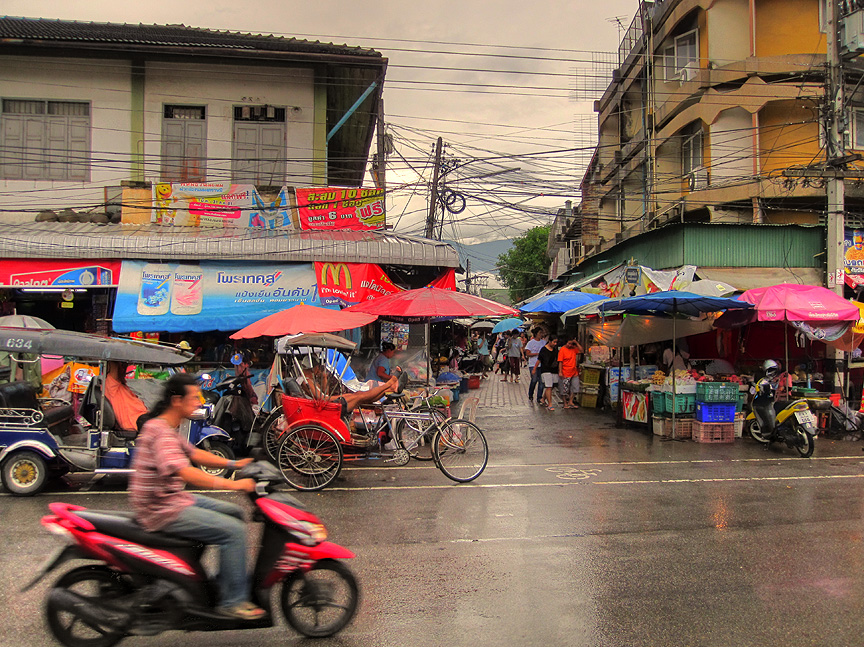
The heart of Chiang Mai is its Old Town, a square surrounded by a moat and a crumbling defensive wall. Tormented clouds gathered overhead, but we had to get out there for a few hours at least. Our plan was to amble about; tomorrow would begin the real adventure: riding elephants, meeting villagers, and taking a bamboo raft downriver. We had low expectations for the afternoon, which is a good thing. Once we made our way to the wall, the rain returned. First sprinkles, then a deluge. Jenny and I ran down a street on the edge of Old Town until we had to duck under the eave of a cafe. The place was closed, but we could see folks cleaning up. I felt guilty sitting there. I'd have preferred to buy something. One of the workers smiled and offered wordless assurance, though; we could stay as long as necessary. Dipping our heads away from the overhang we laughed to see daredevil mopeders using one hand to hoist an umbrella aloft while using the other hand to steer.
Chiang Mai dragon
The rain wasn't going to let up, not for a while anyway, which meant that we had to flag down a taxi-bus back to the hotel. Around here, these vehicles - covered pickup trucks - take on passengers wherever they're hailed and drop them off in the order deemed most convenient by the driver. It's not the most efficient form of personal transportation, but it makes sense on a larger scale. We found an additional benefit on this particular day: the chance to sit with other locals and enjoy a weatherproof tour of town.
Chiang Mai Street, Rainy Day
Returning to our hotel we relaxed until the rain finally died off. Technically it was a light drizzle when we set off, a couple hours before dusk. Hitting the streets once more we hiked along broken sidewalks and narrow alleys in search of the oldest temple in Chiang Mai: Wat Chiang Man. Jenny mapped a path using major roads, but I insisted we find a "back way." Thankfully, Jenny was up for the adventure.
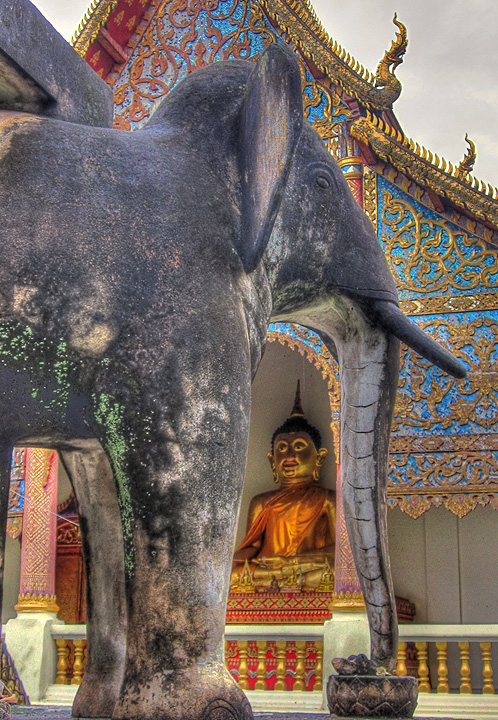
Elephant and Buddha at Wat Chiang Man
At Wat Chiang Man monks were worshiping inside the main hall so we occupied ourselves by wandering about the smaller buildings; we'd learned already that monks in prayer ought not be hassled by tourists. The grass was covered with rain water and the spectre of mosquitos kept us vigilant about spray-on repellent. Later on we meandered by stalls offering freshly killed meat and poultry, stopping to pet a dog whose cocksure attitude left no doubt: he owned the street (perhaps that's why the backpacker's hotel nearby is called The Funky Dog).
Jenny meets the Funky Dog
Dinner was at a riverside restaurant where I had my first non-Westernized version of Tom Yum Goong, the regionally ubiquitous chile pepper-spiced soup that features prawns, lime juice, lemon grass, fish sauce, and other delectables. This stuff sizzled my tongue, mostly because I forgot to ask, "Pet nit noi" (some variation of "a little spicy but not too hot"). Later we ventured in the Night Market and haggled for trinkets. Jenny got suckered into buying a wooden frog that "croaks" when you rub a stick over its serrated wooden surface. I took a minor plunge on a miniature tuk-tuk made out of a beer can. Returning to our hotel I wondered about tomorrow and the rains that could wreck the day. Mostly though, I felt wonderful just to be here.
Our Asian adventures began on Sunday with the rumble of trains rattling alongside a San Francisco airport Comfort Inn, an otherwise convenient place to store a car, grab a night's sleep, and take a shuttle to the international terminal. Korean Air was our means of conveyance across the international date line. By late Tuesday evening we'd be in Shanghai - just enough time to learn not one but two languages: Thai and Chinese.
Jenny, being far more diligent than I about this sort of thing, had been practicing her "Where's the bathroom?" Thai for weeks. She was really concerned about the bathrooms. Me, I'd bought a decent iPhone app, even flipped through the thing once during traffic. But the press of other commitments kept me from my studies until that flight. Jenny kindly kept her frustrations about my slacking to herself.
I made up for it, I suppose, by spending much of the weekend before our flight pulling together literally hundreds of pages of information about the Shanghai world's fair, which was ostensibly the purpose of our journey. I'd focused my stress on that part of the trip, having heard from countless folks that the Fair is miserably hot, insanely crowded, and kind of a drag ("like Disneyworld - without the rides" is a popular review).
I was determined that we'd have a good time. That meant searching for tips about how to organize our visit, find the best pavilions, and avoid running afoul of the many, many rules that served to remind visitors: "Welcome to China, sort of, but don't get too comfy. After all, this is China."
After gathering reams of recommendations and cautionary tales, I transferred the most critical stuff into a tiny red spiral-bound notebook that I naturally called my "Little Red Book." Then, a few hours before we landed, I buckled down and began my inquiries into Mandarin - only to learn that the damned language isn't just composed of different words but also different tones.
That means that I could say, "How ya doing?" with friendly confidence, only to learn later that I'd announced my predilection for sheep or something. Oh, and then it turns out that Shanghai speakers supposedly use an entirely distinct dialect. Worse yet, my mental soundtrack wasn't even anything vaguely Chinese. Over and over, Murray Head's "One Night in Bangkok" ran furrows through my brain, though we wouldn't be in Thailand for another week. I was screwed.
After deplaning, we cruised the travelators, passing welcome signs from Shanghai Expo mascot Haibao and mildly dreading the passport and visa drills to follow. You can imagine my thrill when I offered a cheery "zai jian" to the uniformed guy at customs and received a genuine smile in response. Exiting the baggage area, we were greeted by a guide hired by the tour group who arranged many of our activities for the trip [We don't go on "guided tours," but we have no problem paying a bit more for an expert to secure tickets and transfers, at least during a complex trip far from home].
Shamelessly cheesy pic of Haibao and Andy
Soon enough we'd learn the metro system, hail taxis, and even pilot a boat around a Chinese lake, but tonight we were happy to settle back for a door-to-door ride from the airport to our hotel. We were also grateful for air conditioning. Well into the night, the heat still hovered somewhere above 90 degrees Fahrenheit. Those numbers do little to convey the heaviness of Shanghai's humidity. What's more, the smog was so thick that the clouds cast a jaundiced pall over the city's face.
Driving into town, Jenny and I abandoned any pretense of reserve, oo'ing and ah'ing at the buildings' swirling animation and dazzling neon. It seemed like a child's fantasy of sci-fi movies and cartoons projected onto the landscape. As soon as we'd settled into the Hua Ting Guest House, we stared out the window at the stunning view, which included a giant Ikea sign.
Safely ensconced in our room, I immediately had to leave. I flashed back on Roy Neary's line near the end of Close Encounters of the Third Kind, "I've gotta get down there." So I returned to the street level in search of a quick-stop for a cold drink. On the way, I received an invitation for a "Massage-ee?" by an attractive young woman who appeared from the darkness. Mildly annoyed and mighty tired, I could only remember the Chinese "bu," which means that I replied to her offer with a stupidly non-sensical "not!"
Inside the quick-stop, an old woman was furiously stocking colas in a blessedly cold fridge. A few fell and I stopped to pick them up; she smiled, her brow sweaty from exertion, and offered a weary, "Xie xie." Returning to my room, wilted from the heat, I felt the same way.
Shanghai awaits
That night I dream of two porcelain-skinned Korean Air flight attendants standing like monoliths in our darkened hotel room. Wearing those eerie "Color of Perfection" uniforms, their hair tied in buns cut by sticks, the women bow in silence.
Today begins a 12-part story about my July 2010 trip to Munich, Salzburg, and Vienna. I traveled to Europe this summer to attend the Salzburg Global Seminar's International Study Program, and I met some amazing people and had some great times.
I plan to return to these pages from time to time, adding details and photos (I shot about 1,400 images!). In the meantime, feel free to post comments, especially if you catch typos or opportunities for clarification. Seriously, anything looks hinky? Let me know.
Also, before I begin, I want to express my gratitude to San José State University, its local Salzburg community, and the campus International Studies Program for providing the support necessary to getting me here. It was a wonderful experience.
My trip began with an 11-hour flight on Lufthansa. Somehow I managed to get a little sleep on the plane, despite the usual hassle of crying infants and a guy in front of me determined to recline his seat as far back as the laws of physics would allow. I awoke on Thursday afternoon, having departed California Wednesday night, and mumbled my way uneventfully through customs. Well, there was one minor event. I received a well-deserved lesson in the local appreciation for rules after inadvertently entered the wrong line to get my passport stamped. My first souvenir: a formal explanation of German queuing procedures.
Munich airport lakeside dining
Munich's airport presents a cold and sterile face at the gate, but the semi-roofed area between terminals buzzes with conversation. Smiling at the thrill of finally being outside after a long flight, I wanted to sit under one of those umbrellas surrounding an artificial lake and soak in the atmosphere. But I had to find my way to an ATM to pick up some Euros and locate a train heading for town. Believe it or not, those two minor details -- get money and get moving -- had stressed me more than the prospect of flying across the Atlantic. As usual, the process was just awkward enough for me to feel foolish. Soon enough though I was rolling through green fields toward Munich.
Brewery across the street from Meininger Hostel
Downtown, I met up with Michael Fallon, a fellow participant in the Salzburg Global Seminar's International Study Program. Back in the States he'd suggested that we split a reservation at the Meininger Hostel and share a train to Salzburg the next morning. Weeks of planning later, we were ready to start our shared adventures. And after I unpacked my gear (and took a much-needed shower) we started walking toward the old town district. They say temperatures are spiking above 100 degrees Fahrenheit back on the Eastern Seaboard, but the weather in Munich was perfect for a stroll. We joined scrums of camera-snapping folks taking snapshots of cathedrals; we stopped to enjoy all sorts of musical performances -- drummers, classical renditions, even a jazz soloist in a bar -- and we hoisted a round at our first biergarten.
Michael and Andy at Bratwurstherzl Cafe
For dinner we shared a table with two women in an outdoor cafe called Bratwurstherzl that smelled deliciously of oak fire. At first I felt strange being seated with two strangers, but this turned out to be a "slow food" venue, with locals chatting for hours in a charming piazza. I don't recall anyone leaving throughout the evening. We wrapped up our meal of sausages and potato salad, and lots of bier, with complimentary shots of schnapps. Our waitress felt guilty about being unable to get us some apple strudel before the kitchen closed. Even so, she made sure to count the number of pretzels we ate. After a nightcap at another outdoor cafe, we stumbled back to our room. The plan was for an early morning hike for more sightseeing, sleep being a commodity we could restock back home.
This is a slightly revised version of the speech I presented last month as keynoter for the Rocky Mountain Communication Association's 2010 conference in Denver. The trip was a delight, especially the opportunity it provided to photograph farm relics and neon signs. But the best part was the chance to meet some really cool folks (including some outstanding faculty members and graduate students at The University of Northern Colorado). I just thought it'd be useful to archive my RMCA remarks, if only to bring back some happy memories...
Think back to the last time you were several places at once.
Visualize the moment.
Imagine you're chatting on a mobile phone while scanning a website on your laptop. Perhaps you catch a glimpse of video on another screen nearby. Maybe you're doing these things on the same device.
I knew I'd eventually reach this point, and now it has happened: a colleague has invited me to contribute to a panel about the movie Up in the Air. And yep, I'll be using an omnitopian framework in my analysis. I said I was done with omnitopia for a while, but I just can't resist.
This opportunity raises a number of challenges, most importantly related to the creative use of omnitopian terminology. In City Ubiquitous I outline an omnitopian framework according to five components: dislocation, conflation, fragmentation, mobility, and mutability, illustrating each with the aid of two films, Jaques Tati's Play Time and Steven Spielberg's The Terminal. In Chapter Three of City Ubiquitous, I was less concerned with how the components relate to each other, focusing more on simpler matters: what they mean and how they work.
Larger issues of their deployment - of method - were saved for the book's Section Two introduction that proposed localization as a way of going beyond description toward the goal of omnitopian analysis. To my way of thinking, localization is a sort of counter-reading - that is, "offering an interpretation that both explains and confounds omnitopian practices through engaged observation" (p. 84). Though less a method than a perspective, I found this approach to be useful in connecting otherwise disparate ideas that had guided my writing from the beginning of this project.
In my description of localization, I therefore borrowed Walter Benjamin's concept of the flâneur gaze, a term that bubbled up from his Arcades Project, to animate my perspective on omnitopia. Localization enacts a method of observation that is both keenly aware and mildly intoxicated with the modern scene, a performance of semi-consciousness that seeks to convey a sense of place not otherwise found in formal architectural or rhetorical analysis (with thanks and apologies to Michael Bowman for his recommendation that I re-read Benjamin's writings on intoxication). Put more directly, while I generally am a critic of omnitopia (at least from the position proposed in my articulation of the term), I see little insight to be gained by merely criticizing it. To unmake omnitopia, one must live it first.
For me, this method has proven to be useful, and the articles that ensued fleshed out a skeleton of ideas into a book that said what I wanted to say. Even so, I think a more rigorous and precise method needs to be explored, and I plan to use the invitation to write about Up in the Air as an opportunity to propose a more purely rhetorical form of omnitopian analysis. Ideally, this method can be employed by folks not otherwise inclined to try my idiosyncratic performances of localization. Right away I'm fairly certain I'll need to read Walter Kirn's original book, from which Up in the Air is loosely adapted, if only to think about omnitopia more textually. From there, I hope that something useful emerges: a method that can be expanded beyond the application of cookie-cutter terms toward the goal of analysis that delivers insights on technique and implication.
Despite my occasional announcement of plans to advance past omnitopian musings, to tackle new writings, this project seems worthwhile, and I'm genuinely excited about seeing it through (hoping that the panel proposal for this fall's National Communication Association conference in San Francisco is accepted). It's a chance to wrap up some unfinished work and, best of all, hang out with cool people and chat about a fascinating film. Still, I admit to flashing back to Michael Corleone's line from another movie, the third Godfather, that speaks to my situation today: "Just when I thought I was out - they pull me back in!"
The following is from a ten-part serialized essay on Waffle House, initially written in December 2008. A sort of mashup between scholarly musings and personal reflection, this piece may satisfy no one in particular. But I'm happy to share it nonetheless (presuming you don't edit or repackage this piece without my permission). Also, a reminder: these words do not reflect the opinions of Waffle House, San José State University, or any other entity.
I lied a bit, too...
Most importantly, I lied about where I wrote this piece. I did not write this essay in Waffle House; I wrote it at home. Yes, I did drive to Phoenix; yes, through the snow of the Mojave Desert; yes, barely avoiding a robbery late at night; and yes, the sound of Patsy Cline's "Crazy" transformed an early morning hour into something meaningful, at least to me. These things happened, but I wrote all of these words at home.
Just now I'm sitting in bed with my cat curled up on my lap, she who detests the cold and finds me more than suitable as a means to escaping the winter that creeps through our poorly weather-stripped doors. Outside, I can hear the sounds of children playing on the streets of our cul-de-sac as the sky darkens at dusk. I write this is an enclave called Scotts Valley, a one-hour bus ride from the halls where I work. I live in a community composed of people who are pretty much like me, middle class strivers seeking a safe investment and quiet streets. I write this as the cat groans and sighs in the pleasure of our darkening room, she and I warm and comfortable.
I tried to write this essay entirely on site, in "the field" as the silverbacks (and wannabe silverbacks among us) might say, but I never could get beyond hastily typed notes. I remember typing them and reviewing them again and again. Is that what I heard? Is that what I said? But I quickly forsook any effort to writing "the truth" of my experiences while I was there. Sipping a cup of coffee, typing out notes on my laptop, I was usually surrounded by folks who reasonably assumed me to be a journalist or an author come to make them famous. Consequently, my fellow patrons paid more attention to me that they would have otherwise. The act of writing in Waffle House undoubtedly skewed what I saw. I mean, really: other than college students cramming for exams or banging out a course paper, who comes to write in a Waffle House? And I stopped looking like a college student a long time ago. So I came home, guiltily, carrying a computer filled with digital scribbles and predictable photos.
I thought briefly about writing at my neighborhood Starbucks, a phrase just about as meaningless as one's "Neighborhood Applebees" (where I'm not sure that they serve anything that can technically be called "food," certainly not "apples," any more than they serve "neighborliness"). Sure, there was plenty of noise, a Waffle House hallmark, and Starbucks possesses the same sort of enclavic sensibility, perhaps even more so with its "black card," a clever device to transform Starbucks into something more akin to an airport terminal's private lounge. But one can hardly confuse Starbucks with Waffle House; the theoretical similarities and stylistic differences are just too distracting. It's better to come home as one would come to Waffle House, to a place where they call you "hon."
My home in Scotts Valley culminates a personal and professional search for enclave that brought me westward from Florida to California. It's a place where garage doors are larger than the porches, where we celebrate our community through holiday performances but generally leave each other alone (with some notable exceptions). It is a sign of the times in our age of anxiety. It is perfect for me. I fled a childhood filled with fear for the safest port in the storm, a hitch with the Navy. I then bounded into the cloistered confines of college years, learning to please those who judged me, selecting my battles with precision.
I made mistakes, so many mistakes, especially when admitting my weaknesses to friends better labeled acquaintances, and I found myself behind the closed door of my own tenured office space. I discovered the unhappy truth of so many academic lives: We who enter the Ivory Tower, searching for a fortress for ideas and a mote of separation from the dreaded "real world," generally manage to bring our own fears with us, locking them tight within our interiors.
Home, therefore, is the final freedom, the ultimate closed door. I have found shelter after all these years as the storms rage outside. I am safe in my protected intellectual space, a world in which I can drive hundreds of miles to sit in a cheap fast food diner and expect people to say, "Well, that makes sense." I admit this only from the safety of job security and the confidence that no one would every really publish an essay like this. I shuffle paragraphs, rehash quotations, double check song titles, and abandon any pretense at depth. Moments break and congeal, transformed into a story, an auto-ethnography of fragmentary shards read at highway speeds. Only in this way do I try to explain the bittersweet domesticity of Waffle House, my home away from --
Well, you know.
(Photographs by Andrew Wood)
Thanks to Tyrone Adams for inspiring this essay. While the book we envisioned did not (as yet) come to pass, I am grateful for your seductively written call to write something heartfelt about Waffle House. Anything that works in my essay owes much to your recommendation to tackle this topic. All errors that remain, of course, are my own.
The following is from a ten-part serialized essay on Waffle House, initially written in December 2008. A sort of mashup between scholarly musings and personal reflection, this piece may satisfy no one in particular. But I'm happy to share it nonetheless (presuming you don't edit or repackage this piece without my permission). Also, a reminder: these words do not reflect the opinions of Waffle House, San José State University, or any other entity.
"What will you write about?" I haven't a clue....
I think this conundrum reflects a larger conversation about finding meaning in places rather than people. It's as if I am sitting in a corner watching the streaming crowd of laughing, chatting friends, a cohort I can never quite know. The crowd congeals into a mass of barely remembered names, halfhearted conversations, jokes that never did seem that funny to me. But behind them lies a structure, something I try to see and maybe understand, even as, all too often, insight flashes by too quickly to recognize.
For the past few years I've written about something called omnitopia, an effort, I suppose, to understand. In bits and pieces, confident drives and dogleg detours, and a few hairpin turns, I've carved out some space within this portmanteau of the Latin "all" and the Greek "place." It's an idea that, truthfully, came to fruition from the velvet command of a dean to start publishing more peer reviewed articles if I had any plans to gain tenure. I can still see the wide eyes of a trusted confidant to whom I shared the news. "She wrote that?" At once, some notes from grad school days needed to find order and purpose, and pretty damn quick.
After a few iterations, I came to define omnitopia (my definition; there are others) as a structural and perceptual enclave whose apparently distinct locales convey inhabitants to a singular place. From this perspective, omnitopia refers to the experience that parallels exiting a computer terminal to visit cyberspace or entering an airport terminal to visit the global domain of movement, commerce, and discipline that marks contemporary air travel. Omnitopia is a matrix of undifferentiated, un-striated experiences that has no "capital," no "home," through it has an exemplar, which is Las Vegas. It has no ideology, but it has a motto: "Wherever you go, there you are."
In this "place," one must emphasize the necessary relationship between structure and perception. Just because you're waiting at an airport gate doesn't mean that you're in omnitopia, particularly if you're waiting for a loved one to pass through this door of this gate. The structure of nodes that perpetuate mobility from place to place, typically a conflation of consumer and corporate environments, from airport to interstate to food court to atrium hotel to convention center, requires a perception of flow, a sense of seamlessness, to render omnitopia visible.
In this enclave, one finds a set of distinct places that render even exteriors part of a barricaded interior, crafting a synecdoche of the world, individual places -- this tiki restaurant with glowing blowfish and nautical netting, that "New York" themed casino sitting next to "Paris" in the Nevada desert -- which all blur into the same continuum, one safely detached from the real world outside. Omnitopia is not a place but a desire, sometimes conscious and sometimes just below the surface, to be safe.
Naturally I wonder if Waffle House, with its interchangeable architecture, its mass-produced signage, its utter dependability, reflects a node of omnitopia. Or perhaps does it represent something more meaningful?