Tuesday, February 21, 2012

Memento Park (Budapest)

One of the highlights of last year's Grand Tour was the opportunity to visit Budapest's Memento Park: a collection of statues and other relics from the Communist era. While I've already written about that day, I've yet to post the pics we took from our visit. Time to catch up to the future worker's paradise that never came!

Republic of Councils monument (Kiss István, 1969)

Soviet-Hungarian Friendship (Búza Barna, 1975)

Liberation Monument (Kisfaludi Strobl Zsigmond, 1947)

Liberation Monument (Kisfaludi Strobl Zsigmond, 1947)

Lenin (Pátzay Pál, 1965)

Lenin relief (Szabó Iván, 1970)

Béla Kun memorial (Varga Imre, 1986)

Republic of Councils Pioneers memorial plaque (1959)

"Stalin's boots" reproduction (Ákos Eleőd, 2006)

Soviet Heroic memorial (Mikus Sándor, 1970)

The Heroes of People's Power memorial (Kalló Viktor, 1983)

The Heroes of People's Power memorial (Kalló Viktor, 1983)

Unnamed sculpture awaiting installation

Unnamed sculpture awaiting installation
(Photographs by Andrew Wood)

Monday, February 20, 2012

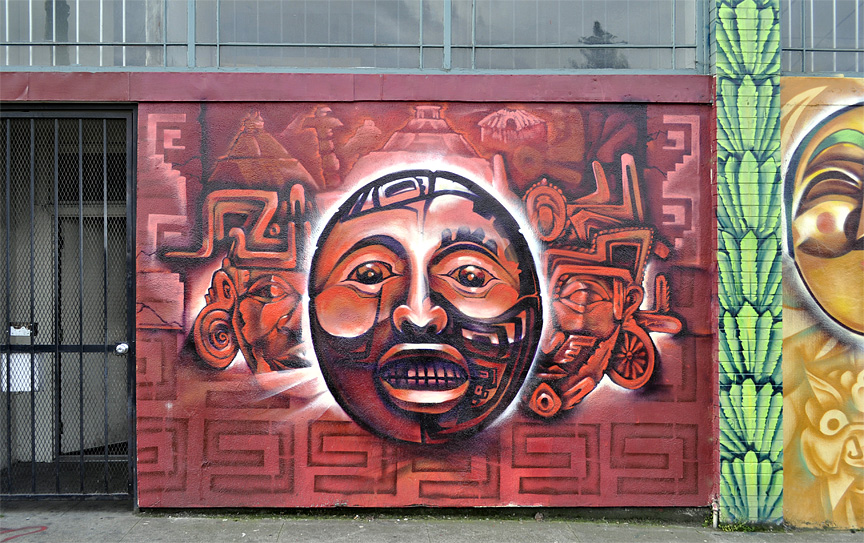
East Oakland Street Art

On Saturday I returned to Oakland to photograph some more street art - followed by a visit to San Francisco's First Amendment Gallery Truck Show. This time I focused my attention on International Avenue (once East 14th Street) and along side streets between 12th and Foothill.

This map is my growing collection of Oakland photo-sites (blue: visited; red: not yet visited).

View Oakland Street Art in a larger map

1739 Solano Way (GMap)
1789 Solano Way (GMap)
2260 International Boulevard (GMap)
2261 International Boulevard (GMap)
2262 International Boulevard (GMap)
"Love your enemies" - East 15th and Miller (GMap)
"Love your enemies" - East 15th and Miller (GMap)
1304 41st Avenue (GMap)
International Boulevard and 45th (GMap)
More Oakland Street Art


(Photographs by Andrew Wood)

Friday, February 17, 2012

Truck Show

While researching Oakland street art [posted yesterday] I learned about this show dedicated to the use of box-style delivery trucks as graffiti canvases. I hope to see this show before it closes on March 4th at San Francisco's First Amendment Gallery (1000 Howard Street - Tue thru Sat, 12 p.m. to 6:30 p.m.; Sunday, 12 p.m. to 5 p.m.). Proceeds benefit a youth art program called Visual Element. Here's a quote:
The modern box-style delivery truck lives in the inner cities all across America. For the modern day graffiti writer it is a contemporary relative to the subway cars of the 70’s and 80’s, which helped spark the explosion of graffiti. In a state of eminent relocation, they assemble a disjointed gallery of ceaseless unrest, a perfect canvas for any opportunistic graffiti artist. In an attempt to keep trucks looking new, many owners will opt to give a graffiti writer permission to assume control over these plots of valuable real estate in the urban landscape. 


Learn morehttp://1amsf.com/art-2/current-show-2/

Thursday, February 16, 2012

West Oakland Street Art

Oakland, like all large cities, is far more complex and fascinating than any stereotypes allow. I don't know the city well, but I'm slowly coming to discover its vibrance and eclecticism. Naturally I am drawn first to its street art. Today's visit focused mostly on the west side, with a brief detour downtown [Soundtrack for the day: "Caves of Altamira" by Steely Dan]. Not sure when I'll return, but I hope to see more soon.

"Water Writes" (2011) by Estria Foundation
Broadway and 21st (GMap)

"Water Writes" (2011) by Estria Foundation
Broadway and 21st (GMap)

Mandela and 20th (GMap)

Willow and 26th (GMap)

Hallis and 32nd (GMap)

Adeline and 26th (GMap)

MLK and 25th (GMap)

MLK and 28th (GMap)

"Street Tattoo" (1981-82) by Daniel Galvez and others
San Pablo Ave. and Castro St. Caltrans underpass (GMap)

26th and Magnolia (GMap)

596 55th Street (GMap)

2610 Peralta (GMap)

20th and Poplar - near American Steel warehouse (GMap)

20th and Poplar - near American Steel warehouse (GMap)

(Photographs by Andrew Wood)

Wednesday, February 15, 2012

First Amendment

Just for kicks, I'm posting an underground newsletter that I produced with two other high school friends, ca. 1985-86. Looking back, this stuff comes across as pretty silly (and the less said about the spelling, the better). Still, I took it seriously - and got a real thrill out of the opportunity to hand out copies of the forbidden document (First Amendment was actually banned on our campus!). Try not to laugh too loud.


Tuesday, February 14, 2012

Willow Grove Diner

Ignoring the crazy cost, I'm thrilled to add this postcard to my collection of roadside Americana. I love the time travel vibe, like we're peering back into the 40s and 50s.


Monday, February 13, 2012

Morozov's "Death of the Cyberflaneur"

Evgeny Morozov's article, The Death of the Cyberflâneur (NYT, Feb 4, 2012) conveys a greatest-hits version of some my personal passions: urban design, modern art, retro-futurism, and a critique of the contemporary public sphere. Heck, there's Caillebotte's "Paris Street; Rainy Day" right at the top! Before I finished reading the piece, I'd already shared it on Facebook. And that, the author says, is the problem.

Launching with a brief description of flânerie, Morozov argues that while today's social networking aggregations fill our screens with countless threads of endless content, they squash the pleasure of wandering through the web's funkier outskirts - and of being present where we are. One source of particular concern: frictionless sharing, that seamless transformation of impulse to flow that anesthetizes conscious engagement:
"This is the very stance that is killing cyberflânerie: the whole point of the flâneur’s wanderings is that he does not know what he cares about. As the German writer Franz Hessel, an occasional collaborator with Walter Benjamin, put it, “in order to engage in flânerie, one must not have anything too definite in mind.” Compared with Facebook’s highly deterministic universe, even Microsoft’s unimaginative slogan from the 1990s — “Where do you want to go today?” — sounds excitingly subversive. Who asks that silly question in the age of Facebook?"
I get the idea, but only to a point. While I appreciate the article's clever allusions, I don't share Morozov's nostalgia for 90s-era modem-screech. Yes, those lengthy periods of waiting for a page to download produced a Yoda-like sense of where-I-was-and-what-I-was-doing [Do you remember your first time?], I don't recall enjoying that moment at all. Nor do I agree that we are bounded into vacuum-sealed mediocracy by our increasingly efficient search tools. Indeed, I found this essay through precisely the kind of flânerie that Morozov celebrates, using Zite to wander electronic boulevards of chance and serendipity.

Even so I agree with broader claim of this piece, that we are less inclined to wander these days, less able to enjoy the pleasures of getting lost in the labyrinth. In my own meanderings through various omnitopian portals, I find this phenomenon less a cause than an effect. Our fear of ambiguity leads us to seek the blandly familiar. And this fear is borne, I think, in something more substantial than the transformation of our tools.

Forgoing further contemplation along those lines [this is a blog-post; the blog is the book], I still think that Morozov makes a reasonable point. We do not "surf" the web, and few of us care to become cyberspace pilots. We prefer the simulacrum of the world to the real thing, customizing it into our own cocoons, mirrors of our preferences and our delusions, as we passively receive the flow. And from time to time we click "like" as a wave (or a courtesy), knowing that our ripples do not run too deeply.

What would our lives be like if we expected more?