John Vidal writes in the Guardian about the convergence of meta-cities into "mega-regions," the first being a conflation of Hong Hong, Shenzhen, and Guangzhou, comprising 120 million people. Other mega-regions, he says, are in Japan and Brazil, with others forming in India and west Africa.
"Research shows that the world's largest 40 mega-regions cover only a tiny fraction of the habitable surface of our planet and are home to fewer than 18% of the world's population [but] account for 66% of all economic activity and about 85% of technological and scientific innovation."
The article adds, however, that mega-regions may intensify urban sprawl and social inequity.
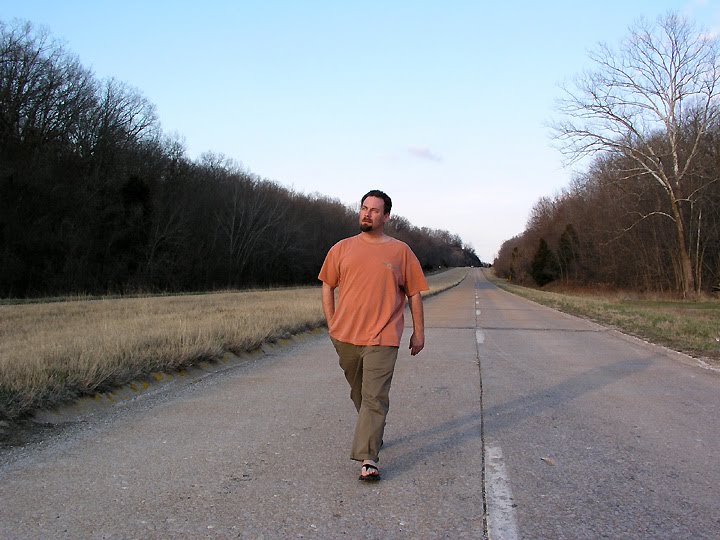
Here's my first experiment with tilt-shift photo modification. I borrowed the technique from Don Engel's diorama tutorial. I've got a lot to learn, but the process looks promising thus far.
Here's the original.
Here's the tilt-shift (click on image to see fuller effect).
I'm delighted to report that my newest publication, an essay called "Two roads diverge: Route 66, 'Route 66,' and the mediation of American ruin" (recently "translated" for a wider audience in Communication Currents) has garnered some positive feedback. A couple days ago I received a kind and thoughtful note from a Route 66 preservationist whom I quoted in the piece, and then I received a lovely email from my former office mate, Phil Wander.
If you're a student of rhetoric or media studies, you've likely heard his name. I read Phil's work in grad school and was subsequently amazed (and a little intimidated) to find myself sharing an office with this fellow upon taking a job at San José State University. Phil has since departed NorCal, earning a prominent position at Loyola Marymount University. Still, we keep in touch. Thus I am particularly grateful for him to have shared his thoughts about my Route 66 piece.
What he offers is a reflection, a critique, a nudge, and a call for next steps, all bound up in the kind of lived-experience memory that demands a broader audience than is allowed by a simple email. I'm honored to share it with you (with his permission, of course).
----------
I grew up along side Rt. 66. It ran by the Outdoor Theatre where I took Nancy Wilson to kiss the night away. And the then-modern truck stop was where the dance band I was in went to get something to eat, around mid-night, after the dance. It held no nostalgia for us, back in the 1950s, it was simply there and useful, as we moved on and off it in our newly discovered teenage car-freedom. The freedom to fly, as I drove my dad's red and white Mercury on an empty Rt. 66 a hundred and four miles an hour, to see how fast she goes, before thinking, the road is wet, the car feels it might be rising, and brakes don't work so good on wet. The freedom to cuddle up in corn fields off country roads that led back to the freeway.
But it was a freedom more real for my father, during the great migration from farms to cities. He loved driving the whole of Iowa, working as an adjuster, negotiating settlements with folks with automobile policies with State Farm. He loved it as much as he loved driving a couple of miles off road to park by a rail road track to watch a train go by. Rail roads took him from the corn fields to Chicago with his dad on a stock car where, with long poles they stayed up all day and all night to make sure the hogs did not fall and die, before they got to the slaughter house.
Two pathways for migration, some forty millions moving South to North from the 1880s to the 1940s, creating what become the other side of the tracks in New York, Atlanta, St. Louis, Chicago, Kansas City, Oakland, and LA, and all metro-points in between and above and below. But the trip on Route 66 was different for those who were not "real Americans." The speed, the movement, was shared, but not the road side attractions. If you were black you expected to piss in culverts, corn fields, and hedge rows. And buy the fixings and wrap your sandwiches up in wax paper. And not move off into the off road farm towns and expect to remain after sundown, before threading your way back to the highway. It was "freedom," of a sort not fit for nostalgia, at least not the kind that white folks enjoy.
I learned this from a conversation I had with the jazz composer, Bill Cole, an old friend from my time at Pitt. His grandfather, a successful dentist in Pittsburgh, did not drive. He took his grandson to a Buick dealership, bought a brand new car, and had him drive the two of them cross country. A dignified old man, successful, even wealthy, but black, and it was hard to find food, a toilet, and a place to sleep anywhere on any highway. And even more dangerous on country roads.
I remember reading Walter Benjamin's essay on the work of "art" in an age of mechanical reproduction. The reproduction for "real Americans," as you point out, has become the sacred, the original, the cliche that was everywhere, for not quite everyone and was anything but sacred.
I loved your essay and understood it, in the way that the peasant woman summoned up by Martin Heidegger from Van Gogh's painting of Shoes left off the real in favor of blood and soil in a claim on national identity inspired by a political movement which promised to preserve peasant life and the virtues it recalled for "real Germans." This is not what you do, of course, but I would like to hear your reflections on Sarah Palin and the tea party on Route 66. The rapid retreat by a political faction into a dream and a need to reload to and get back into the fight once again to make real what never was, even for white people, begins an inquiry into the rhetoric of nostalgia that promises the kind of inclusiveness that the real roads and highways made, up to a point, possible.
Again, I loved the essay. That it is a point of departure rather than a terminal for the wistful, which is not bad either, if well written, and yours is wonderfully evocative writing at many levels, a delight for those of us whose wistfulness for the 50's is bounded by lynchings on one side and above ground nuclear testing on the other, and in between what Herbert Marcuse referred to as the sure-fire way to get beyond one dimensional thought, living, and imagination for kids, the unadulterated pleasures of sex and the revolutionary experience of love.
In those hot and inhospitable climates, plants demonstrate the kind of adaptability necessary to catch and store water, making them remarkable survivors in terrains seemingly unsuited for life.
The Saguaro Cactus, for example, uses its shallow but lengthy root system to gather water in a barren climate, encircling underground rocks to help keep itself upright.
Moreover, its trunk expands and contracts like an accordion to store water in preparation for the frequent droughts that punish the land.
Finally, its buds appear slowly -- the first arm forming after more than five decades. In this way, the Saguaro demonstrates patience, waiting until its root system is extended broadly enough to keep potentially 5,000 pounds of cactus upright in the wind.
Flexibility, outreach, and patience allow the Saguaro to stand between 35 and 50 feet tall and live 200 years, sometimes longer.
We can learn much from these desert survivors in today's arid climate of constraint. But first we must unlearn some long-taught lessons about scarcity.
Thriving amid Scarcity
Hamlet exclaimed, "I could be bounded in a nut shell and count myself a king of infinite space" -- if only, he added, one could be freed from one's many lamentations.
A modern lament that might surprise Hamlet is not our paucity of options but rather our excess of choice.
And, troublesomely, many of us presume that more choices are always better, that any constraint somehow harms us.
Research, however, suggests otherwise. Indeed, a number of fascinating psychological and economic studies suggest that too many options lead to paralysis.
As one researcher put it, “It is not clear that more choice gives you more freedom. It could decrease our freedom if we spend so much time trying to make choices” (See NYT article, Too Many Choices).
Shakespeare suggested in Hamlet that our lamentations mingle with our limitations to place us in a nut shell, to "drive us nuts," one might say.
Yet those very limitations -- restrictions in budget, limits of power consumption, moral boundaries to our actions -- actually compel us to thrive.
A blank canvas, after all, forces us to deploy the infinite space of our imaginations, to think our ways out of the problems that bind us.
Look again at the picture of the person staring at a blank canvas. Perhaps this kind of thinking makes artists of us all.
Even so, as artists, what do we train ourselves to see?
What counts as real?
Think for a moment about the modern world -- what it means, what it does, what it costs...
When you close your eyes and fill an empty frame with the modern world, what do you see?
An Age of Artificiality
For me, an explosion of iconic images appear, each pulsing with the rhythm of Paul Simon's song, "Boy in the Bubble."
It was a dry wind,
And it swept across the desert
And it curled into the circle of birth...
These are the days of lasers in the jungle
Lasers in the jungle somewhere
Staccato signals of constant information
A loose affiliation of millionaires
And billionaires...
When I see the modern world, I see handheld computers that possess a power once contained in rooms, but I also see teeming masses of people crushed into urban slums. I see the simultaneous expansion and contraction of potential, and find it floating on the surface of killing paradox.
Perhaps that is the unsustainable reality of the modern world, how the real is lost amid the winds of unreality.
Today a tiny sliver of humanity imagines themselves living in a sailboat, one like Dubai's Burj Al Arab hotel, a fantasy in which you can play tennis while teetering in the air.
This blessed portion of people -- and you might consider yourself one of them -- floats upon the roiling waters, seeing only blue sky and endless promise.
The Desert of the Real
Occasionally though, fortuitously, we see things as they are. And we shiver, even in the growing heat, as the sky turns orange.
We know something meaningful is happening, oddly, frighteningly, because we cannot tell whether the light portends a dawn to the new world, or the gloaming of its imminent nightfall.
Beyond our brilliant and optimistic cities, the desert expands, kicking up hot breezes and hurling the dust at the gates: a barbarous future with which we cannot reckon via the anesthetizing balm of abstraction.
Modernity meets its end, William Butler Yeats wrote this in The Second Coming, when "Things fall apart; the centre cannot hold/Mere anarchy is loosed upon the world..."
In Beijing, another sandstorm, one of an increasing number produced by decades of environmental degradation, recently dumped tons of dirt and grit into the capital city of a nation foretold by some futurists as the capital of the 21st century.
It's a cruel irony that a nation with so many resources and resilient people, looking ahead to tomorrow from the gleaming towers of Beijing and Shanghai, must also look backward to the words of an author we in Silicon Valley know well, John Steinbeck.
Dustbowls, we find, aren't merely a thing of 1930s Americana.
An article from The Huffington Post states, "China's expanding deserts now cover one-third of the country because of overgrazing, deforestation, urban sprawl and drought." And that dust is not limited to a distant land. It flies all over the world on the winds of commerce and war and microsecond thinking.
China turns away from the desert, but the desert advances on us all.
In his book, Simulacra and Simulations, Jean Baudrillard imagined the desert in a way we recognize, not only as engineers or artists, but as citizens of a world that seems increasingly covered with the dust and grit of modernity, the detritus of mental maps that no longer represent the world in any meaningful way.
We survey our horizons along electronic grids and layout endless cities of fantasy. These are sustainable to the extent that the current of power flows up and down the spines of people and cities.
But upon what, really, do we stand? How long can our cities endure on foundations of sand?
Of this world, Baudrillard writes:
Abstraction today is no longer that of the map, the double, the mirror or the concept. Simulation is no longer that of a territory, a referential being or a substance. It is the generation by models of a real without origin or reality: a hyperreal. The territory no longer precedes the map, nor survives it. Henceforth, it is the map that precedes the territory -- precession of simulacra -- it is the map that engenders the territory and if we were to revive the fable today, it would be the territory whose shreds are slowly rotting across the map. It is the real, and not the map, whose vestiges subsist here and there, in the deserts which are no longer those of the Empire, but our own. The desert of the real itself.
Sustainability
The desert can teach us something about the fate of the modern world. Walking upon its hot, dry surface, we learn that sustainability is not simply about technology; it is both an expanse and an expense of the imagination.
Yet as we constrain our gaze to the cities we build, we kill the lifegiving reality upon which all human inventions are founded. Our cities grow and our minds shrink.
Our mental canvases must stretch beyond the limits of the world that we know. We must visualize an age no longer defined solely by our cities, which are parched and dying at the desert's edge. We must re-imagine ourselves with more permanent things.
After nightfall, Polaris appears to us, fixed in the northern sky. Stars pinwheel, the universe turns, and things change. But survivors stand tall in the dark, amid all transformations.
The North Star in the firmament and the cactus in the desert speak to us in different ways, even though they share the same message. They have something to teach us here.
The kind of sustainable thinking calls upon us to rethink our values...
... starting first with what lasts.
Photo Credits: Sunset flora in Saguaro National Park, Tucson, Arizona: Photograph by Andrew Wood. Person staring at a blank canvas: Photograph by Johnny Mobasher Street Photography. Burj Al Arab Hotel next to sailboat on the water: Photograph borrowed from ETF Trends. Burj Tennis Court: Photograph borrowed from Travel Around the World. Orange dust covers Beijing: Photograph by Markus Källander. Megadunes of sand that resemble waves: Photograph by NASA. Children play on computers next to a huge window upon a city: Photograph borrowed from The Librarian's Guide to Gaming. Stars pinwheel over Saguaro cacti: Photograph by Jenny and Andrew Wood.
Since being asked to deliver the keynote address at the Rocky Mountain Communication Association's annual conference, I've been gathering material and organizing my thoughts on their theme, "convergence." Here's a summary of the approach I envision for my 30 minute speech...
Having witnessed the varied articulations of postmodernity, the postwar rise of globalization, and the transformative integration of the internet into our daily lives, we share a unique opportunity to both define and critique what many call an Age of Convergence. After all, each of these forces -- uniting intellectual, economic, and technological trajectories -- contribute to the vanishing of formally sacrosanct divides between "high and low," "here and there," and "us and them." Still, all that is solid does not melt into air. Instead, as communication scholars and as human beings, we are compelled to consider the implications of convergence upon our roles and duties within an increasingly corporatized public sphere in which discourse that could possibly disrupt traditional modes of power becomes replaced by the babble of singularities.
Indeed, with apologies and appreciation to the late Neil Postman (whose germinal book, Amusing Ourselves to Death, inspires the title of my talk) my enthusiasm for this Age of Convergence must be defined as "guarded." As a shameless tourist of places and ideas, as a professor initially hired to teach courses on internet communication in Silicon Valley, and, of course, as a hopeless iPhone junkie, I recognize the opportunities that flow from our power to dive into oceans of data, where once we seemed trapped within lonely rivulets. And I accept both the efficiency and the serendipity of technologies that enable us to leap from node to node in a ubiquitous network that gathers all of human society into a shared structure and perception of mutual presence and potential interaction.
Yet I encourage caution and some degree of existential forbearance before we plunge so deeply into that matrix that we lose sight of ourselves. Put another way, I suggest a middle-ground between globe-girdling convergence and the rearguard erection of solitary cathedrals set against the desert of the threatening Other. I offer this proposal in recognition of the need for physical and intellectual "locales" wherein we affirm the virtue of places marked by time and character. I emphasize here that places and people set apart, a necessarily revitalized notion of the sacred, need not cast us into towers of elitism, so long as we refine the purpose of our endeavors as humanistic first and opportunistic later. Toward that end, my talk considers one basic question designed to complicate the presumed pleasures of our ever-present, ever-conflated society: How may the communication studies professor working both in the classroom and within the broader marketplace of ideas make a unique and useful contribution to the world in this Age of Convergence?
Following the publication of my essay, "Two roads diverge: Route 66, 'Route 66,' and the mediation of American ruin," in Critical Studies in Media Communication, I was invited to repackage the piece into a form that's more accessible to a wider audience.
The venue? Communication Currents: an effort by the National Communication Association to disseminate academic scholarship beyond the narrow confines of the audience for peer reviewed journals.
The process of transforming an 8,500-word essay into a 1,000 word magazine-style article contained no small amount of frustration, let me tell you. But I appreciated the opportunity to share my work in a new way.
 John Vidal writes in the Guardian about the convergence of meta-cities into "mega-regions," the first being a conflation of Hong Hong, Shenzhen, and Guangzhou, comprising 120 million people. Other mega-regions, he says, are in Japan and Brazil, with others forming in India and west Africa.