Well, I'm back from Florida, teaching a three-week public speaking course, and dreaming of a swell 2014. David Terry and I are burrowing through revisions of our DPRK essay, and I have hopes that an internationally co-authored book project is finally coming to fruition. This year's travel plans range from Baton Rouge to Finland (with a possible side trip to St. Petersburg, Russia). Of course I'll also be tackling new lecture projects for the honors humanities program. This semester's topics:
Industrial Society: Capitalism and its Radical Critics
American Transcendentalism and the Beginnings of Environmentalism
The Depression, the New Deal, and pre-World War II America
Totalitarianism and World War II: the Holocaust and Inhumanity in the 20th Century
Modern and Post-Modern Art
Equal Protection of the Law: Excluded Voices and the Rhetoric of Multicultural America
Vietnam, Watergate, American Politics and Society
I presented the arts lecture during my last sabbatical; all the others will be written new from scratch. As ever, I anticipate a constant hybrid of exhaustion and exuberance. Building these presentations will draw from time I'd otherwise devote to blogging - but the results, I hope, will be worth the hassle.
The 2012 election was an endless dinner party whose guests showed up drunk, puked on the pets, and set the rug on fire. Now it's morning in America, and the house is trashed. There's a big screen TV on the lawn, there's a copy of Atlas Shrugged in the toilet, and there's pudding in the blender [Who the hell put pudding in the blender?]. I'm trying to coax the cats back into the living room. I'm saying, "It's over, kitties. Those awful people are gone." The felines know better though; the guests are still here. Some are sleeping, snoring, drooling. Yet a few are pre-gaming for the next big bash, God love 'em. They are, after all, us.
We voted (some of us, at least) on November 6th, but we also expressed our every thought on this grand debate, extolling our opinions all over Facebook, Twitter, and, for all I know, Instagram. We posted and we tweeted and we exclaimed, loudly, that these two candidates somehow reflect the Manichean cosmos of America, blithely ignoring our quiet doubts that the candidates never really debated, not in a meaningful way. Somehow we know that this election cycle was a war between pundits and handlers and flaks who battle only for their own aggrandizement. Party politics as reality television. Here Comes Honey Boo Boo in '16.
Yes, Barack Obama and Mitt Romney offered distinct agendas. And I preferred one to the other. I still do. Yet I know - and you know it too - that the parties who sustain them represent nothing more than a singular culture industry, a machine that produces little more than sound and fury, bread and circuses. At times it felt like we were watching a Coke-vs.-Pepsi Taste Test and actually caring about which sugar water quenches our thirst. It's a game of dissemination, not dialogue, and we're rotting with every corn syrup swig.
A few folks eschewed the vitriolic attacks and bumper sticker discourse that marked this sad, silly season. Jenny, to great credit, attempted a sane and responsible conversation over the past few months, even as some of her Facebook friends became increasingly unhinged. She explored the issues, read broadly, and struggled to make the right call. She tried to vote for both faith and facts. All too frequently, though, many of us abandoned our better angels. I certainly did.
More than once I said to some pals how much I hated Mitt Romney. Hated him. Not just for his policies (whatever they were that particular week) but for his pandering, his cynicism, and that sanctimonious half-smile that invariably preceded a lie. I hated him for the day, years ago, when he supposedly led a pack of prep school bullies to beat up a kid and cut his hair. I hated him for that dismissal of 47 percent of Americans as too lazy and too weak to be born a millionaire. And I hated his cowardly genuflection to the likes of Rush Limbaugh and Donald Trump. I admit it, I sometimes enjoyed how much I hated Mitt Romney, the clarity of it all.
And now the party's over and we're stuck with the mess. Mitt Romney will probably find a way to make a few more millions. But he'll still hang around too, if only because those Americans who voted for him aren't going anywhere. His partisans are no less sure of their votes now than before election night, and I can't blame them. We could take a walk of shame, but we'd wind up together, right (and left) where we started. It's our house, after all. Honestly I'm not sure how to start cleaning up the mess we've made. The cats are still freaked out, a stench is beginning to rise, and that gunk in the blender? I'm not sure it's pudding. At least I can take some solace in a few wise words I heard on Tuesday night:
"This is a time of great challenges for America, and I pray that the president will be successful in guiding our nation… The nation, as you know, is at a critical point. At a time like this, we can’t risk partisan bickering and political posturing. Our leaders have to reach across the aisle to do the people’s work… This election is over, but our principles endure."
Those are good words, decent words. They remind us of our obligation to be a little kinder to each other, a bit more tolerant of our different beliefs, and a lot more humble. We Americans are a contentious bunch. Always have been, always had to be. We've faced imperial constraint, civil war, economic collapse, and totalitarian advance - and somehow we've stuck together. Better yet, somehow we've managed to expand the sphere of public life, slowly, to include more and more of us. We've been better than this past four years, and we can be better again.
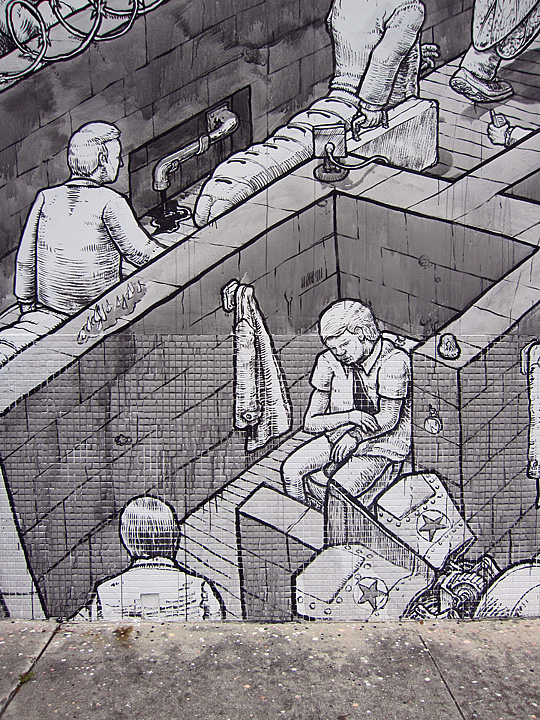
Miami's Wynwood Walls district offers a world-class canvas for street art. Jenny and I spotted this place on a recent Florida visit, following one of those Did-I-Just-See-That? hunches that sucked us off the interstate and onto the surface roads. I'll post more pix over the next couple days, but I couldn't wait to share this late 2011 piece by Liqen, "Vision of Wall Street Labyrinth." You like Devo? You'll love this stuff.
W. Joseph King and Michael Nanfito have written a fascinating future-history of the 21st century academy, epitomized by their vision wandering rōnin: peripatetic academics who use social networking tools and post-institutional "guilds" to connect with students priced out of a dying higher education system. Two representative quotes:
"Success in the flat-world economy [requires] training to think, communicate, strategize, and lead. It also [depends] on a mastery of the collective knowledge of humanity, an understanding of diverse cultures, and a desire to enter into the diaspora of global commerce."
"The rōnin [are] free to pursue their work unfettered by tenure and promotion policies or antiquated accreditation boards. Rather than sinking into self-indulgent solitary research, as some had predicted, they [flourish] in dynamic collaborations with similarly motivated colleagues."
Does this stuff sound too high-minded and impractical? Don't worry. King and Nanfito offer plenty of specifics. You may disagree with their vision, but you can't ignore the sense that these folks may be onto something.
Drudge plucked another doom and gloom article from the Financial Times to highlight the depths of despair that is our due for having the audacity to hope that President Obama was the real deal. Generally I ignore these red flags, especially since the American Right appears to be dead set on taking Obama down. Even so, Gideon Rachman's essay makes the depressingly credible argument that our nation will inevitably be required to seed dominance to China, adding, "Those who refuse to entertain any discussion of decline actually risk accelerating the process." No matter who wins the 2012 elections, we all should prepare to lose our "We're Number One" attitude.
The article offers a reasonable enough parallel between our decline and that of Great Britain after the Second World War, adding, however, that our approaches toward also-ran status couldn't be more distinct. While Britain faced the loss of empire with a certain magnanimity, the U.S. is far too invested in its "American Exceptionalism" identity to recognize the passing of power. Some among us, for instance, respond to the Rising China thesis with a smug reminder of our 1980s near-capitulation to Rising Japan. It's a fair point. Remember when Japan Inc was buying America from under our feet? Doesn't it seem strange to recall? I mean, really, when's the last time you heard someone say that we all must learn Japanese to stay competitive?
Still, as Rachman rightly points out, China's got tough numbers to beat. They're awash in money, they've got an increasingly potent military force, and they've got workers, workers, workers. They face their share of structural and fiscal problems too. We mustn't forget that. And all of us, the U.S., the Europeans, the Chinese - the whole world - we all confront an economic contagion that threatens to make the 2008 crisis seem positively healthy in comparison. The Occupy Wall Street protestors, for all their goofy eclecticism, seem to know this better than most. Something has deflated in the American psyche. A privileged few will ensure the continuation of their personal pleasures. The rest of us will pay the price. China is part of that new future. But they are hardly its author.
Recently I was quoted in a Contra Costa Times article about crowdsourcing businesses that are leveraging the slow economy by paying people to take pictures of public places.
This trend reflects a clever use of increasingly ubiquitous digital cameras - adding detail to Bing results, TomTom directions, and other databases.
My quote is brief - edited as usual (and commonly necessary in my case):
"Crowdsourcing apps that can transform free time into currency and connections offer a smart response to today's economic doldrums," Andrew Wood, a professor of communication studies at San Jose State, said in an email."
The Onion has done it again, creating a "story" whose goofy fakery manages to say something meaningfully true. The article, Silicon Valley Town Pinning Tourism Hopes On World's Largest Website, packs so much in a few paragraphs: pitch-perfect mimicry of small town-boosterism, a perfect quote from the feller who "just kept building" (maybe he's a cousin to that dude who spun the Biggest Ball of Twine in Minnesota), and an aching wistfulness for a time that's been bypassed by the Interstate of Relentless Progress.
"After the bubble burst, we didn't have too many visitors coming through these parts," says the mayor. Now they're coming back - just like Route 66. So gas up the '51 Desoto, pile the backseat with "crossword puzzles, Spider-Man comics, and Mama's homemade rhubarb pie," and...
See! Acres of Java Applets...
See! Hectares of HTML code... and
See! the Scroll Bar that Stretches All the Way to the Horizon!
Oh, and don't forget to grab some souvenirs on the way out. "Won't the folks back home be jealous?"
(Image from The Onion; lyrics from Weird Al Yankovic)
Following up on my recent Michigan travels, I decided to focus on one of the area's most important social statements: The Heidelberg Project. HP is an outdoor art space in Detroit's McDougall-Hunt neighborhood where two blocks of blighted houses and empty lots have been transformed into colorful, disturbing, witty, and thought-provoking comments on the Motor City's state and fate. As you'd guess, Heidelberg is a street passing through the area, once a sign of dilapidation, now something far more lively.
Tyree Guyton launched the project in 1986 as a personal and politically charged response to the despair and decay of his neighborhood. No etherial artiste, Guyton took wreckage as his media, determined to draw attention to the forces of racial discrimination and economic depravation that helped wreck his hometown. Working with his grandfather, Sam Mackey, along with other local artists and neighborhood kids, Guyton painted polka dots, assembled discarded items, and composed jarring juxtapositions to challenge others to rethink the meaning of ruin.
Naysayers, including two mayors, have called for the HP's demolition, and a number of Heidelberg houses were razed in the nineties. Even so, the Project draws photographers, activists, and curious onlookers from around the world. Tell a few folks that you're visiting Detroit and at least one person will insist that you add HP to your itineracy. Indeed a few local boosters have even begun (nervously) to add this place to their lists of must-sees. Just imagine the sight of reclaimed houses - eyesores to critics - on those glossy four-color brochures selling Detroit as a tourism destination.
Artwork by Tim Burke
During my visit, on a blue-sky weekday, I saw an empty information booth and a handful of tourists taking pictures from their cars, windows up. I was compelled to get out and walk. I spotted a couple older guys sitting in a pickup and asked whether they thought it'd be OK for me to take some pictures. "Go ahead," one guy said. "But don't sell 'em," the other one added. Unsurprisingly several neighborhood signs warn that the entire place is copyrighted. Detroiters know a thing or two about exploitation.
Artwork by Tim Burke
Since visiting HP I have wanted to learn more about this experiment in urban renewal. The official website offers plenty of information about one of this project's goals: "The inclusion of vacant lands into a networked system of art/play/garden spaces and the adoption of an 'art-as-life' philosophy into all components of the neighborhood infrastructure" - a worthy enterprise, especially given the alternatives in this part of town.
In many ways, project founder Tyree Guyton is a symbol of Detroit. He served in the Army, he was an autoworker, and he was a firefighter. Now he's an artist, active as ever. In fact Guyton has just mounted a temporary show called Street Folk, an exhibit of about 10,000 shoes filling a city block, seeking to evoke the plight of Detroit's homeless population. For better or worse, the Motor City is increasingly a work of art.
No, this is not all of Detroit; it is simply one facet of a place reeling under the weight of a collapsed auto industry and a disintegrating tax base. Once the nation's fourth most populous city, Detroit's numbers have now fallen to 1910-levels. Little more than 700,000 people live there today. Roughly one-third of its area - 138 square miles - lies abandoned. You can drive for hours and never see a chain grocery store. Even so, many of Detroit's remaining residents are working hard to breathe new life into their hometown.
I visited Detroit over three days in March, drawn to its ruins - especially those downtown office buildings that tower like tombstones, unlit at night. My memories are fragments: vapor plumes rising from steam vents, downtown traffic lights switched to blinking yellow, and a tense moment with a guy determined to break into a car while I was shooting the GAR building. They say that local boosters have come up with a crackerjack way to draw tourists: they want to build a $50,000 statue of Robocop.
I remember other things too: the vibrant transformation of the Heidelberg Project; tasty BBQ at Slow's (and a nearly perfect burger at Miller's Bar, in nearby Dearborn); and friendly conversations with locals who share my fascination with Michigan Central Station, that Beaux Arts ruin that has come to symbolize, for many, America's postindustrial decline. During my visit I drove day and night, and I felt the survivor's guilt of someone who lives a country away from a place that is not the backlot for a grim movie but is, rather, home to its residents.
Detroiters are understandably tired of photographers reproducing the same images of ruin and decay that feeds hopeless narratives of a dying city. More than once I received a withering stare from a local who saw me as some sort of Thanatourist, a holiday-seeker of death and suffering. [Plenty of other times, though, I also received smiles and advice. Here, as in all places, most people are basically good]. I did not come to exploit this place - though others may disagree.
The news is not all bad. Citizen volunteers are working to strengthen their neighborhoods. Entrepreneurs and artists are streaming in, taking advantage of dirt-cheap housing and the hunger for new ideas. Urban farmers are wrangling with weeds to produce jobs as well as sustenance. Chrysler's defiant Imported from Detroit Super Bowl ad tells the story well enough: Detroit can work. Even so, I just can't shake the sadness I felt here.
We feel no guilt at photographing a true ghost town, but we feel a collective guilt for the wrenching transformation of the Motor City. It says something about our country, about all of us. At the same time, any effort to watch this place, to photograph it, to report on it, conveys another kind of guilt. Any story of this place is bound up in our fascination with death, the easy narrative that resists an honest reckoning. So I offer no truth about Detroit in my video-essay - just some pictures of a place caught between what it was and what it is becoming.
Still on my travel hiatus - just returned from an amazing week on the east coast [with plenty of pix to come]. But I wanted to share this plug from the Rome News-Tribune about my forthcoming Berry College presentation.
As part of the Oxbridge Lecture Series, Wood will speak at 7 p.m. in the Berry College Science Auditorium. The event, entitled “Seeking Public Life in a Mediated World,” is sponsored by the Berry College Honors Program and admission is free and open to the public. A reception sponsored by the Berry College Forensics Union will follow the event.
In the lecture, Wood will explore how today's communication practices reflect broader transformations in urban design. Tracing a path from the boulevards of 19th century Paris through the totalizing spectacle of 20th century world's fairs to the rise of today's surveillance society, the lecture examines the modern paradox that simultaneously converges and fragments people, that, as Wood explains, leaves “us tapping on cell phones and clicking on virtual corn crops to relieve anxieties we can barely name.”
Bridging scholarly research and pop culture fascination, Wood will lead a tour through digital footprints, iPod dogma, the death of Detroit and why the next Depression will be televised. This presentation, anchored in critique but motivated by hope, aims to get audience members talking.
Last night's 60 Minutes presented a heartbreaking reminder of how the Great Recession has hurt those who can least protect themselves. Scott Palley's story crystalizes just how bad things have gotten with a report on Florida families forced to live in motels and with neighbors after losing (nearly) everything in today's economic doldrums. I know it's a cliche, but this piece will draw tears. And it will inspire hope. Seriously, you've got to see this: Hard times generation: Homeless kids
Rain is falling and the cats are roughhousing - and I am emerging from an epic cold. We're talking a real life-stopper that kicked up last Wednesday. All-night hacking (and not the cool cyberpunk kind). Reacquainting myself with the various bouquets of cough syrup. And so many bloody kleenexes that Charlie Sheen himself would recommend an intervention. So, no blogging of late. Sorry.
I plan to see the doc tomorrow, just in case. But I must teach today (Yes, I'm bathing in Purell - and keeping my distance). I think I may be climbing out of this mess. Thank goodness, because the next few days, weeks, and months promise to be hectic. Next week I'm doing a departmental presentation that will preview themes for a new article (and ultimately a book) on world's fairs. I'm flying to D.C. over spring break for a week of research and road-tripping. And a couple days after my return I'll head back east, this time to Berry College where I have been invited to present a talk. Along the way I'm launching my second new class this academic year and prepping to teach in the SJSU Humanities Honors Program (a half-time buy-out, starting this fall). Oh, and there's that video package for the Salzburg Program and the documentary for the College of Engineering Global Technology Initiative, both of which involve returning to Austria and China this summer. Busy days.
I see some respite ahead in the form of a sabbatical. My application has been tentatively approved, though no promises can be made until a number of budgetary issues are resolved at the state level. So I'm on the cusp of having the time to write a new book. Maybe. Wow, maybe I should just hide under the covers for the day. I can't complain, but I sure wish I felt a little less like I'd been hit by a truck.
I spent hours this weekend glued to the set, watching the Egyptian uprising. For some reason I drift back to memories of a rotten tooth that I once allowed to fester too long. Then one day the pain came, and the required root canal brought more misery.
No one knows that's going to happen tonight or tomorrow in Egypt, but it's clear that the nation's old order is crumbling. What will arise if President Mubarak falls, bringing down three decades of authoritarian rule? It's anyone's guess.
Some fragments of the first few days:
Protestors climb aboard tanks, greeting soldiers with hugs and cheers. Egyptians generally fear the police, but they respect the military.
Vandals storm the nation's Antiquities Museum and, inexplicably, rip the heads off of two mummies [Egyptologists over here are panicking].
Mubarak calls on fighter planes to fly low over crowds, warning them that he won't hold his troops off much longer.
Tourists shoot footage of a crowd marching across Cairo Bridge. The scene shows riot police launching teargas grenades at protestors - who simply lob them back.
The beleaguered president offers a sop to his people by picking a vice president - a first. Supposedly this fellow is hated just about as much as Mubarak. Footage shows the man saluting awkwardly before shaking the president's hand.
CNN anchors breathlessly report tweets: doctors needed at a mosque, looters spotted on motorcycles, the president's party headquarters is in flames. We're told that this is a social networking revolution.
Around here most folks seem unperturbed by the unfolding events. But Egypt controls the Suez Canal, a strategic pathway for oil and other goods. With the U.S. economy teetering on the edge of an abyss, these days may be long remembered as a turning point.
As you know I'm fascinated by relics and ruins. But during my recent trip to Mojave I found an even more sublime encounter with the detritus of urbanity: dead cities that were never born. This is one of them, discovered using Google Maps to chart my path across the desert. I was drawn to this grid of streets just north of Mojave and West of California City [here's a link]. I had to see what all that geography looked like up close.
So I found my way to this site, testing the suspension of our new (used) car in search of the grid. It's a strange thing to encounter these lonely roads, which from above resemble an Excel document yet are actually rutted dirt paths. Sometimes I'd see piles of stones marking four corners of a future homestead. Other times I'd spot a beer can or the ashy remains of a campfire. But I saw no signs of life. Still Google Maps confirmed that I was driving on streets! Broadway, Spring, Lemon, even a Main Street.
From time to time I'd roll past a wooden marker. Otherwise I could only imagine. Was I on bustling Church Street, or had I slipped into one of Excel City's lesser traveled avenues (marked by number alone). I could be wrong, but this looks like one of those bursts of speculation that arose periodically in the last century. Cities in the desert waiting to bloom. Using the language of William Gibson: "a tomorrow that never was." No homes, no families. Just dirt roads and the occasional Joshua tree.
Come to California's beautiful Excel City! A glorious grid in the middle of the Mojave Desert. A city of tomorrow that exists in overhead view alone.
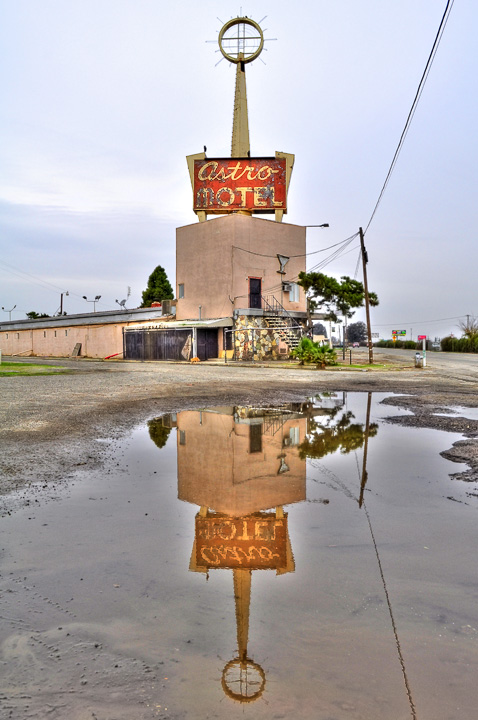
I thought I'd share some photos from the Fresno portion of a brief roadtrip I took last week. As I mentioned yesterday I was drawn to the quiet and solitude of the desert. Indeed I was delighted to explore several ghost towns that haven't even been born [more on that paradox tomorrow]. Yet when the rains threatened, I decided to head north and try out some HDR photography on the motels of Fresno.
I'd been here some years back, drawn to Fresno's gritty relics of roadside Americana. As I expected, a number of my favorite motels have been razed. Others, like the Astro Motel, looked like they won't stand long. The dreary nature of this place was compounded by the sight of tent camps stretching along arterial roads, proof that the lousy economy has trashed the lives of countless Californians.
The Motel California is still standing, continuing its strange service as a satellite of the state's penal system. I can only imagine the cheery postcards that were once sent by traveling families who stopped here decades ago. I'm sure someone wrote something like, "We made it, even with a broken radiator! At last we're in California! - at a cute (and perfectly named) motel." Few residents behind the barbed wire would share such joyful sentiments today.
I wrapped up my tour with a stop at the Storyland Inn. Several years ago this motel was a haven of sorts for folks who might otherwise be homeless. Residents committed themselves to keeping drugs off the property and local organizations helped children living at Storyland stay focused on their homework. That dream was fading then, and the motel is boarded up now, another casualty of a dying valley.
"Something feels different this time.": This quote from Fareed Zakaria's Time essay, "How to restore the American Dream," rings true to me. I recommend this piece for its honest and thoughtful assessment of our nation's contemporary fears and potential. A few excerpts:
What's happening today: "The middle class, many Americans have come to believe, is being hollowed out. I think they are right."
Why is the middle class getting hammered? "You can divide the American workforce in many ways, but any way you slice it, you see the same trend. People who get paid a decent wage for skilled but routine work in manufacturing or services are getting squeezed by a pincer movement of technology and globalization."
One part of the solution: Grow our economy by investment, not by goosing consumption: "The only good jobs that will stay in the U.S. are jobs related to knowledge and innovation." And, yes, changes to our tax system must be part of the plan. But the Republican mantra of "cut 'em all" suffers from near criminal cluelessness.
The time to act is now: "America needs radical change, and it has an 18th century system determined to check and balance the absolute power of a monarchy. It is designed for gridlock at a moment when quick and large-scale action is our only hope."
Somehow I missed this New Yorker cover from last year: a literally perfect illustration of contemporary life, and least the life of middle class privilege in the United States. As I contemplate the next Halloween for the Wood Family in our own comfortable bedroom community, I am compelled to consider the worlds seen and unseen in this image.
I was sitting in a Starbucks this morning in downtown San Jose where buildings tower but are increasingly empty of residents, where storefronts are filled with artwork because business has died off and isn't coming back anytime soon. At the table next to me, four bedraggled folks were strategizing on how to move a TV left on a sidewalk somewhere to a storage container. Someone would want to buy it, one argued reasonably enough.
Yet somewhere - a world where folks get subscriptions to smart magazines like The New Yorker, I guess - this image also makes sense: a place where parents drag their costumed offspring from McMansion to McMansion (those tacky signs of conspicuous consumption are beginning to weigh heavy in an age of imminent double-dip recession, but the kids don't know) - only to gaggle on their phones the entire time. Chris Ware's cover image offers a glimpse of that privileged enclave.
His critique is soft. But the illustration's muted, autumnal colors say something important. The middle class world of mobile community, of dispersed community, exists today. It's anyone's guess how long it can endure.
Today we would commence the second major part of our trip: departing Shanghai and heading southwest to Hangzhou. For the trip we'd reserved seats on a bullet train, but we had to get to the station on our own. Feeling confident in our urban navigation skills we lugged our bags in the general direction of the metro, only to confront the realities of walking in a city where the drivers of motorcycles, cars, and buses tend to view pedestrians as minor irritants. Given the wide, congested streets, we found that jaywalking - though dangerous enough to be stupid - is almost a requirement for getting anywhere. Most vehicles don't care about red lights anyway. Under the gray drizzle we dragged our gear over cracked sidewalks until the metro revealed itself amidst a construction zone.
A short hop later, we entered the world's first circular train station, Shanghai South. It really is a remarkable place, something like a circus tent or a UFO made of glass. Gates line the edges, each shooting off like sun rays, while the vast interior is flooded by natural diffused light. I was fascinated by the scene, though Jenny concentrated more on the growing line near the door. We knew that lines don't necessarily mean much in China, that the most determined folks will push their ways to the front anyway. Fortunately we'd secured seats. A very good idea, since many people were forced to stand for the roughly 1 1/2-hour ride. In fact, during an unsuccessful search for a dining car, I found that each car appeared to be filled with more and more crowds of folks who, lacking chairs, bounced abruptly with every shake and shimmy of the train.
Joining Jenny (sort of - while our seats were numerically adjacent, we were in different rows) I settled into leisurely appreciation of the view, watching another face of China roll by. Junks plying the rivers, tumble-down shacks, and communal gardens vied with occasional sprouts of newly built houses that could fit into any exurb in the U.S., signs of a nation growing in fits and starts. I sipped tangerine juice and flipped through pictures we'd taken at the world's fair. Truthfully much of my planning and enthusiasm had been focused on the Shanghai Expo; I had thought little about these next stages of our trip. Now we would begin to see a city that existed, to my mind, only as a vague idea: something about a lake, some pagodas, and perhaps a bit of quiet detachment from the megalopolis we'd just left. How big can Hangzhou be anyway?
Yeah, I'd failed to even consider how we'd make our way from the station to our hotel. Sure enough, once we departed the train (inspired to quicken our pace by the English reminder, "Please get out fast") I felt overwhelmed. The Hangzhou station is quite a bit different from Shanghai's: darker, crowded, and louder. Immediately, thanks to our bags and clueless looks, we were surrounded by touts offering taxi services. They looked friendly enough, and all were intent on convincing us they could take us anywhere in the city, cheaply and quickly. But I felt uncomfortable, facing insistent strangers on all sides. Jenny looked at me expectedly (a variation of "you did have a plan, didn't you, honey?") and I decided: we'd buy a city map and step out of the station to collect our bearings.
The heat was, if possible, even more fierce than in Shanghai. Sweat poured from our faces as we bumbled around outside. Jenny then spotted a large bus map, which we could compare to the smaller version we got at a newsstand. Comparing landmarks and Chinese characters, Jenny managed to get a fix on our position. And I began to think that we must be fairly close to our hotel. We'll walk, I said. We should take a cab, Jenny replied. I looked back at the teeming station and just couldn't imagine returning. It'd almost seem like an admission of failure. We'd mastered a fair amount of Shanghai over the past couple days. Surely we could figure a path to our hotel. And a little bit of walking would do us good. Heck, it'd be an adventure!
We started walking.
I figured that we might see a taxi heading our way; we'd flag one of those. I always prefer selecting a cab rather than feeling pressured by a driver. We had no luck, though. Those few taxis we saw were already packed. Jenny, gently at first but with increasing firmness, assured me that we should return to the station. But I was determined. We had a general idea of our hotel's location - really, it was just a few blocks by my reckoning - every step would bring us closer to the reality that taking a cab was for suckers.
After two or three blocks, the wheels on my bag began to melt. It really was that hot. Then when I tried to be gentlemanly about the whole mess, carrying Jenny's stuff while scrapping my own beat-up bag along the sidewalk, I got exhausted. We stopped here and there, glaring at each other. Jenny would search for directions and I would insist we keep walking (once I regained my strength). We weren't lost really. We simply had no clue where we were going. The so-called "general direction" quickly became a large section of a city that stretched way beyond my limited mental geography. "How big can Hangzhou be?" Pretty damned big, actually.
West Lake, Hangzhou
We stopped again, yelled at each other in frustration, and then Jenny began to cry. Right then I remembered another trip, years earlier. We were driving somewhere north of Los Angeles when Jenny mentioned that she'd like to stop and sing karaoke. I'm not usually up for that sort of stuff, but I agreed. We found a place, parked the car, and started through the door of a local club. Promptly we were told that we couldn't get in; our clothes weren't sufficiently fancy for this joint. Staring into the smug, merciless face of a gatekeeper I wouldn't employ to wash my car, I decided I couldn't care less about singing karaoke. Jenny, however, was mortified to the point of tears. That, I could not stand.
I didn't know what to do until I remembered something I'd read in one of my favorite books, John Stilgoe's Outside Lies Magic: at virtually every Holiday Inn there's sure to be a party, reception, or crowded bar filled with mingling strangers and locals out for a good time. We'd find some karaoke there! Jenny wasn't buying it, but I pushed on: "We will go to the nearest Holiday Inn and, as God is my witness, we will sing tonight." Within an hour, we had joined a karaoke queue (which included some dude who insisted on doing a rendition of Led Zeppelin's "Stairway to Heaven" - all of it) and I felt like a hero.
Melting in Hangzhou, with Jenny frustrated at my failure to plan our pathway, I remembered that night in California and I knew: We would find the nearby Holiday Inn (there must be one… yep, there it is on the map) and get help, at least a cab. Heck, I don't even like staying in Holiday Inns since the chain abandoned its family-friendly pricing. But I trust the brand in a pinch. 15 trudging minutes later we were met by a doorman who looked at us like we were insane. "You shouldn't be carrying all that stuff in the heat," he advised. "Come inside!" We explained our situation and he called us a cab. That's when we discovered that I'd entirely misread our small map. Our hotel was actually miles away.
Jenny and I overtipped the cabby obnoxiously (we were so grateful for a ride in air-conditioned civility) and finally made it to our hotel, some place called the Hangzhou Lily. With all the buttons and knobs in our room, and all that dingy carpet and those long, dark hallways, the place looked like it was teleported from 1964. But it was close to West Lake, Hangzhou's centuries-old tourist attraction. We were exhausted, and our spirits were dampened further by continual soft rain. Nonetheless Jenny and I made a brief hike along the shore, pausing under pagodas and taking pictures of lotus flowers. We saw one spot that rented boats, but the place was closed.
Somewhat guiltily we settled for dinner back at the hotel. We felt fairly confident in our abilities to understand the menu, but for some reason an economics professor who works at a nearby university took it upon himself to advise us on our dining options, even recommending a garlic version of snow peas that I couldn't spot on the menu. Afterward he came over from time to time and we discussed his speciality: the present economic relationship between our two countries. I felt a little strange about the conversation, being unsure about whether I was merely sharing my own ideas or was somehow being seen as a representative for the American perspective. Still, our chat was pleasant and illuminating. If he represented anything about his country's perspective, it is this: China is increasingly sure of its imminent dominance in global affairs. I think the professor almost pitied me.
Stormy weather over Hangzhou
Back in the room, Jenny and I tried to watch a bit of television. We were drawn especially to a game show that pitted a single contestant against a group of judges. While we couldn't guess the details, it appeared that the guy was tasked with telling a story at length. From time to time the camera would study the judges' reactions. Sometimes they were supporting; sometimes they were critical. Following a countdown, the player would wrap up his story, whereupon the judges would evaluate his performance. Judges who liked his story would conclude their explanations by turning a ship's wheel (why, I don't know). Other judges would rebuke him or otherwise explain why his story failed to move them. The player would listen empathetically and then he would bow deeply. Jenny and I had no idea what it all meant, and we were too tired to watch more. Our beds felt stiff as wooden boards, but we took no time falling asleep.
I wasn't sure about uploading this story, another one from back when I was a Navy journalist. Despite the ability to tweak some of its parameters after transferring the video from 3/4-inch analog tape to digital format, the color and stability are lousy. Nonetheless I thought it'd be cool to recall more images of Rota-life back in the eighties. Scroll down for scenes of the exchange, commissary, pizza parlor, and more. Better yet, stick around to read more about my adventures in broadcasting. We'll get to the video soon enough.
Today's live-blog (8 a.m. to 5 p.m., PDT) was dedicated to enduring a Friday's worth of daytime television: droning infomercials, shouting confessionals, courtroom procedurals, and, of course, Oprah. As I get a chance, I'll review this draft for typos. Also, feel free to check out Year Two and Year One.
8:00 (AMC): I'm all a-twitter, getting ready to start another edition of Daytime Dispatches. I've got my junk food ready. My easy chair's stretched out. And my clicker's on stand-by. My fingers quiver over the button. How to begin the next nine hours of brain-melting entertainment? Hmm... I think I'll start with an infomercial...