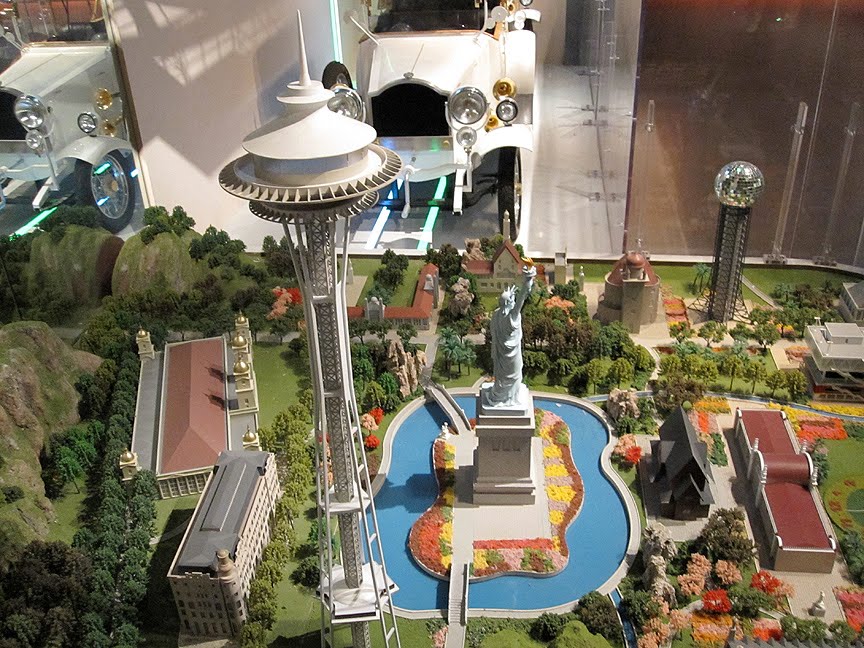
This is a video I've wanted to edit for more than 20 years. Really. For even longer than that, I've had a love affair with retro-futurism. Things to Come. Metropolis. Streamlined moderne architecture. Teardrop-shaped cars... For as long as I can remember, I've been entranced by the wind tunnel efficiency and earnest optimism of yesterday's tomorrows. William Gibson's "The Gernsback Continuum" reminded me also of the totalitarian underside to these fantasies, particularly those arising from the Great Depression. But I am drawn to their plucky can-do spirit all the same. So when I found myself in the middle of this semester's crush of projects, feeling a bit overwhelmed by the minutia of these days' obligations, I dug up hours of source material and cut this video. The song is by Donald Fagen. The scenes range from 1927 to 1968, the year I was born. The future, of course, is where it has always been: Just beyond today's fears.
Source Material
American Telephone and Telegraph (1961) Seeing the Digital Future
David Butler [Dir.] (1930) Just Imagine
Fritz Lang [Dir.] (1927) Metropolis
General Motors (1940) To New Horizons
General Motors (1956) Design for Dreaming
General Motors (1956) Keys to the Future
Peter Bogdanovich [Dir.] (1968) Voyage to the Planet of Prehistoric Women
Philco-Ford Corporation (1967) Year 1999 A.D.
Walt Disney's Wonderful World of Color (1956) Man and the Moon
Westinghouse Electric Company (1939) The Middleton Family at the New York World's Fair
William Cameron Menzies [Dir.] (1936) Things to Come
While researching elocutionism at San José State University, I spent some time reviewing old catalogs. One, from 1918-1919, included a pull-out panoramic photo of the old campus quad. The picture was marred with folds and yellowing paper, but I couldn't resist taking a few snaps with my phone. A little Photoshop and Prezi magic, and now I can share it with you!
Note: Click the arrows to advance through the panorama.
Panorama composed of nine separate images by Andrew F. Wood
During my recent trip to D.C. (attending the National Communication Association's annual conference), I was drawn to this artwork that dominates the north lobby of the AFL-CIO headquarters: Lumen Martin Winter's Labor Omnia Vincit ("Work Conquers All"). The 15-by-71-foot mosaic mural offers a vivid sense of what the future looked like (at least to some folks) in 1973.
I'll be sprinkling images and memories from my recent Texas Solo over the next few days. Let's start this week with an animated neon sign that glows in Addison, TX. Syd Nagoshi writes that this google-style beacon for Sigel's Liquor once resided near the Dallas intersection of Lemmon Avenue and Inwood Road. It was moved to this site sometime after 2009.
In fact, here's a surreal time travel experience: As of today, Google Street View shows the sign in its original Dallas location, where it stood for more than five decades. The scene shows construction work underway but the sign still hangs on. Advance the map left or right though, and - poof! - the sign is gone; the place has been replaced by a bank. This effect will surely vanish as Google updates its files, so...
Ignoring the crazy cost, I'm thrilled to add this postcard to my collection of roadside Americana. I love the time travel vibe, like we're peering back into the 40s and 50s.
Today began with proof that I've got the coolest spouse ever: We took the tube to University College London (South Cloisters building) to see Jeremy Bentham: founder of utilitarianism, theorist of the panopticon, social reformer, and corpse. I read this fellow first in grad school, following up on Michel Foucault's citation of Bentham's panopticon as a "humane penitentiary" whose design for anonymous control would provide a model for much of the discipline of contemporary life. And while yesterday I settled to photograph a statue of Thomas More, today I could see Bentham's actual body - though missing the head.
Bentham, you see, left instruction for his body to be placed in an upright box and dressed in one of his suits. He hoped for his head to be preserved enough to be mounted atop his body, but the postmortem procedure didn't work. A wax replica rests there instead. So, where's the head? In a vault maintained by the College, a safeguard against it being stolen by student pranksters (as they did in 1975). Happily, Bentham's head was not used as a soccer ball, though a myth to that effect endures even today. Gazing upon the box, which Bentham named an Auto-Icon ("A man who is his own image") hardly inspires reverence. The idea strikes me as quite silly, actually. Still, there I was, with Jenny waiting patiently, setting up my tripod to shoot photos. Students walking by have seen it before and hardly paid us any attention.
Later in Hyde Park, we spotted a troop of horses making their way toward Buckingham Palace. Jenny was smitten right away; we ditched our itinerary and joined the crowds. Amazingly we arrived a half-hour before the changing of the guards. However, the fence was already lined with hundreds of tourists hoping to catch a glimpse of whatever was going to happen. Well, it turns out that unless you arrive early enough to peer through the bars of the fence, there really isn't much to see. At least we could enjoy the band music and watch the horses clomp by. Finally when the guards had finished their ceremony a police officer informed us that the "next big thing" would occur in about 30 minutes. We'd had our fill of Buckingham Palace and began head back. Bobbies wagged their fingers and scolded jaywalkers with a "no, no, noooo," but they didn't care when we crossed anyway. What with all the fences to manage the crowds, there were few legal options.
For the next couple hours we strolled along Hyde Park, grabbing lunch at a cafe near the Serpentine, standing inside a cool, dark umbrella tree; sniffing roses on the Princess Diana Walkway; and gazing upon the Art Nouveau monument to Peter Pan. Then, after a brief stop at our hotel, we headed back to the Thames and its pedestrian walkway that leads from the recreated Globe Theatre to Tower Bridge. This was my favorite part of London. I love walking through narrow alleys and imagining myself a time traveler to an older version of the city, with each dripping pipe or pasted advertisement a sign of that alternate universe. Jenny, thank goodness, tolerates my passion for urban wandering. We also spent a bit of time bumming around the Tower of London, checking out a free movie near the information desk. Naturally I spent a few moments gazing upward to the room where Thomas More supposedly spent his final days before facing the executioner’s axe. We couldn’t abide the obnoxious pricing of the Tower, but we’ll surely add it to our plans when we return.
We wrapped our day up with a show at the West End’s Victoria Palace. While I'm not much for musicals, Jenny managed to find a performance that we both could enjoy: Billy Elliot. Weirdly enough, I think I enjoyed the show even more than her. The language and occasionally bleak themes, not to mention the melancholy conclusion (before the big dancing finish, of course) just don't gel with Jenny's sensibilities. As for me, I enjoyed the evocation of time and place found in the performance, especially in the hilariously over the top Act Two opener, "Merry Christmas, Maggie Thatcher." Once the show wrapped up, we strolled back to the tube and returned to our amazingly quiet and comfy room amidst the noise and spectacle of London. Tomorrow we depart for Germany, launching a new leg of our European adventure.
While preparing to teach a course on the rhetoric of urbanity (focusing the next lecture on the concept of urban labyrinth) I came across a reference to Jorge Luis Borges's short story, "The Garden of the Forking Paths." This story has flitted around me for years, a particle among the infinite yawning buzz of Things I Should Read. Finally today I downloaded a copy and wormed my way through its intricacies.
It'll take many re-readings, I suspect, to ever claim any mastery of this piece, but I can tell you this: "The Garden" is an essential stop for anyone interested in alternative histories, science fiction, hypertext, probability, or simply the mere pleasure of good reading. As with my notes from The Man in the High Castle I offer little guidance here, just some quotes that struck me as especially meaningful:
"Everything happens to a man precisely now. Centuries of centuries and only in the present do things happen; countless men in the air, on the face of the earth and the sea, and all that really is happening is happening to me" (p. 40).
"The author of an atrocious undertaking ought to imagine that he has already accomplished it, ought to impose upon himself a future as irrevocable as the past" (p. 42).
"In all fictional works, each time a man is confronted with several alternatives, he chooses one and eliminates the others; in the [this particular fiction] he chooses - simultaneously - all of them. He creates, in this way, diverse futures, diverse times which themselves also proliferate and fork" (p. 47).
"To omit a word always, to resort to inept metaphors and obvious periphrases, is perhaps the most emphatic way of stressing it" (p. 49).
Hypertext does not invoke "a uniform, absolute time… [but] an infinite series of times . . . a growing, dizzying net of divergent, convergent and parallel times" (p. 49).
Finally, a disturbing and entirely perfect line, considering the shocking way that "The Garden of the Forking Paths" ends: "Time forms perpetually toward innumerable futures. In one of them I am your enemy" (p. 50).
Recently I came across a video I'd been seeking for years: the BBC adaptation of William Gibson's "The Gernsback Continuum." A short production - barely 11 minutes - "Tomorrow Calling" is an earnest if somewhat cheesy depiction of Gibson's sublime short story. It is also, as you'd imagine, a British retelling, abandoning the story's references to L.A. and Tucson (and San Jose!).
"The Gernsback Continuum" makes a regular appearance in my COMM 149 classes - sometimes to the consternation of my students who struggle to wrangle with the author's rat-a-tat pop culture references and full-tilt plunge into weirdness.
Never read the story? I recommend that you start there. Afterward you might check out the BBC's version. Doing it the other way around - or, God forbid, limiting your exposure to the video - would be like dismissing the need to read The Great Gatsby because the movie is available at Blockbuster [Ooops, I'm dating myself. I mean Netflix].
And, no, Gibson's short story isn't "great literature," but it's certainly worth a read. Then a look.
First of all, it seems a bit silly to get pissed off at a movie called Machete for being anything other than what it is. Films named after weapons generally don't deliver more than their titles. Would you expect Oscar greatness from Saw or The Naked Gun or, I dunno, Two By Four: The Movie? OK, Sling Blade proves an exception to the rule. But most of the time it's best to downshift expectations.
Robert Rodriguez's newest guilty pleasure is a busty, bloody, barfing ode to a film genre that exists, I think, mostly in retrospect: Mexploitation. At the same time Machete provides an exemplar for that broader, more generally disappointing crop of ironically detached meta-ploitation films that stretch beyond parody (such as Don't Be a Menace to South Central While Drinking Your Juice in the Hood and lamer examples I can't bear to name) to genuine homage.
By homage I'm referring to movies like Alien Trespass and Black Dynamite and, of course, Grindhouse: movies made by auteurs willing to scrounge backlots for discarded camera lenses and old cans of aging film stock - or at least willing to digitally produce the patina of age. Meta-ploitation flicks are purist holidays, a chance for transport back to the grimy Times Square theaters of film-historian legend whose posters are now coveted by serious collectors. Machete, with its scratchy intro and 70s-porn star interludes, shows that Rodriguez is serious about this genre.
By now pretty much everyone knows that Rodriquez directed Machete as a fake-trailer between Grindhouse's features, only to dream of ginning it up into a full-blown feature. Sounds like fun, right? Of course exploitation flicks were famous for jamming all the good parts into the trailers; the movies were never as good as the commercials.
And that's the problem. Machete stretches its plot to feature-length while mistakenly trying to add some depth to the cheesy mixture. Oh, don't worry, it's still got the good parts, which means that we See! "Machete's" wife and daughter decapitated by a slimy drug lord, See! "Machete" double-crossed and left for dead, and See! "Machete" rise up for revenge. [Danny Trejo's character is actually called "Machete," just in case you weren't sure.]
There's no doubt at the end of this grisly Hard-R flick, "If you're gonna hire Machete to kill the bad guy, you better make damn sure the bad guy isn't YOU!"
Yet Rodriguez can't quite leave well enough alone. So with the addition of extraneous subplots and undeveloped secondary characters, "Machete" must become a symbol of Mexican pride amidst the moral and technological wasteland of Gringo culture. A reasonable enough proposition, resulting in occasionally laugh-out-loud dialogue like, "Machete don't text." Hell yes!
But by speaking of himself in the third-person, as he frequently does, Trejo's character becomes somehow less vivid than his trashy trailer-persona. Not quite a walking myth, "Machete" is merely a shill for Rodriguez's half-baked assault on those brain-dead politicians who've turned America's immigration debate into a sad sideshow ("SEE! Headless Bodies in the Arizona Desert!"). Ultimately this flick folds under the pressure of its director's expectations.
Yes, the film features "Machete" swinging on intestines, getting it on with the ladies, and plunking an M134 minigun on a chopper to kill the bad guys. It's the trailer made into a movie. Sometimes it's even fun (the blink-and-you'll-miss-it scene of ice cream cart-venders on the warpath is almost worth the price of admission). But Machete tries so hard to do everything right, it fails to do terribly well.
As I wrote three years ago, Machete looked like it'd be a gas as long as Rodriquez didn't invest the exercise with too much gravity. Produce it as a roadshow, toss it up on aging outdoor screens and in rundown burlesque theaters, I said - just don't expect it to work in a suburban cineplex. Unfortunately that's exactly what the director chose to do, trying to hit several audiences with the same sledgehammer.
The results are a sloppy second-take of a great first trailer. Hell, I think only ten people lined up to last night's show (in admittedly sleepy Scotts Valley). Friday night, and only ten die-hard folks bought tickets for Rodriguez's latest splatterfest. Once again, meta-ploitation fires blanks and misses the target.
When our guide picked us up at 7:30 I almost wondered if she was slightly amazed at our willingness to navigate the metro to get home the previous night. She'd offered to get us to our hotel, of course, but we didn't want to force her and the driver to work around our prime-the-pump schedule. Moreover, we crave our independence when traveling, and we felt a little guilty about accepting any degree of hand-holding. That said, we had to admit our appreciation about having a ride this morning. We'd paid for a little convenience and were determined to enjoy it. Gradually, as we motored through those jammed streets under increasingly blue skies, Shanghai landmarks became more recognizable to us. Soon enough we'd be touring the city on our own; it was nice to get a basic awareness of how its structures and spaces fit together.
Returning to the line at the security tent, waiting to enter the fair for a second day, we fell more comfortably into the routine. Our complexions and demeanors continued to attract attention, but we felt the calm of having been here before. We'd tossed our extraneous survival guide notes, we had our plastic folding chairs and cardboard fans. We knew the score. The heat - again, supposedly a lucky break for foreign visitors hoping to avoid the fair's famously protracted lines - inspired the crowd to bubble into tiny cones of community. Nearby, a guy flicked his fan to thump cool air toward an elderly woman. At the same time my own burden of heat lightened a bit when a neighbor lifted his umbrella high enough to cover us both. Whipping out my fan, I waved in broad strokes, making sure to send extra breeze his way. Now and again we would smile at each other in quick glances, advancing in broken waves to the entrance.
After passing through the security queue we took the metro to the Pudong side this time, alighting near the national pavilions. Checking our directions we fast-walked toward our goal: the UK Pavilion. I'm glad we did. The line had already stretched past the 20 minute mark when we arrived, and it quadrupled in size while we waited. We felt pretty good about our progress up until the very last moment when our section of line was set to enter the pavilion, only to be stopped near the door for a maddening delay of 20 minutes. We sat and stewed and then, without a hint of explanation, were finally admitted.
Andy in front of UK Pavilion
Describing the UK Pavilion is just about as difficult as photographing it. A giant cube of waving acrylic tendrils, rising 60 feet over a weirdly curved foundation of "Don't Sue Us" playground-rubber flooring (an "urban park" described in promotional materials as "wrapping paper" for the British gift to China) the thing seems like a blurry vision in even the most sharply focused pictures [Check out the Virtual Exhibit]. The pavilion's centerpiece is something called the Seed Cathedral, though it's more commonly nicknamed "the hedgehog" or, especially by Chinese visitors, "the dandelion."
Seed Cathedral Interior
Wags at the Daily Mail dismiss the thing as a pricy "pin cushion." Yet thoughtful reviewers worldwide have concluded that The Seed Cathedral may be the most impressive exhibit at the fair, not to mention the most impactful. Each of its 60,000 transparent rods, you see, contain seeds. Standing inside the cathedral, you are surrounded by walls of them, all aglow with light streaming from the outside. The scene is almost reverential. And when the expo closes for good, the seeds will be distributed to schools across China and the UK as a sort of distributed bank of biodiversity [Check my blog for more pix].
Receiving henna tattoos at the Mauritania Exhibit
From the UK we strolled a short distance to the Africa Pavilion where 42 countries and the African Union had come to exhibit aspects of their cultures and industrial might (Did you know that Sudan is the world's "prebiotic basket"?). Why were so many nations stuck under one roof? Turns out that many couldn't fund their own buildings. In response, China, determined to make this expo the world's largest, simply footed the bill. Inside the so-called "Gift Box" building, each country got space in a sort of open-bazaar mall filled with trinket tables and passport stations for the fair's tireless stamp collectors.
Shopping in the Africa "Gift Box"
After being stopped by a couple of guys who asked me take pictures with them, Jenny and I took silly snapshots of our own at designated photo-spots: a camel, an ape, and even giant faces of African people, including, supposedly, a version of the famed "Lucy" fossil. At the Mauritania Exhibit, Jenny sat down to receive a henna tattoo, while an endless stream of Chinese fairgoers snapped photos. The Africa building, perhaps being most famous as the one pavilion you could enter without standing in line, satiated our need to visit countries separated by feet rather than miles.
Netherlands Pavilion seen from UK Pavilion queue
Heading back outside, we marched straight to the Netherlands Pavilion, one of the expo's quirkier displays. Known as "Happy Street," the figure-8-shaped exhibit is a walking tour of Dutch culture that rises like a roller coaster of looping pedestrian paths. Happy Street is a collection of houses, each built on stilts, that become peepshows for a cheerily eclectic assemblage displays that range from clocks and Van Gogh artifacts to a purification plant that serves water through fuel pumps and a creepy teddy bear whose eyes follow your movements [That last one is called "Social Eyes" - get it?].
Stairway to Happy Street
Nearby, polyester/fiberglass sheep graze upon fake grass, fascinated visitors peer into a greenhouse packed with tulips, and crowds line up at a Dutch restaurant that distributes tiny wooden clogs with each combo meal. Jenny and I joined a throng of resting, lunching fairgoers among the sheep, appreciating a shady respite from the sun [Some version of the sheep, by the way, is supposed to go on sale sometime in the near future].
Plastic sheep at the Netherlands Pavilion
Departing Happy Street we turned toward the fairground's southern edge in search of the Chile Pavilion. On the way, we were approached by a man who commenced to remind us in broken English that tickets for the China Pavilion are rare, that reservations are required. I knew the pitch, having heard that scalpers were combing the streets in search of suckers, so we ignored this guy and kept walking [That evening I read that fair authorities were beginning to replace paper pavilion tickets with plastic versions, complete with computer chips, to reduce counterfeiting].
Inside Chile we explored a fascinating inquiry into urban life. A rolling view of suburban living is augmented by a disembodied voice that asks, "What is a city?" An upside-down apartment complex invites visitors to consider the koan, "If no one knows anyone… then why live in the same city?" Nearby, a chasm of video monitors creates a Blade Runner vibe. And toward the end of the show, a "Well of the Antipodes" presents viewers a chance to gaze downward onto a video display of life on the other side of the planet.
Looking down the Well of the Antipodes
As afternoon began turning toward dusk we ambled through a few more sites. The Cuban pavilion offered a Mojito bar but otherwise was a disappointment, suggesting (though hardly proving) that the island nation is good for nothing else but rum and cigars. The Pavilion of City Being, another one of the expo's five theme sites, offered an excuse to duck out from the scorching weather with its life-sized rail station (called Vigor Station, for some reason) and a 360-degree cinema vision of how plazas contribute to urban vitality.
Buying trinkets at a souvenir shop
Best of all, a nearby mega souvenir shop fulfilled a world's fair fantasy of mine, the chance to flip through row after row of postcards, booklets, t-shirts, and other collectibles. I can't time-travel back to 1939 to stock up on New York World's Fair baubles. But at least I could bring home plenty of memories from Shanghai for the next generation of expo aficionados.
China Pavilion
Back outside we crossed wide avenues to get closer to the China Pavilion. The streets were thronged with electric buses and small non-electric cars. Pedestrians, in the usual fashion, crossed wherever they pleased. They say that bigger vehicles outrank smaller ones in China, and that pedestrians rank lowest in the urban scheme of things. That's right: You get hit by a car in these parts, it's your own fault. Even so, Jenny and I found ourselves increasingly bold in our excursions, barreling across the broad boulevards with an I-Dare-You glare. The slogan for our crosses, a stupid choice on retrospect, was, "You're not gonna look for me? I'm not gonna look for you."
Expo 2010's "Axis of Evil"
Feeling suitably tough, we boarded an expo bus for the northeast edge of the fairgrounds, headed for the "Axis of Evil." So far no one knows precisely who thought it'd be literally perfect to place the Iran and North Korea buildings next to each other, but the convenience of the choice has surely attracted every American expo visitor. In Iran I felt especially welcome, receiving a piece of rose flavored candy when I handed our passports to the stamper (none of the other folks received a treat for some reason).
Adding to the friendly atmosphere, the exhibit displays Iranian President Mahmoud Ahmadinejad in a smiling pose, professing his love for humankind and his confidence that city life is living for each other, not just with each other. A scale model of a nuclear power plant showcases the country's peaceful application of atomic power, without the tiniest hint of weaponized potential. I joked with Jenny about being a CIA agent and that we were secretly gathering intelligence on Iran's nuke plans.
Iran nuclear plant model
Our next stop, North Korea, presented a more stark mood. The pavilion features a miniature "Juche Tower" (standing for the country's practical necessity of Self Reliance) and some videos illustrating the "Paradise for People" sign that hangs, dimly lit, from the ceiling. Mostly I remember images of North Korean athletes, which, presumably, did not include North Korea's ill-fated soccer team. A guy stamping passports looked almost emaciated. In contrast, the women at the souvenir stand were positively aglow under vertical edifices of hair.
North Korea doesn't quite get the concept of subtlety
Most intriguingly, these folks seemed more focused on selling stuff than almost any other pavilion we'd visited. Shelves offered books containing Kim Jong-il's writings on everything from economics to opera, stamps highlighting stalwart soldiers bayonetting Running Dog Americans, and postcards depicting various heroes of the revolution ("No, that's Kim Jong-il's uncle," I was helpfully informed). The most thoughtful item: cold water that had been once "gushing out from the rock formation of granite on Mt. Kalmae in Onchon County, South Pyongan Province." That's South Pyongan Province - none of that North Province swill!
I packed a spine-bending bag of souvenirs (anticipating a delightful conversation with a San Francisco customs official upon our return) and returned with Jenny outside, where the temperature had dropped to a mere 90 degrees Fahrenheit. We dropped by an information station, though by now we'd long gotten used to the pleasant green-shirted, English-speaking volunteer guides having no clue how to interpret our questions. Having had some luck with the bus getting to the Axis of Evil, we climbed aboard again, anticipating a quick ride to the area where the U.S. Pavilion is lumped.
Haibao reminds bus-riders to be courteous
Yep, Haibao was on the video screen again. And we recognized our general direction. And then we started heading under the river, traveling through a tunnel back to the Puxi side. By this point, we didn't mind. It was a free opportunity to check out the expo's World's Fair Museum. So we exited on the other shore, stopped for a quick bite at a Papa John's Pizza place ("Papa John's" in name only) and joined a queue to take another bus further down the road. A guy tried to cut in front of Jenny, only to be shoved backward, first by Jenny and then by an old guy who started smacking the would-be line-jumper on the arm. We felt almost like locals at this point.
Famous expo theme buildings (and the Statue of Liberty)
The World's Fair Museum was nice enough, though it seemed curated by someone who had only a glancing awareness of the concept. Mostly I was worried that my camera had almost entirely run out of battery power. I tried the one outlet I could see, but it didn't work. I didn't try a second time at the museum because a guard started looking warily at me. Conserving the one or two minutes of power remaining, we toured the largely empty exhibit and then returned back to the boat dock for one last ferry ride.
Our evening would conclude at the China Pavilion, that new symbol of the PRC's 21st-century might. But first, we trudged around the U.S. Building, with no intention of joining the two-hour line for a pavilion universally panned as a disappointment, before catching a bus heading toward that huge, red inverted pyramid. We got close enough, and I sat up the tripod and furiously composed the shot, the camera's power indicator blinking rapidly - and then off.
Frustrated, Jenny and I walked into a tiny mall of restaurants and shops, looking for a power outlet. Nothing, not a single place to power up. We thought about giving up until we stepped into a pleasantly titled Official Merchandise Store. That's where I spotted an outlet behind a display of Haibao dolls. Over the next 20 minutes, Jenny and I "looked at souvenirs," while the camera sucked some juice (how happy I was to have packed a converter this time!). We'd bought so many expo souvenirs over the past two days, I felt OK about the subterfuge.
Finally I got some decent photos and video of that bold, tacky, and gloriously confident China Pavilion. Getting inside was never an option, of course. Lines were said to stretch for hours and hours. You'd have to arrive at the gates earlier than five in the morning just to get a chance to run toward a reservation desk in hopes of snagging one of 30,000 tickets. Yeah, that would happen. No pavilion is worth the eight hours I'd read this one would take to enter. Eight hours!
Last night at Expo 2010
I'd heard that some countries were purposefully stretching their waiting times as a sign of prominence. If it takes a half day to see Saudi Arabia, that country's got to be important, right? Then there's China's ultimate goal of making this the most heavily attended expo in history, with an expectation of 70 million attendees. Some critics whisper that the government is doing more than give free tickets to Shanghai locals, that they're threatening the salaries of regional officials who fail to meet quotas. For China, an economic behemoth still sometimes laughably called a "Developing Nation," Expo 2010 is that big a deal. Nonetheless we were happy to see its signature pavilion from the outside.
We snapped our last pictures, took a walk along the Expo Axis, and made our way to a bus promising a quick ride to a nearby metro station (the wait for the ride to start was interminable, but never mind). Walking under the arched bridge with its animated, blinking colors, our eyes were drawn forward to that city of 20,000,000 people that stretched beyond the fairgrounds. Amnesty International reports that 18,000 households were evicted to make room for the world's fair, but we see no signs of that strife tonight. We only see the towering ambition of a nation shoving the past aside for a glittering tomorrow.
Sometimes we are dubious, sometimes we are amused, and sometimes we are horrified. But always at the fair, always, we are amazed. That night back at the hotel I expect to hear a cacophony of voices in my ears; there's no way I can sleep after our adventures in China's glorious future! Still, I drift away immediately. We've toured ourselves to near-exhaustion in only three days - and our Asian adventures are only just getting started.
I opened the drapes and beheld a thick, dreary sky. Shanghai pulsed with cars and a hint of rain, and we were going to the World's Fair. As a scholar who writes about these things, it's strange to admit, this would be my first world's fair. All the others, I'd merely studied. Not that I hadn't come close to the real thing.
Looking out the window, I remembered another day, about a decade ago, when I was invited to present a speech in New York about the 1939-40 and 1964-65 World's Fairs. My talk would be part of a celebration for Flushing Meadows Corona Park, site of those famed expos. For me, it was a chance to solidify my reputation as a serious researcher on world's fairs.
I spent months preparing that speech, and days memorizing it: the number of fake plants in Norman bel Geddes' Futurama exhibit, the amount of acreage claimed from land once described by F. Scott Fitzgerald as the "Valley of Ashes," the names and key pavilions of the fair's various "zones," stuff like that. I wanted to do well.
Over the phone, the person running the show described the set-up. There'd be a portable stage built near the stainless steel Unisphere (you know, that metal Earth that was blown up in Men in Black). There'd be no LCD projectors or other media-crutches, though. just me and a microphone - and an hour to talk about the world's fair as a global phantasmagorium of commerce.
I was terrified.
When I arrived, a little before midnight, I focused only on the next morning. I flowed from airport gate to taxi to hotel room, my eyes nearly shut the entire time. The speech filled my vision, each word a potential stumble into public humiliation. Being driven along the Grand Central Parkway, I barely noticed when we rode past the silvery Unisphere, lit up at night.
In my hotel room I shut the curtains and paced in the darkness, practicing and practicing. By about three in the morning I could do the entire speech without a glitch. A gentle tapping sound against the windows helped me drift to sleep. Two hours later I awoke and opened the curtains, ready to see the city at last.
The sky was blotted out with pouring rain.
The event organizers were packing up when I arrived. The celebration was canceled, with no backup plans. The visionary who booked my speech: nowhere to be found. One of the set-up guys looked sadly at me and fished out some t-shirts from the back of a van. "Thanks anyway, dude," he said, handing me souvenirs of a speech I would never give.
Ten years later, while our guide was driving us through Shanghai, I took comfort in private knowledge: For all my practicing, I wasn't ready for that speech. I didn't yet know enough. Heck, I'd never even seen a real world's fair; I'd merely read about them. I would have made a fool of myself.
Well, today I was going to see a world's fair. And not just any fair, but the largest and most expensive expo in the history of the world.
Merging into the convoluted stream of cars, buses, motorcycles, bikes, and pedestrians, heading for Expo 2010, Jenny and I laughed at the site of googly-eyed Haibao dancing on an animated sign. The smiling blob and his cheesy blue pompadour is supposed to resemble the Chinese character for "human" (though he more closely mimics Gumby to American critics, and his name actually means "sea treasure"). In all sorts of media around town, Haibao is even being used to instill new rules of courtesy into Shanghai life.
In one cartoon, we see someone in a movie theater talking too loudly on a mobile phone while other folks are trying to watch the show. The patrons are getting surly when Haibao bounces to the rescue, gently reminding the social scofflaw to be more considerate. The cell-yeller's cheeks grow red; the lesson has sunk in.
Haibao is everywhere in Shanghai: as topiary, on manhole covers, in comic books: a constant presence reminding people to avoid abandoning bags in metro stations, to offer elderly people seats on crowded trains, and to stop wearing pajamas outside their homes (outdoor pajama-wearing is still a fashion amongst some of Shanghai's older residents). Haibao also reminds locals to see the Fair, of course.
Waiting to enter the world's fair
As the weight of Shanghai's humidity began to bear down on us, a morning scorcher promising a high that could exceed a hundred degrees, our guide dropped us off at the Fair's entrance. That's where we faced our first real sense of what was ahead. A swarm of people, thousands of them, were waiting for officials to open the gates to the security tent. This wasn't a line but a long collection of lines, row after row of sweating, jostling, chatting, laughing, arguing humanity.
Which line was the one for us? Our tickets offered no clue, so we just fell into one crowd and commenced to wait for the gates to open. I'd read somewhere that entrepreneurial folks were hawking fold-up stools, and right away I bought a couple. At ten Yuan a piece, these cheap plastic gimmicks would become two of our favorite and most practical world's fair souvenirs.
Over a half hour or so, the mass of people packed deeper and deeper. More lines would form with the logic of bird clusters splitting from a flock, and sometimes cops would tell a large group waiting in one queue to join another, inspiring groans but no apparent anger. These folks, it seems, know about lines, and they were generally homogenous in projecting a spirit of calm in the face of the potentially maddening crowd.
I should add that the population of this growing community of fairgoers was almost entirely Asian. Rarely did I see anyone who looked like they'd traveled from Europe or the Americas (though I got used to hearing an occasional crock of Aussie twang). Planners expect that 95 percent of all fairgoers will be from China, which means that Jenny and I were sure to stand out. We drew smiles and some awed looks, along with a few nods of encouragement, especially when we opened our folding chairs and joined the congregation.
Courtesy reminders are everywhere in the expo
Getting into the fair and seeing its most popular exhibits is a matter of waiting and walking and sitting. Wait for the group in front of you to move ahead. Walk into their section. Sit down (or stand if you need to stretch your legs). Then there's security, followed by more waiting, some jostling, and a little cutting. While I wouldn't presume to speak authoritatively about the Chinese people, I can say with confidence that folks in Shanghai have no problem taking some slowpoke's place in line. Leave an opening and you convey in universal terms: "I don't really care when I get there." Lacking any appearance of remorse, the faster, more determined local will snap up your spot and never look back. Jenny and I learned to smile in these moments, but also to zealously advance when space became available, lest we get turned in circles like slipstreams from a jet airplane. Around here things move fast, or not at all.
Security proved to be a perfunctory affair, with the guards doing as well as possible to move the crowd along without allowing gaping hazards onto the expo site. It didn't take long to get pushed out of the sweaty tent onto a concrete square. Riding that human current, our hearts gladdened to finally get started, we headed for the stairs. Just one quick pass through a metro station and then… Another line, this time to board the train that leads to the fairgrounds. This is Line 13, a newly built three-station stretch that conveys visitors to the east or west banks of the Huangpu River. Knowing the difference, we'd soon discover, is critical to enjoying the fair.
Water misters help manage the heat
Just ambling along the broad boulevards under those punishing temperatures leads to frustration, if not heat stroke. Extending over two square miles and packed with about a half million visitors on some peak days, the expo is just too big for browsing. Best to approach the fair somewhat more methodically, understanding first that it's built on both banks of the river. On the east side (the Pudong) lay most of the national pavilions; that's where most visitors start. On the west side (the Puxi), corporate and state exhibits command slightly less attention. The Puxi lines are still long - oh, yes - but not quite as long as those on the Pudong. Jenny and I agreed that we'd start slow and steel ourselves for the more crowded side later in the day.
Communication technologies are showcased throughout Expo 2010
Our first stops were practical: an ATM to get some cash and a souvenir stand to buy a "passport." By passport, I mean a booklet used by fair visitors to collect pavilion stamps, which are colored ink icons applied by hand. Perhaps the most popular collectible at the expo, the passport produces a sense of accomplishment, especially, observers note, for locals who may never travel outside of China. Colorful names from faraway places will do nicely instead. I'd heard tales of older folks (who supposedly love these things the most) walking from stamp-table to stamp-table, collecting inked proof of having gone somewhere while ignoring the pavilions themselves.
Expo 2010 passport
That's why when I read about how these trinkets get snapped up quickly each day, I insisted that we dive into a scrum of people shoving money at the poor young woman trying to get rid of the things. Once again I was amazed to see the disappearance of any sense of decorum (don't get Jenny started on the locals' propensity for outdoor loogie-hocking). Passports didn't go to those who waited longest; they went to those who shouted most loudly or pounded the counter most forcefully. Later I'd learn that the fair is stocked with passports; they're everywhere, and in lots of varieties. Nonetheless we got ours and commenced on our tour of civilization as imagined by Chinese planners and corporate PR-types.
We started, inevitably given my research passions, at the SAIC-GM Pavilion. SAIC refers to something called the Shanghai Automotive Industry Corporation, but I was there for the GM side of the show. General Motors, after all, produced one of the most famous pavilions in world's fair history: the Futurama exhibit, back in the 1939-40 New York World's Fair.
Futurama was a demonstration of America's future, the thrillingly almost-here world of 1960, as it could be imagined by car manufacturers. A dark-ride through a diorama of modern planning, Futurama asked: Why should we suffer in crowded cities and rundown small towns when we could stretch out across a continent? Why poke about in packed buses when we could drive our own cars? All-weather interstate highways and reasonably priced autos would transform public life, allowing each worker to own a piece of the American dream: a suburban house far from work, a garden away from the machine! For years I'd imagined myself as a time traveler standing in one of Futurama's famously endless queues (I'd prefer the 1939 version, though I would have settled for the lamer 1964-65 model).
For 2010, GM and SAIC teamed up to produce a vision of Shanghai in the year 2030. OK, that's pretty cool too. Anyway, it's a line that leads to a "4-D" theater that leads to a set of interconnected stories told in Chinese language (and no subtitles). Something about how mobility and the spirit of "Xing!" connect us all. Whatever. The fun part is sitting in these cool moving seats that jerk with each motion of the film, immersing yourself in the Shanghai of Tomorrow: an urban fantasy of cartoon people, crazy architecture, and futuristic gadgets. And driving.
Cars of the Future
In the SAIC-GM future, everyone drives, even blind people. But no one worries about controlling their Future Cars. No, they're immersed in a colorful mediascape of heads-up displays and videoconferencing. Of course they experience drama in the world of tomorrow too. A young woman is set to give birth, a video game-obsessed boyfriend chases after the girl who dumps him, and an estranged father and daughter reconnect. The film presents hazy memories and near-death moments and a global concert witnessed by everyone, from space-borne Chinese astronauts and drunken American revelers. The film's got self-charging, self-driving, self-parking Bubble Cars! (and a piano that explodes into a burst of birds for some reason). The film is an unabashed celebration of corporate power to produce the greater good [Here's a YouTube video made by another fairgoer]. After the show, child performers cavort around real-life versions of the Car of Tomorrow, prancing around the techno-maypole.
Andy and Jenny at Pavilion of the Future
Afterward we walked by the Oil Pavilion, which has been reviewed as a must-see. But those lines already looked like they were stretching past the hour-mark. So we kept moving toward Pavilion of [the] Future, an exhibit dedicated to tomorrow's visions of urbanity that is incongruously located in a Rust Belt-era power plant building topped with a smokestack called the "Expo Harmony Tower." The pavilion starts with a long hallway showing cinema-sized clips of movies depicting tomorrow's cities. Then there's a room filled with stacks of oversized books that address utopian themes, and even larger books with digitally turning pages that rise above fairgoers' heads.
Toilet of the Future
And then there are the toilets of the future -- two of them! (both, western pedestal models). Tomorrow's toilets illustrate the promise of new technology, I guess. Then comes the darkened statue room lined by naked people watching videos of, well, I'm not sure. Best not to dwell too deeply here. Finally there's a 110 foot tall screen featuring five visions of future cities as they'd be imagined by children. It's the perfect world's fair pavilion. Crowded, complex, and confusing. I loved it [Oh, and Star Wars fans should look carefully for Y-Wing Fighters on the "Intelligence City" display].
Y-Wings over China
Outside, the temperature was nearly starting to melt the sidewalks. Happily the clouds that had been gathering all morning burst into a perfectly timed shower (maybe an example of China's cloud-seeding technology at work). Jogging into the Urban Best Practices Area, Jenny and I sauntered through "case buildings" that featured local examples of livable city-life. I was drawn immediately to the Malmö exhibit and its miniaturized version of the Swedish city, and we both enjoyed the chance to walk over an ersatz Charles Bridge in "Prague."
Jenny visits a tiny town
Other memorable moments from the UBPA include the long line for Osaka's 360-degree film about the role of water in the city's history, a Beijing Tiny Town reproducing the 2008 Olympic Village, and Hong Kong's animated floor that allowed us to present an impromptu remake of Michael Jackson's "Beat it" video. I got some good natured ribbing at a case focusing on Izmir, Turkey, when I failed to present my expo passport opened to the supposedly correct page. After directing me to the proper page for stamping, the woman smiled mischievously and pronounced her verdict: "You naughty" [Maybe she was still steamed that Izmir's proposal to host Expo 2015 was bested by Milan's sleep-inducing pitch]. Nearby fairgoers who'd packed their own lunches were sitting alongside walls, enjoying a break from the weather.
Andy practices his LunchFu against Bruce Lee
Once the rain turned into light drizzle we headed to Kungfu for a Chinese version of fast food: steamed spareribs, vegetables, rice, and chicken quarters. We both thought the meal was pretty good, even the soup was tasty (though the viscous lumps of gunk floating in our pots of chicken broth gave me pause). Potty breaks introduced us to the delightful option of the traditional squat toilet. By now, lines to popular pavilions were snaking around the buildings. GM's had ballooned to epic size, and the community outside the Oil Pavilion had grown large enough to potentially elect a mayor (or Central Committee, I guess). I estimated, roughly, an hour-long wait, and some sections of the line seemed to shuffle along pretty fast. It couldn't be that bad.
Line outside the Oil Pavilion
Yes, it was worse. In fact the line was composed of three sections, each its own little sub-contained cell of long marches down one row and back up the next. The sun had returned, its heat only dissipated by misters that rained water drops down from the open-air roof. At one section, folks would dig through boxes containing hunks of ice. At other parts of the line, guys would hawk sodas and ice creams over the fences (Jenny and I sprung for cups that contained some sort of creamy pineapple concoction). One family even passed out vegetables, which contributed to a cooling sense of solidarity.
Andy enjoys a cucumber at the Oil Pavilion
Still, that line was annoying. One section would appear to race toward the entrance while ours wouldn't budge. Perhaps jumpers were crowding in somewhere? Later I understood that the dynamics of the line were similar to the whole "flapping butterfly in China causing a hurricane in America" phenomenon. Eventually we'd move too, rapidly, clearly on the wake of motions that took perhaps a half hour to filter to us.
Waiting outside the Oil Pavilion
Toward the end of our wait, which passed the two-hour mark, a couple of women broke into a screeching fight, much to the amusement of folks standing nearby. The scene of shouting and clinched fists was so remarkable because it was so unlike the rest of the experience. Indeed, after marching (mostly) patiently around fenceposts toward the yawning entrance of an air conditioned pavilion dedicated to oil production, sharing that time with a thousand other Chinese fairgoers, I found myself feeling downright philosophical. Thus I present…
Zen and the Art of Chinese Line Standing:
5. Trust your neighbors: It's OK to hang heavy stuff on a fencepost as long as your row will head this way back again. Everyone is watching, and no one will swipe your stuff.
4. Celebrate the success of strangers: If someone else is moving closer to the pavilion entrance, that means you're getting closer too.
3. De-stress: Just because you can fill a gap in the line, you don't have to (especially if that section is exposed to the sun). While disorganized lines can be sites of chaos, solid barriers and peer pressure can produce a community of people willing to follow the rules. So cop a squat and catch up once you can advance to the next shady spot.
2. Stay humble: It may take you hours to get from the rear to the front; It's OK to feel good at the finish line. But remember, in a tightly compacted line you're never that far from folks who are just starting out.
1. Be nice: When standing in a line that snakes back and forth, smile at folks on the other side of the railing. You'll see your neighbors again.
Oil Pavilion mascot gets fresh with Jenny
Was the Oil Pavilion worth the wait? Of course it was! I was thrilled by each nonsensical geegaw and every deceptive piece of pro-oil propaganda. A mannequin that vaguely resembles Marilyn Monroe? Sure! An inverted pyramid of, I dunno, grains fed by petrochemicals? Where's my camera! A corn-colored "oil-drop" mascot competing with our beloved Haibao for love and affection? Go get 'em, you golden bastard!
Yeah, I was a little punchy by this point. As a result I was perfectly primed for the 4-D film - you know, with bursts of air and hidden seat-mechanisms to produce that "You Are There" feeling in a movie that can't be somehow approximated by mere characterization and plot development. In one scene, an oil-hand produces and sets aloft a glorious airplane. In another scene, three-dimensional candy floats inches from our faces. The movie supposedly tells the story of oil in human affairs, how our lives revolve around each barrel. I loved every minute.
Jenny wasn't that impressed
Jenny, less enamored with the two-hour wait, quoted The Simpsons:
Lisa: "They can't seriously expect us to swallow that tripe."
Skinner: "Now as a special treat, courtesy of our friends at the Meat Council, please help yourself to this tripe."
Later I'd learn that our lengthy wait to enter the Oil Pavilion was actually quite short. In fact, the Shanghai Daily reported in an article entitled Heat Thrills Foreigners that century-mark temperatures had cut the crowds to a more manageable size, resulting in wait-times being halved at some pavilions. The locals, we were told, were too smart to brave the heat today.
By evening, we both were pooped. But I had to see the other side of the river, to get closer to some of those national pavilions we'd heard so much about. So we did a quick pass through the State Grid Pavilion, which offered a dazzling video presentation inside a giant cube called a "Magic Box," meant somehow to convey how energy is "everywhere" (even in video displays on the ceiling and beneath our feet). It was a total sensory experience, like standing in the center of the cosmos as stars wheeled around in all directions. We were tired, sweaty, and a bit cranky, and yet the show was undeniably cool.
Inside the "Magic Box"
Back outside, the buildings were now aglow with exterior light shows. The bubbled facade of the Oil Pavilion pulsated with saturated colors that radiated in complex patterns. The other pavilions danced to their own symphonies too. Jenny sat awhile to rest her feet while I shot some video. A few minutes later we agreed to head across the Huangpu. Our expo map was now thoroughly crumpled and drenched with sweat from being stuffed all day in the left pocket of my cargo shorts. Ever the patient navigator, Jenny surveyed the map and charted a course to the nearest dock. Before long we passed through the gates and boarded a ferry that would take us across the river to the fair's Pudong Side.
Jenny navigates Expo 2010
Disembarking about 15 minute later, we wandered through a dimly lit park. The crowds dissipated as folks followed their own directions, and we enjoyed the sound of waves lapping against the shore. In the distance, China's massive inverted pyramid, a sky-filling display of national might dwarfing every other pavilion, seemed a million miles of walking away. Jenny and I drifted toward a collection of European exhibits, knowing that we'd only have time to sample one before our legs gave out entirely. For me there was no other choice: I had to see that Spanish exhibit. Jenny was ready to call it a night, but she kindly relented to my pleading and allowed us to join the queue that crawled along the building's wicker basket exterior. Even past 9 p.m. a long line still circled the building.
Video displays at the Spanish Pavilion
Getting inside the Spain Pavilion, much to our delight, didn't take as long as we feared. Once more we were transported to a multimedia explosion of sounds and images. At one point, Pamplona bulls tore through the building, such that even the floors seemed to shake from the tumult. Elsewhere, scenes of Spanish culture and urban life, photographs without names, dripped with anonymous pathos. We walked under a video display of people looking down upon us - we visitors now exhibits - unsure just what it all had to do with Spain, lit by all those random synapses firing at once. But we'd come to see one thing and one thing only: the big baby.
Sitting nearly 21 feet tall, "Miguelín" is an animatronic colossus of cooing, blinking, nodding infantile gigantism built, it turns out, by the same experts who produced the nightmarish aliens in the Alien vs. Predator and Starship Troopers movies. I've read about tensions arising from Spain's choice to focus its culminating moment on babies in a country with a (semi)strict one-child-per-family policy, leading me to wonder just what was Miguelín's creator Isabel Coixet thinking when she designed this monstrous robo-sapien.
Unfortunately her explanation suffers both from the limits of translation and the bland politics of diplomacy: "All our actions have direct consequences on our children's future… [We] have to react to this." OK, then. We saw the Big Baby. We had to see her, to photograph her, and to take some guess at her deeper meanings. Thereafter we grabbed a quick and regrettable meal before making our way toward the exits, through Shanghai's subway system, and finally to our hotel for the night.