Tuesday was mostly focused around travels. We met up with Anne, our liaison with the company that helped arrange our flights and some of the transfers. She was kind enough to drive us to the maglev station, which we added to our itinerary at the last minute. Well actually we'd heard that the train from Shanghai to Hangzhou had been updated as one of those cool levitating versions, only to find before our trip began that we were stuck with a relatively pokey bullet train. Turns out that plans to update that route are stuck in what Hollywood types recognize as "development hell."
Instead we settled for a brief jolt on the demonstration line connecting Longyang Road to the Pudong airport. The 30 kilometer (18 mile) trip lasts only about seven minutes, with speeds topping out at 427 kph (265 mph). The speed, registering on a digital readout, hardly seems real until you watch the cars on the parallel highway racing into the distance. Even then, the velocity is almost abstract. Only when the train rolls sharply to make a turn, a gut-curdling maneuver for the unprepared, can you sense just how fast you're going.
Heading for Thailand
Departing the maglev we boarded a plane heading for Bangkok. We were excited for this transition, but also tired for the week's exertions. Our flight was perfunctory (sometimes the best quality one can expect from modern air travel). Upon arrival we had few ambitions. Mainly we just wanted to get situated and start our travels the following morning. That process nonetheless required some patience as we waited for our in-country liaison to pick us up and then poured into a jagged traffic jam leading downtown.
Welcome to Bangkok!
Of Bangkok, one's first words can never suffice. The town reminded us of some of the funkier environs of Shanghai: buildings that looked bombed out, the air choked with exhaust and drizzle, the streets filled with color and sound. Buses chugged along, intercut by zippy cars and three wheeled tuk-tuk taxies. Drivers would cut across lanes with no-look "I dare you" merges, but somehow the dance proceeded without violence; no one seemed stressed about the rules. And everywhere, we saw paintings of the king and queen. We remembered the many, many times we'd read about Thailand's reverence for its royals.
Wat Arun - view from our room
At last we were dropped off at our lodging for the next couple days, Arun Residence. Our room commanded an awesome view of Wat Arun ("wat" meaning temple), with its sharply pitched central prang that reminded me of a dribbled sand castle. The room boasted two levels, with a bed on the upstairs loft. It was clean, quiet, perfect. In evening we took a brief walk around Wat Pho, home of the reclining Buddha, and ignored would-be tour guides who accosted us with a litany of questions designed to grab our attention ("Where you going?" "Where you from?" "Where's your hotel?").
Too tired for adventure, we grabbed dinner at Arun Residence and called it an early night.
Our final full day in Shanghai was dedicated to a walking tour. We had a few destinations in mind but were mostly hoping to wander the streets as photographers and detectives. The morning began with a visit to Yu Yuan Garden and the nearby Old Town district. Getting there took us through a complex, maddening maze of stalls and shops, and plenty of determined hawkers intent on selling "genuine" Rolexes. Our maps generally steered us to our destination, but we frequently had to take a guesses to interpret directional signs. Whenever we doubted, we just remembered the advice a cop told us the night before: "Follow the People." Where there are crowds, there's something worth seeing, we figured.
Jenny at Yu Yuan Garden
The sixteenth century Yu Yuan Garden is a lovely and comparatively peaceful respite from Shanghai's heat and crowds. Even so, I found myself regretting my ignorance of Chinese cultural references (yet again). In places like this virtually everything represents something deeper than what can be read on the surface. The curve of stone, the color of tile, the sweep of calligraphy, even more than their literal "meanings," these signs convey historical narrative and philosophical truth, if only you can read them. Lacking the cultural lenses to interpret this place, we contented ourselves with a limited focus on aesthetics: watching carp jostle for pieces of bread near the zigzag bridge, following the undulations of dragons set atop stone walls, and stopping to pet cats lounging languidly in dark corners.
Chinese theater
After our garden tour we returned to the jumble of sights and sounds in the market outside, gobbling up Nanxiang dumplings and watching children gaze upon puppet shows through slots in a curved wooden theater. Thereafter we headed away from the touristy section of Old Town, passing through its nouveau-ancient pagodas to the streetside shops outside. For hours we crawled aimlessly alongside cooking stalls the size of closets and shops selling an impossibly random assortment of junk and treasure.
Low tech Shanghai
As we drifted away from Feng Bang Street, where Jenny was entranced by every shopping opportunity, Shanghai seemed to shrink. We saw shacks stuffed with car parts, cots where old men slept with damp towels over the heads, and seedy-looking guys locked in whispered negotiations over official looking documents. As the streets grew ever more narrow I half expected to wind up in someone's bedroom. In a place like this, toting a bag of souvenirs and seeing the world through a camera lens, tourism becomes voyeurism.
Walking down one cramped corridor I saw a sleeping baby getting his hair shaved. Nestled in his mother's arms, the infant was enjoying some relief from the heat. Nearby a fellow was urinating against a wall. I thought about snapping pictures. Shame stopped me. Here, where public and private blur, melting into each other, the alleys of Shanghai aren't just passageways; sometimes they are homes.
Inside out in Shanghai
A block or so away, cops surrounded two guys locked in a bitter dispute. A crowd had gathered. Chuckles and curses, shouts and applause: the drama was well under way. One fellow had clearly cheated the other, and the victim demanded justice, gripping the first fellow's arm tightly. The officers were trying to resolve things; it was too hot for violence. Everyone knew how this story would end. The accuser would release his grip, the scofflaw would stop his pathetic appeals, and the cops would soon depart. Pretty much everyone looked like they could use a nap.
Haibaos wait for better days
Further down the road, near a skewer of limping blow-up Haibao dolls smiling those crazy blue smiles, I stopped at a shop selling Chinese comics from the 70s. I was drawn to a couple that depicted young kids becoming soldiers and sailors, scenes of resolute youth discovering the joys of patriotic duty. Other comics conveyed pedestrian themes, sometimes trying to show life in the USA. The guy at the booth knew that I had money. He strummed a guitar while I rummaged through his stuff, his tune a gentle rhythm to my shopping.
The revolution is for sale
At the Dongtai Lu Antiques Market, we searched for Mao memorabilia. I felt especially street savvy at this point. But despite my reminders to Jenny that she should avoid getting taken by sellers who saw us as rubes, I was thoroughly bested in my negotiations by a young woman selling Cultural Revolution-era collectables. Oh sure, I summoned a courteous but righteous contempt for her initial offer, a price tapped out on a calculator. But I lacked the toughness to talk her further down. She smiled sweetly while she wrapped up my purchases. Jenny earned a lusty laugh at my expense.
"One day, American tourists will overpay for this book!"
At least we'd gotten somewhat adept at crossing Shanghai's busy streets. We learned to keep a close eye on racing taxies and barreling buses that careened through red lights, remembering also to listen for the almost inaudible buzz of bikes and mopeds racing past us. Finally, after hours of walking, we returned to our hotel and surveyed the condition of our clothes - the ones we laid out in a room lacking even the most rudimentary ventilation. They were almost dry.
Our last evening in Shanghai included a final stroll down Nanjing. We were determined to see those neon lights. Over the past two nights we discovered that many of them shut down by 10 p.m. This time we arrived early enough to catch the blinking show above the pedestrian walkway. The glowing signs were worth the wait, for me at least. Jenny preferred to watch an outdoor performance, so I began to ply the roads away from the main thoroughfare in search of hidden neon art treaures.
Some of the sidewalks were sloshy with foaming soap, a small gesture against the occasionally rancid odors of piss on the street curbs. I felt safe enough, yet I kept an increasingly vigilant focus as I passed dark alleys. An hour later I noticed that the music from the downtown performance had stopped echoing through the streets. Jenny was alone. Was she OK? I ran back to find that my wife had become popular during my neon odyssey. A number of young people had joined her, some hoping to snap photos, others wanting to practice their English with a westerner. She loved the attention. Our feet swollen and sore from the day's travels, we returned cheerfully to our hotel.
Today started with a visit to the Urban Planning Exhibition Center, a must-see site that features an 800 square meter, 1:200 scale model of Shanghai as planners envision the city in 2020. There are other remarkable exhibits too: a 360-degree film that flies the audience through an animated version of the city, detailed models of new urbanist housing schemes, kid-friendly urban design games, even a temporary exhibit of John Portman scale models. But I was there to see that huge "tiny town." And it was just a few blocks away! Of course, I was glad that I'd printed off a picture of the UPEC before departing; it proved mighty hard amid the expanse of People's Square. Sure, you could spot it easily enough on a map. But outside, in the heat and size of the city, where signage frequently lacks English translation, I recognized the virtue of bringing a photo.
The UPEC's miniature version of Shanghai is, as you'd guess, amazing, large enough to accommodate both a ground-level and mezzanine gallery. Jenny and I stared across a machine grid of highways and skyscrapers and apartments, a green and gray megalopolis that radiates off both shores of the Huangpu River. We hunted for landmarks, finding our comparatively tiny hotel near the Square, and we snapped photos when tiny LED lights set the buildings aglow under the cover of artificial night. I was especially drawn to the model's world's fair expo site, smiling giddily at those gaudy colors that evoked our first night in Shanghai. Cutting straight lines through a God's eye view of national and corporate hubris, the miniature expo seemed perfect. One could hardly imagine crowds or smog or noise. Miniaturized, the plastic expo is a pure vision of rational design, a new Age of Confidence that eschews even a hint of nostalgia.
Miniaturizing the Shanghai Expo at UPEC
One strange moment: While I was setting up my shots, dealing with the predictable frustrations of photographing weirdly lit objects that shimmered in and out of narrow and deep focus, a guy leaned over my shoulder and asked, "Why are you taking pictures of particular buildings?" The question creeped me out, mainly because I'd grown up presuming the presence of secret police anywhere I might travel in a communist country. Forgetting initially that China's communism is no more viable than America's "free market," I couldn't help but flash back to my recent conversation with that economics professor in Hangzhou, remembering the detail and precision of his questions. These meetings are certainly innocuous I reminded myself; there's no point in getting paranoid. Still, it was fun to wonder whether I was starring in a spy movie plotted by unseen planners.
Shanghai green zone in the not too distant future
Wrapping up our visit at the UPEC (where I bought a t-shirt showing a Mao-era worker reminding us to plant the "red seed") we grabbed lunch at a nearby mall, joining the crowds at a Carl's Junior before tucking into some ice cream. Then, to my frustration, I managed to drip my dessert onto my shorts. Great. Now I'd have to wander Shanghai looking like I had some sort of bowel explosion. Jenny recommended that we return to the hotel where I could wash up. I added the apparently clever idea that we could wash all our clothes in the sink and leave them out to dry, thereby saving on cleaning costs. Again, it seemed like a good idea, until we noticed later that our dimly lit room whose windows open to a dreary atrium received no ventilation. I didn't feel so smart right then.
Shanghai street life
After a brief nap we headed back outside in search of what we began to call Funkytown. I was hunting for snippets of "Old Shanghai": land of narrow alleys, hanging laundry, and street venders. Actually our destination was a train that crossed the river. That's where we had tickets to climb the Oriental Pearl Tower later in the evening.
Andy near the Pudong
On the way, however, we would bypass the glitz of Nanjing Road. We'd see real Shanghai. The side streets did not disappoint. As shadows drifted down over the ragged buildings we ambled by cluttered stores where many of Shanghai's locals eke out a living hawking whatever they can sell. Auto parts, fish pieces, knock-off shoes, "leather" belts, pirated DVDs... I reveled in the randomness of it all. Jenny and I agreed that we'd spend much more time tomorrow engaged in this kind of urban exploration.
More Shanghai street life
The "Bund Sightseeing Tunnel," our ride across the Huangpu, was, if possible, even tackier than the tourist guidebooks had warned. It's a train that transports visitors under the river through a creepy light show about hell. No really, that's the plot: a train ride through hell (and paradise too, they explain). We bought our ticket, we rode the train, and we exited near the Oriental Pearl. And that was that. There's no need for alcohol to lubricate this trip, incidentally; five minutes in the Bund Tunnel will set anyone reeling.
Shanghai World Financial Centre
and Jin Mao building
Finally we were on the Pudong side of the river, walking under those bold towers. We made our way to the Pearl and showed our tickets to get in. There were crowds of people joining various lines and, near the entrance, a village of spectators watched a hip hop concert. The guy on stage, an American clad in a Celtics jersey, made a passable attempt at laying down some old school beats, and Jenny and I grooved along for a while. Yet we wanted to see the view from atop that tower. So we started looking for the line that went with our ticket. When we got confused, a cop pointed at the largest cluster of folks and offered a most Chinese form of advice: "Follow the people."
"Follow the People"
We circled the outside at a half-hour crawl. And then, passing security, we joined another line to circle the inside of the tower. The wait stretched well past an hour - maybe two. We lost track of time, but didn't stress excessively about the grind. Adults pointed and chortled at my "red seed" t-shirt while kids greeted us with their best English "hellos," laughing at our attempts to teach them a few American catchphrases. Before long we had a crowd of tweens shouting "awesome!" and giving a Fonzie-style thumbs-up. Then it was time to enter the silver elevator, to get a glimpse of Shanghai's magnificent skyline from above. Aloft, Jenny and I spent roughly an hour circling the vista, taking pictures of the golden buildings of the Bund and those fantasy structures of metal ambition that rise above the new city.
View from the Oriental Pearl
Departing the Oriental Pearl (in a queue that was amazingly even more soul-crushing than the line to get in) we were cheered by a faint cool breeze and by animated lights that transformed trees alongside the road into dripping, glowing pieces of art. We took the metro back across the river and returned to the Bund. Then, there it was, that skyline I'd longed to see, lit and sparkling. I took my pictures, stared awhile, and felt ready to call it a night.
Night in the Pudong
Walking down Nanjing Road we passed guys who pitched glowing toys into the air, grabbing our attention while the trinkets drifted to the ground. We also spotted touts who'd shine laser lights onto the street in another effort to seize our eyes (and our wallets). More animated signs were blinking this time, but fewer than I would have expected. Maybe we'll have better luck tomorrow.
A decent night's sleep improved our outlooks greatly, and the weather was gorgeous. We only had the one day in Hangzhou before being scheduled to catch the train back to Shanghai, so we started early. Breakfast at the Lily hotel was pretty decent, a combination of Chinese foods -- including dumplings, fried rice, and other savory stuff -- alongside Western options. Jenny and I sampled from both sets of choices and congratulated ourselves for showing up to China with some confidence with chop sticks. We'd noticed by now that, unlike Shanghai, this place had fewer people (including members of the hotel staff) who speak English. Thus we had to rely on our inchoate grasp of emergency Mandarin and lots of pointing and smiling.
Jenny on West Lake
Recalling yesterday's walk around West Lake, I kept thinking that it'd be swell to rent a boat. I feared, though, that the businesses would be closed again. And what if the shop were open? Then I imagined the various hassles we'd face. I mean, come on, we hoped to rent a boat. There'd be problems with identity cards, or questions about certification, or perhaps some issue with our passports. Heck, they may not even have any boats to rent. For all I could imagine, there was a crowd swelling into the hundreds, all waiting to grab one of a handful of sailing opportunities. The massive queues at the Shanghai Expo spooked me. Plus, it doesn't take much for me to dread that the worst can happen.
In fact renting a boat proved to be incredibly easy. We merely had to drop off 100 Yuan as a deposit (about 15 bucks; locals got to pay less, but that's understandable). The actual price was about 20 Yuan per half hour. After donning clumsy lifejackets we boarded a four-seater model, finding a motor with three positions: on, off, and reverse. The speed was something close to walking. We loved it. Dragonflies darted around us (one getting snapped up by the jaws of a baby duck) and other boaters hailed each time we passed. Children were particularly thrilled to shout variations of English greetings at us. We'd reply with our best efforts in Mandarin, earning giggles. Lotuses and weeping willows dripped into the water as we drifted for about an hour and a half. The whole trip cost less than we'd pay for a movie back home. Worth every penny.
Lovely trees dipping into West Lake
Afterward we walked most of the length of Su Causeway. It's such a lovely place, and pretty much everyone seemed to smile at us. Many shared friendly greetings, and a few stopped and asked us to take pictures with them. Jenny and I even paused along the shore to take a nap, lulled to sleep by the constant buzzing of cicadas.
Around lunchtime we paid for our priciest meal yet, a serving of Beggar's Chicken, a separate plate of shrimp, and some Longjing tea. Beggar's Chicken… how to describe it? Well, it involves a whole chicken, some lotus leaves (sometimes tea), mushrooms, cabbage, and ginger, and other flavorful additions. The concoction is stuffed, wrapped, and shoved into a glop of either mud or clay, which is then baked for hours and hours until to glop hardens. Crack it open and get a whiff of a smell that can hardly be imagined. Muddled in a stew of bones and veggies, the chicken is so tender that it might be confused with soup. Yum?
Temple of Yue Fei
Following lunch we toured the twelfth century temple of Yue Fei, a courageous general of the Southern Song Dynasty who was executed after facing trumped up charges of treason. Knowing little of his history, we nonetheless appreciated the artwork that told the general's life story and the examples of calligraphy that surrounded the main complex. Then it was time to grab a taxi back to the train station. We arrived a bit early, which allowed me a chance to discover a new favorite soft drink: Green Apple Soda.
Yue Fei, beloved patriot the Southern Song Dynasty
While we waited in the station, Jenny passed the time by crocheting, attracting plenty of attention from many women (and a few men) sitting nearby. From their expressions, it appears that this kind of needlework is unfamiliar to folks around here. One woman joined Jenny and they began a piecemeal conversation in scratches of English and Mandarin. Thrilled to make a new friend, Jenny offered the scrunchie she was making and received an embroidered handkerchief in return.
By nightfall we arrived in Shanghai. Right away, I wanted to tour Nanjing Road, which is well known for a dazzling assortment of animated neon signs. Problem was, most of the signs were turned off. It was around ten at night; what was the deal? OK, I figured we could at least see the famed Pudong skyline. But Jenny wasn't too impressed with that idea. She figured that we were too far from the river (She was pretty tired too). Well, I kept drifting toward the river until she said she'd had enough. I agreed and turned back toward our hotel. And that's when Jenny spotted it: the glittering, blinking Oriental Pearl Tower.
This is where the 21st century was born
My heart raced. I'd wanted to see this building for years. There was no way I'd wait one more minute. We both ran toward the river, joining a throng of photographers standing along the Bund. There were thousands of them, all thinking the same thing. It was hard to find a spot along the railing. Finally, though, I would get a picture of that glorious, futuristic cityscape: the heart of the 21st century. Smiling, being exactly where I wanted to be, I spent a moment tweaking the controls of my camera, fiddling with settings to interpret the high contrast lighting situation. At last, I got the composition set, just as - the lights went out.
Sad skyline
Unbelievable! It was just like that night at the China Pavilion, like the power went out for the entire place. I looked despairingly at those towering shadow shapes. I think I actually moaned. Jenny had been a bit upset with me for my impatience, but she knew how bummed I was. She held my hand as we turned around. Street cleaners were spraying Nanjing Road with water cannons, shutting that part of the city down too. We grabbed a quick dessert at an outdoor cafe, but I felt too forlorn to enjoy it. We found our hotel room and turned out the lights. So far, I wasn't loving our return to Shanghai.
Sign in our Shanghai hotel. Not much to add, really...
Today we would commence the second major part of our trip: departing Shanghai and heading southwest to Hangzhou. For the trip we'd reserved seats on a bullet train, but we had to get to the station on our own. Feeling confident in our urban navigation skills we lugged our bags in the general direction of the metro, only to confront the realities of walking in a city where the drivers of motorcycles, cars, and buses tend to view pedestrians as minor irritants. Given the wide, congested streets, we found that jaywalking - though dangerous enough to be stupid - is almost a requirement for getting anywhere. Most vehicles don't care about red lights anyway. Under the gray drizzle we dragged our gear over cracked sidewalks until the metro revealed itself amidst a construction zone.
A short hop later, we entered the world's first circular train station, Shanghai South. It really is a remarkable place, something like a circus tent or a UFO made of glass. Gates line the edges, each shooting off like sun rays, while the vast interior is flooded by natural diffused light. I was fascinated by the scene, though Jenny concentrated more on the growing line near the door. We knew that lines don't necessarily mean much in China, that the most determined folks will push their ways to the front anyway. Fortunately we'd secured seats. A very good idea, since many people were forced to stand for the roughly 1 1/2-hour ride. In fact, during an unsuccessful search for a dining car, I found that each car appeared to be filled with more and more crowds of folks who, lacking chairs, bounced abruptly with every shake and shimmy of the train.
Joining Jenny (sort of - while our seats were numerically adjacent, we were in different rows) I settled into leisurely appreciation of the view, watching another face of China roll by. Junks plying the rivers, tumble-down shacks, and communal gardens vied with occasional sprouts of newly built houses that could fit into any exurb in the U.S., signs of a nation growing in fits and starts. I sipped tangerine juice and flipped through pictures we'd taken at the world's fair. Truthfully much of my planning and enthusiasm had been focused on the Shanghai Expo; I had thought little about these next stages of our trip. Now we would begin to see a city that existed, to my mind, only as a vague idea: something about a lake, some pagodas, and perhaps a bit of quiet detachment from the megalopolis we'd just left. How big can Hangzhou be anyway?
Yeah, I'd failed to even consider how we'd make our way from the station to our hotel. Sure enough, once we departed the train (inspired to quicken our pace by the English reminder, "Please get out fast") I felt overwhelmed. The Hangzhou station is quite a bit different from Shanghai's: darker, crowded, and louder. Immediately, thanks to our bags and clueless looks, we were surrounded by touts offering taxi services. They looked friendly enough, and all were intent on convincing us they could take us anywhere in the city, cheaply and quickly. But I felt uncomfortable, facing insistent strangers on all sides. Jenny looked at me expectedly (a variation of "you did have a plan, didn't you, honey?") and I decided: we'd buy a city map and step out of the station to collect our bearings.
The heat was, if possible, even more fierce than in Shanghai. Sweat poured from our faces as we bumbled around outside. Jenny then spotted a large bus map, which we could compare to the smaller version we got at a newsstand. Comparing landmarks and Chinese characters, Jenny managed to get a fix on our position. And I began to think that we must be fairly close to our hotel. We'll walk, I said. We should take a cab, Jenny replied. I looked back at the teeming station and just couldn't imagine returning. It'd almost seem like an admission of failure. We'd mastered a fair amount of Shanghai over the past couple days. Surely we could figure a path to our hotel. And a little bit of walking would do us good. Heck, it'd be an adventure!
We started walking.
I figured that we might see a taxi heading our way; we'd flag one of those. I always prefer selecting a cab rather than feeling pressured by a driver. We had no luck, though. Those few taxis we saw were already packed. Jenny, gently at first but with increasing firmness, assured me that we should return to the station. But I was determined. We had a general idea of our hotel's location - really, it was just a few blocks by my reckoning - every step would bring us closer to the reality that taking a cab was for suckers.
After two or three blocks, the wheels on my bag began to melt. It really was that hot. Then when I tried to be gentlemanly about the whole mess, carrying Jenny's stuff while scrapping my own beat-up bag along the sidewalk, I got exhausted. We stopped here and there, glaring at each other. Jenny would search for directions and I would insist we keep walking (once I regained my strength). We weren't lost really. We simply had no clue where we were going. The so-called "general direction" quickly became a large section of a city that stretched way beyond my limited mental geography. "How big can Hangzhou be?" Pretty damned big, actually.
West Lake, Hangzhou
We stopped again, yelled at each other in frustration, and then Jenny began to cry. Right then I remembered another trip, years earlier. We were driving somewhere north of Los Angeles when Jenny mentioned that she'd like to stop and sing karaoke. I'm not usually up for that sort of stuff, but I agreed. We found a place, parked the car, and started through the door of a local club. Promptly we were told that we couldn't get in; our clothes weren't sufficiently fancy for this joint. Staring into the smug, merciless face of a gatekeeper I wouldn't employ to wash my car, I decided I couldn't care less about singing karaoke. Jenny, however, was mortified to the point of tears. That, I could not stand.
I didn't know what to do until I remembered something I'd read in one of my favorite books, John Stilgoe's Outside Lies Magic: at virtually every Holiday Inn there's sure to be a party, reception, or crowded bar filled with mingling strangers and locals out for a good time. We'd find some karaoke there! Jenny wasn't buying it, but I pushed on: "We will go to the nearest Holiday Inn and, as God is my witness, we will sing tonight." Within an hour, we had joined a karaoke queue (which included some dude who insisted on doing a rendition of Led Zeppelin's "Stairway to Heaven" - all of it) and I felt like a hero.
Melting in Hangzhou, with Jenny frustrated at my failure to plan our pathway, I remembered that night in California and I knew: We would find the nearby Holiday Inn (there must be one… yep, there it is on the map) and get help, at least a cab. Heck, I don't even like staying in Holiday Inns since the chain abandoned its family-friendly pricing. But I trust the brand in a pinch. 15 trudging minutes later we were met by a doorman who looked at us like we were insane. "You shouldn't be carrying all that stuff in the heat," he advised. "Come inside!" We explained our situation and he called us a cab. That's when we discovered that I'd entirely misread our small map. Our hotel was actually miles away.
Jenny and I overtipped the cabby obnoxiously (we were so grateful for a ride in air-conditioned civility) and finally made it to our hotel, some place called the Hangzhou Lily. With all the buttons and knobs in our room, and all that dingy carpet and those long, dark hallways, the place looked like it was teleported from 1964. But it was close to West Lake, Hangzhou's centuries-old tourist attraction. We were exhausted, and our spirits were dampened further by continual soft rain. Nonetheless Jenny and I made a brief hike along the shore, pausing under pagodas and taking pictures of lotus flowers. We saw one spot that rented boats, but the place was closed.
Somewhat guiltily we settled for dinner back at the hotel. We felt fairly confident in our abilities to understand the menu, but for some reason an economics professor who works at a nearby university took it upon himself to advise us on our dining options, even recommending a garlic version of snow peas that I couldn't spot on the menu. Afterward he came over from time to time and we discussed his speciality: the present economic relationship between our two countries. I felt a little strange about the conversation, being unsure about whether I was merely sharing my own ideas or was somehow being seen as a representative for the American perspective. Still, our chat was pleasant and illuminating. If he represented anything about his country's perspective, it is this: China is increasingly sure of its imminent dominance in global affairs. I think the professor almost pitied me.
Stormy weather over Hangzhou
Back in the room, Jenny and I tried to watch a bit of television. We were drawn especially to a game show that pitted a single contestant against a group of judges. While we couldn't guess the details, it appeared that the guy was tasked with telling a story at length. From time to time the camera would study the judges' reactions. Sometimes they were supporting; sometimes they were critical. Following a countdown, the player would wrap up his story, whereupon the judges would evaluate his performance. Judges who liked his story would conclude their explanations by turning a ship's wheel (why, I don't know). Other judges would rebuke him or otherwise explain why his story failed to move them. The player would listen empathetically and then he would bow deeply. Jenny and I had no idea what it all meant, and we were too tired to watch more. Our beds felt stiff as wooden boards, but we took no time falling asleep.
When our guide picked us up at 7:30 I almost wondered if she was slightly amazed at our willingness to navigate the metro to get home the previous night. She'd offered to get us to our hotel, of course, but we didn't want to force her and the driver to work around our prime-the-pump schedule. Moreover, we crave our independence when traveling, and we felt a little guilty about accepting any degree of hand-holding. That said, we had to admit our appreciation about having a ride this morning. We'd paid for a little convenience and were determined to enjoy it. Gradually, as we motored through those jammed streets under increasingly blue skies, Shanghai landmarks became more recognizable to us. Soon enough we'd be touring the city on our own; it was nice to get a basic awareness of how its structures and spaces fit together.
Returning to the line at the security tent, waiting to enter the fair for a second day, we fell more comfortably into the routine. Our complexions and demeanors continued to attract attention, but we felt the calm of having been here before. We'd tossed our extraneous survival guide notes, we had our plastic folding chairs and cardboard fans. We knew the score. The heat - again, supposedly a lucky break for foreign visitors hoping to avoid the fair's famously protracted lines - inspired the crowd to bubble into tiny cones of community. Nearby, a guy flicked his fan to thump cool air toward an elderly woman. At the same time my own burden of heat lightened a bit when a neighbor lifted his umbrella high enough to cover us both. Whipping out my fan, I waved in broad strokes, making sure to send extra breeze his way. Now and again we would smile at each other in quick glances, advancing in broken waves to the entrance.
After passing through the security queue we took the metro to the Pudong side this time, alighting near the national pavilions. Checking our directions we fast-walked toward our goal: the UK Pavilion. I'm glad we did. The line had already stretched past the 20 minute mark when we arrived, and it quadrupled in size while we waited. We felt pretty good about our progress up until the very last moment when our section of line was set to enter the pavilion, only to be stopped near the door for a maddening delay of 20 minutes. We sat and stewed and then, without a hint of explanation, were finally admitted.
Andy in front of UK Pavilion
Describing the UK Pavilion is just about as difficult as photographing it. A giant cube of waving acrylic tendrils, rising 60 feet over a weirdly curved foundation of "Don't Sue Us" playground-rubber flooring (an "urban park" described in promotional materials as "wrapping paper" for the British gift to China) the thing seems like a blurry vision in even the most sharply focused pictures [Check out the Virtual Exhibit]. The pavilion's centerpiece is something called the Seed Cathedral, though it's more commonly nicknamed "the hedgehog" or, especially by Chinese visitors, "the dandelion."
Seed Cathedral Interior
Wags at the Daily Mail dismiss the thing as a pricy "pin cushion." Yet thoughtful reviewers worldwide have concluded that The Seed Cathedral may be the most impressive exhibit at the fair, not to mention the most impactful. Each of its 60,000 transparent rods, you see, contain seeds. Standing inside the cathedral, you are surrounded by walls of them, all aglow with light streaming from the outside. The scene is almost reverential. And when the expo closes for good, the seeds will be distributed to schools across China and the UK as a sort of distributed bank of biodiversity [Check my blog for more pix].
Receiving henna tattoos at the Mauritania Exhibit
From the UK we strolled a short distance to the Africa Pavilion where 42 countries and the African Union had come to exhibit aspects of their cultures and industrial might (Did you know that Sudan is the world's "prebiotic basket"?). Why were so many nations stuck under one roof? Turns out that many couldn't fund their own buildings. In response, China, determined to make this expo the world's largest, simply footed the bill. Inside the so-called "Gift Box" building, each country got space in a sort of open-bazaar mall filled with trinket tables and passport stations for the fair's tireless stamp collectors.
Shopping in the Africa "Gift Box"
After being stopped by a couple of guys who asked me take pictures with them, Jenny and I took silly snapshots of our own at designated photo-spots: a camel, an ape, and even giant faces of African people, including, supposedly, a version of the famed "Lucy" fossil. At the Mauritania Exhibit, Jenny sat down to receive a henna tattoo, while an endless stream of Chinese fairgoers snapped photos. The Africa building, perhaps being most famous as the one pavilion you could enter without standing in line, satiated our need to visit countries separated by feet rather than miles.
Netherlands Pavilion seen from UK Pavilion queue
Heading back outside, we marched straight to the Netherlands Pavilion, one of the expo's quirkier displays. Known as "Happy Street," the figure-8-shaped exhibit is a walking tour of Dutch culture that rises like a roller coaster of looping pedestrian paths. Happy Street is a collection of houses, each built on stilts, that become peepshows for a cheerily eclectic assemblage displays that range from clocks and Van Gogh artifacts to a purification plant that serves water through fuel pumps and a creepy teddy bear whose eyes follow your movements [That last one is called "Social Eyes" - get it?].
Stairway to Happy Street
Nearby, polyester/fiberglass sheep graze upon fake grass, fascinated visitors peer into a greenhouse packed with tulips, and crowds line up at a Dutch restaurant that distributes tiny wooden clogs with each combo meal. Jenny and I joined a throng of resting, lunching fairgoers among the sheep, appreciating a shady respite from the sun [Some version of the sheep, by the way, is supposed to go on sale sometime in the near future].
Plastic sheep at the Netherlands Pavilion
Departing Happy Street we turned toward the fairground's southern edge in search of the Chile Pavilion. On the way, we were approached by a man who commenced to remind us in broken English that tickets for the China Pavilion are rare, that reservations are required. I knew the pitch, having heard that scalpers were combing the streets in search of suckers, so we ignored this guy and kept walking [That evening I read that fair authorities were beginning to replace paper pavilion tickets with plastic versions, complete with computer chips, to reduce counterfeiting].
Inside Chile we explored a fascinating inquiry into urban life. A rolling view of suburban living is augmented by a disembodied voice that asks, "What is a city?" An upside-down apartment complex invites visitors to consider the koan, "If no one knows anyone… then why live in the same city?" Nearby, a chasm of video monitors creates a Blade Runner vibe. And toward the end of the show, a "Well of the Antipodes" presents viewers a chance to gaze downward onto a video display of life on the other side of the planet.
Looking down the Well of the Antipodes
As afternoon began turning toward dusk we ambled through a few more sites. The Cuban pavilion offered a Mojito bar but otherwise was a disappointment, suggesting (though hardly proving) that the island nation is good for nothing else but rum and cigars. The Pavilion of City Being, another one of the expo's five theme sites, offered an excuse to duck out from the scorching weather with its life-sized rail station (called Vigor Station, for some reason) and a 360-degree cinema vision of how plazas contribute to urban vitality.
Buying trinkets at a souvenir shop
Best of all, a nearby mega souvenir shop fulfilled a world's fair fantasy of mine, the chance to flip through row after row of postcards, booklets, t-shirts, and other collectibles. I can't time-travel back to 1939 to stock up on New York World's Fair baubles. But at least I could bring home plenty of memories from Shanghai for the next generation of expo aficionados.
China Pavilion
Back outside we crossed wide avenues to get closer to the China Pavilion. The streets were thronged with electric buses and small non-electric cars. Pedestrians, in the usual fashion, crossed wherever they pleased. They say that bigger vehicles outrank smaller ones in China, and that pedestrians rank lowest in the urban scheme of things. That's right: You get hit by a car in these parts, it's your own fault. Even so, Jenny and I found ourselves increasingly bold in our excursions, barreling across the broad boulevards with an I-Dare-You glare. The slogan for our crosses, a stupid choice on retrospect, was, "You're not gonna look for me? I'm not gonna look for you."
Expo 2010's "Axis of Evil"
Feeling suitably tough, we boarded an expo bus for the northeast edge of the fairgrounds, headed for the "Axis of Evil." So far no one knows precisely who thought it'd be literally perfect to place the Iran and North Korea buildings next to each other, but the convenience of the choice has surely attracted every American expo visitor. In Iran I felt especially welcome, receiving a piece of rose flavored candy when I handed our passports to the stamper (none of the other folks received a treat for some reason).
Adding to the friendly atmosphere, the exhibit displays Iranian President Mahmoud Ahmadinejad in a smiling pose, professing his love for humankind and his confidence that city life is living for each other, not just with each other. A scale model of a nuclear power plant showcases the country's peaceful application of atomic power, without the tiniest hint of weaponized potential. I joked with Jenny about being a CIA agent and that we were secretly gathering intelligence on Iran's nuke plans.
Iran nuclear plant model
Our next stop, North Korea, presented a more stark mood. The pavilion features a miniature "Juche Tower" (standing for the country's practical necessity of Self Reliance) and some videos illustrating the "Paradise for People" sign that hangs, dimly lit, from the ceiling. Mostly I remember images of North Korean athletes, which, presumably, did not include North Korea's ill-fated soccer team. A guy stamping passports looked almost emaciated. In contrast, the women at the souvenir stand were positively aglow under vertical edifices of hair.
North Korea doesn't quite get the concept of subtlety
Most intriguingly, these folks seemed more focused on selling stuff than almost any other pavilion we'd visited. Shelves offered books containing Kim Jong-il's writings on everything from economics to opera, stamps highlighting stalwart soldiers bayonetting Running Dog Americans, and postcards depicting various heroes of the revolution ("No, that's Kim Jong-il's uncle," I was helpfully informed). The most thoughtful item: cold water that had been once "gushing out from the rock formation of granite on Mt. Kalmae in Onchon County, South Pyongan Province." That's South Pyongan Province - none of that North Province swill!
I packed a spine-bending bag of souvenirs (anticipating a delightful conversation with a San Francisco customs official upon our return) and returned with Jenny outside, where the temperature had dropped to a mere 90 degrees Fahrenheit. We dropped by an information station, though by now we'd long gotten used to the pleasant green-shirted, English-speaking volunteer guides having no clue how to interpret our questions. Having had some luck with the bus getting to the Axis of Evil, we climbed aboard again, anticipating a quick ride to the area where the U.S. Pavilion is lumped.
Haibao reminds bus-riders to be courteous
Yep, Haibao was on the video screen again. And we recognized our general direction. And then we started heading under the river, traveling through a tunnel back to the Puxi side. By this point, we didn't mind. It was a free opportunity to check out the expo's World's Fair Museum. So we exited on the other shore, stopped for a quick bite at a Papa John's Pizza place ("Papa John's" in name only) and joined a queue to take another bus further down the road. A guy tried to cut in front of Jenny, only to be shoved backward, first by Jenny and then by an old guy who started smacking the would-be line-jumper on the arm. We felt almost like locals at this point.
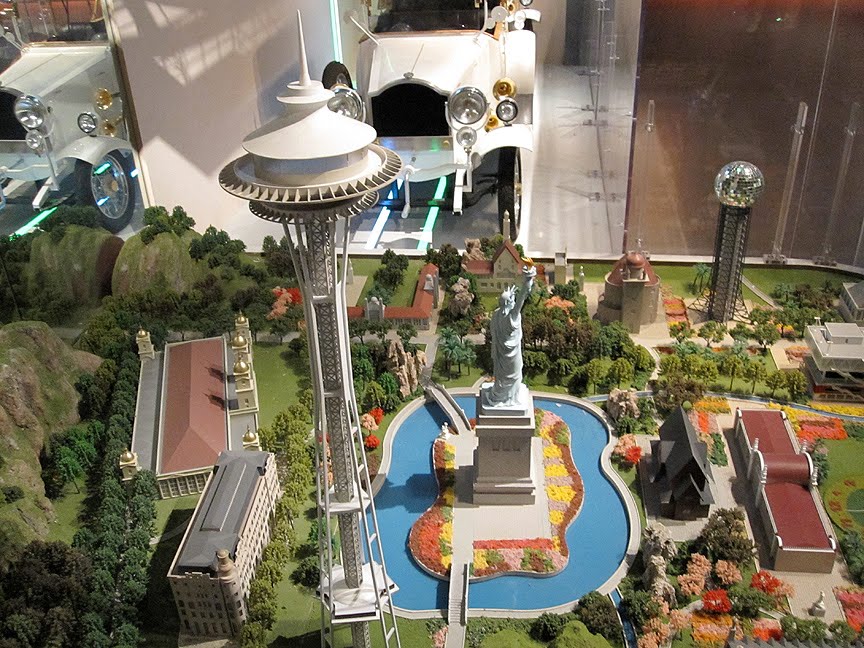
Famous expo theme buildings (and the Statue of Liberty)
The World's Fair Museum was nice enough, though it seemed curated by someone who had only a glancing awareness of the concept. Mostly I was worried that my camera had almost entirely run out of battery power. I tried the one outlet I could see, but it didn't work. I didn't try a second time at the museum because a guard started looking warily at me. Conserving the one or two minutes of power remaining, we toured the largely empty exhibit and then returned back to the boat dock for one last ferry ride.
Our evening would conclude at the China Pavilion, that new symbol of the PRC's 21st-century might. But first, we trudged around the U.S. Building, with no intention of joining the two-hour line for a pavilion universally panned as a disappointment, before catching a bus heading toward that huge, red inverted pyramid. We got close enough, and I sat up the tripod and furiously composed the shot, the camera's power indicator blinking rapidly - and then off.
Frustrated, Jenny and I walked into a tiny mall of restaurants and shops, looking for a power outlet. Nothing, not a single place to power up. We thought about giving up until we stepped into a pleasantly titled Official Merchandise Store. That's where I spotted an outlet behind a display of Haibao dolls. Over the next 20 minutes, Jenny and I "looked at souvenirs," while the camera sucked some juice (how happy I was to have packed a converter this time!). We'd bought so many expo souvenirs over the past two days, I felt OK about the subterfuge.
Finally I got some decent photos and video of that bold, tacky, and gloriously confident China Pavilion. Getting inside was never an option, of course. Lines were said to stretch for hours and hours. You'd have to arrive at the gates earlier than five in the morning just to get a chance to run toward a reservation desk in hopes of snagging one of 30,000 tickets. Yeah, that would happen. No pavilion is worth the eight hours I'd read this one would take to enter. Eight hours!
Last night at Expo 2010
I'd heard that some countries were purposefully stretching their waiting times as a sign of prominence. If it takes a half day to see Saudi Arabia, that country's got to be important, right? Then there's China's ultimate goal of making this the most heavily attended expo in history, with an expectation of 70 million attendees. Some critics whisper that the government is doing more than give free tickets to Shanghai locals, that they're threatening the salaries of regional officials who fail to meet quotas. For China, an economic behemoth still sometimes laughably called a "Developing Nation," Expo 2010 is that big a deal. Nonetheless we were happy to see its signature pavilion from the outside.
We snapped our last pictures, took a walk along the Expo Axis, and made our way to a bus promising a quick ride to a nearby metro station (the wait for the ride to start was interminable, but never mind). Walking under the arched bridge with its animated, blinking colors, our eyes were drawn forward to that city of 20,000,000 people that stretched beyond the fairgrounds. Amnesty International reports that 18,000 households were evicted to make room for the world's fair, but we see no signs of that strife tonight. We only see the towering ambition of a nation shoving the past aside for a glittering tomorrow.
Sometimes we are dubious, sometimes we are amused, and sometimes we are horrified. But always at the fair, always, we are amazed. That night back at the hotel I expect to hear a cacophony of voices in my ears; there's no way I can sleep after our adventures in China's glorious future! Still, I drift away immediately. We've toured ourselves to near-exhaustion in only three days - and our Asian adventures are only just getting started.