Tuesday, November 30, 2010

Airport Writer-in-Residence

Alain de Botton stole a dream job of mine; he got a gig at Heathrow Airport as a Writer-in-Residence. Even better (or worse) he transformed a week of omnitopian adventure into a book called, reasonably enough, A Week at the Airport. Here's a description (gleaned from a CNN story on his project):
"I had a big desk in the middle of departures, with a screen showing what I was typing and most people didn't bat an eyelid as they walked past. Others quickly assumed that it was very normal that there should be a guy writing a book by the check-in desks and came to tell me how I could improve my book and what anecdotes I would be a complete fool for not including. Then there was also a minority of people who just saw me as a useful conduit to information about the location of the restrooms."
Here's another pithy reply to a questioner's implication that airport research must be boring:
"I was delighted not to be going anywhere and therefore, to be free to actually observe where I was. Part of the problem of airports is that we only go to them when we are off somewhere else, and therefore don't see them as a legitimate destination."
Yep, I've added A Week at the Airport to my wish list.


Read the CNN interview: Memoirs of an airport 'writer in residence'

Monday, November 29, 2010

Draft Policy on Mobile Devices

Lately I've been thinking about how and why students use electronic gadgets in class. A fair amount of research and anecdotal evidence shows that students are using mobile phones (and other devices) far more than most faculty recognize. Quoting Wilkes University research:
"95 percent of students bring their phones to class every day and 91 percent have used their phones to text message during class time. Almost half of all respondents indicated that it is easy to text in class without their instructor being aware. In fact, students frequently commented on the survey that their professors would be 'shocked' if they knew how much texting went on in class."
I certainly remember taking a community college refresher course last year and observing that roughly one third of my fellow students seemed more interested in updating their Facebook pages than in focusing on the topic at hand.

My initial response to the notion of students fiddling with their machines in my classroom is to propose a draconian rule: no mobile devices, ever. I didn't use them in my college classes, I figure; students don't need them today. Upon reflection, though, that approach strikes me as being shortsighted.

So now I've developed a more nuanced response, one that affirms my basic respect for the autonomy of adults while trying to maintain a minimal standard of decorum and practicality.

My plan is to share a revised version of this note with my students this spring [here's the current draft]. It's over-written, I admit it, and it's crafted in a more legalistic tone than I'd prefer. But my written policy is merely a supporting document for a conversation I intend to conduct with my students.

Few students (if any) will actually read these words. I just want to have something written down. At a minimum, a message like this signals that I've considered the issue carefully. Better yet, this note might help us avoid frustration later on.

Here's a draft.

Any thoughts? Concerns? Recommendations? Please post a comment.

Also, fellow faculty members, do you have a mobile device policy that you'd like to share? I'd love to see it.

Mobile Devices in Class

You may use mobile devices (phones, laptops, etc.) in my class so long as you follow basic social and ethical guidelines.

To explain those guidelines, let me first explain why I created a mobile device policy at all. Like it or not, virtually all students bring electronic gadgets to class. And why not? You want to stay connected to friends and family, and sometimes important news just can't wait until the end of class. Moreover, these devices aren't toys; they're tools.

Today's mobile devices enable you to check notes, update your calendar, or perhaps get a second opinion on assertions I may offer. Additionally, mobile devices play an essential role in our university's emergency notification network. It therefore seems silly to mandate that you cannot access your phones, laptops, and other electronic tools in class.

That being said, there are three obvious exceptions to this policy, related to testing, privacy, and distraction. In these cases I must adopt a hard line.

1. You may not use any mobile device while any student is taking a quiz or test in the classroom. Restricting the use of mobile devices in a testing environment is a matter of integrity, both practical and perceptual. And I would be well within my rights to interpret any such usage (without my express permission) as a sign of cheating.

2. You may not use any mobile device to record sound or images in class without my consent. Why? Well, for starters, even though you are attending a public university, my classroom is not located in the "public domain." No one in this class has authorized you to record their images or voices. Doing so without gaining permission thus constitutes an invasion of privacy - and potentially a form of theft.

Let me explain: My lectures and other classroom activities are my intellectual property. And while I recognize that student fees help pay for the costs of this room (and for my services) I do not wave my right to create and distribute classroom content as I see fit. That's why you must ask my permission (ideally in written form) to photograph a slide, record a lecture, or distribute my likeness in any way.

3. You may not use any mobile device in a manner that distracts other people. If your use of a mobile device disturbs other folks (especially with ringtones or loud buzzing) - or if attention paid to your device means that you cannot participate meaningfully in our conversations - you may be required to leave the class.

That regrettable action may seem harsh. But ultimately it's a matter of respect. You deserve my full attention in the classroom; I ask for a reasonable portion of the same. If you want to send a quick text or perform a brief web search, feel free. Just be discrete. If you need a gentle reminder about this policy, I'll provide one. Thereafter my approach must become much more strict.

After all, our classroom is a community. What we do and say here matters. There's an anxious, busy world beyond our walls, I know. But that world can wait, at least for the brief time we share together. And when it can't, you can always quietly step outside. I merely ask you to remember that this class - indeed, your choice to seek a degree - is ultimately your choice. And with that choice comes certain responsibilities. One of them: contributing to a respectful learning environment.

Otherwise, there's really no point in coming to college at all.

Wednesday, November 24, 2010

Off for Thanksgiving

I'm taking a few days off to enjoy Thanksgiving at home. I'll be back in the blogger's seat on Monday. Until then, I hope you and yours have a lovely holiday.

Monday, November 22, 2010

2010 Travels

Reviewing the past year Jenny and I found ourselves struggling to remember all the trips we took in 2010. I figured it might be good idea to collect 'em all onto one page.

• Joshua Tree (Dec '09): "Despite the seemingly vertiginous height, we worked together to identify safe footholds and climbing routes before reaching our own humble summit."

• Carl B. Mattson funeral (March): "Over the weekend, we traveled to Florida to commemorate the passing of Jenny's uncle."

• Weekend in Tucson (March): "We'd flown and driven a long way to see them up close. And then there they were. Gnarled, weird, awesome."

• Denver and northern Colorado (April): "With all the hassles and stresses of the past few months, it was a real treat to find some big sky and open highway far from everyday life."

• CA-395 (May): "My recent drive down the eastern spine of California's Sierra Mountains was easily the best solo roadtrip I've ever taken, the culmination of a long-held desire to experience that strange transformation from the state's northern frozen plains to its southern depths that burn under the sun."

• Florida (May): "Our trip served no real purpose; it was just about time that we return to our favorite Sunshine State haunts."

• San Francisco Bay Area (June): "With still a bit of wanderlust between us, we crossed the Golden Gate in search of a nice spot to take a picture."

• Carmel and Point Lobos (June) "There's just so much to see in this part of California, with each turn yielding another path through a breezy meadow and down a stone trail to the end of the world."

• Munich, Salzburg, and Vienna (July): "I traveled to Europe this summer to attend the Salzburg Global Seminar's International Study Program, and I met some amazing people and had some great times."

• Shanghai, Hangzhou, Bangkok, Chiang Mai, and Phuket (August): "We drew smiles and some awed looks, along with a few nods of encouragement, especially when we opened our folding chairs and joined the congregation."

• Florida (September): "My first trip to South Beach, back in '91, hooked me, and every time we return I have to see the gorgeous marquees of those hotels by the sea."

• Texas (September): "Pounding heat and imminent rain quickened our pace, but I had to stop when I saw the Oil City Brass Works."

• Skydiving over Hollister (October): "The air pounded against my chest and I yelled for the thrill of it all. I knew we were falling at a rate of about 120 miles per hour, but I felt no fear. Nothing but exhilaration. My mouth grew stale with the storm rattling my tongue; I didn't care. We plunged and I shouted 'Hell yeah!'"

• NCA in San Francisco (November): "The San Francisco Zoo is nearby, and romantically inclined writers say you can hear the lions from the motel. I never heard any animals, but I'm sure I caught the throaty call of a Golden Gate foghorn."

2011 looks even better. I'm planning to return to China in May/June and fly back to Europe in July. Best of all, Jenny and I are planning our European Grand Tour for August. Oh yes, there will be pictures.

Friday, November 19, 2010

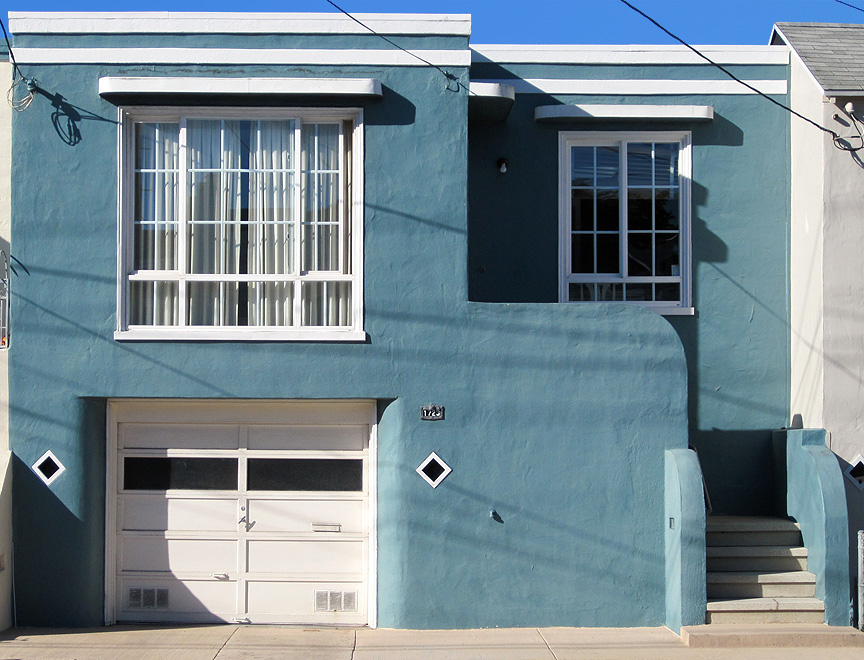
Outer Sunset Deco (San Francisco)

I thought I'd share some swell deco and streamline inspired houses seen during my recent trip to San Francisco. These are from the southwestern portion of the city - the Outer Sunset neighborhood - which rose in the aftermath of the 1906 earthquake.

1735 47th Avenue
A district overview provided by the San Francisco Chronicle describes how a post-quake real estate boom, helped along by the extended reach of street cars, inspired developers to pave over sand dunes and build a middle class suburb.

1723 46th Avenue
The Chronicle adds that the neighborhood is especially known for its diversity: "From block to block, it's difficult to predict whether you'll come upon a hofbrau, a Thai noodle house, an Irish bar, a Vietnamese restaurant or a Chinese dry cleaner, adding to these neighborhoods' attraction for visitors."

2263 47th Avenue
As I have time, I hope to learn more about San Francisco's Outer Sunset neighborhood. My first step includes plans to investigate the Western Neighborhoods Project, an amazing resource filled with images, stories, and artifacts.

2131 46th Avenue
(Photographs by Andrew Wood)

Thursday, November 18, 2010

Ocean Park Motel


I'm resurfacing from the 2010 meeting of the National Communication Association where I stayed at a perfect motor lodge. Normally for these conferences I stick with the convention hotel, which is typically an expensive and crowded tower of pricy restaurants, crystal chandeliers, miserable air, and noisy elevators (while being, at least, convenient). This time I opted for a distant lodging option. I was in San Francisco and had always wanted to visit the Ocean Park Motel. This time I did, and I'm glad.


The Ocean Park is San Francisco's oldest motel, yet is impeccably maintained. A marvel of Nautical Moderne style, built between 1936 and '37, this place is an ocean liner of steel balustrades, 90 degree curves and, of course, portholes. The owners are proud of the Ocean Park and appreciate visitors who dig the property. In fact, I got an upgrade after I whistled at the beauty of the place (but I think my fortune was due to the low season and subsequent surfeit of available rooms).


The Ocean park is located in San Francisco's Outer Sunset district, which presents an aging collection of row homes that march up and down the avenues near the ocean. [I spent a couple hours photographing some of my favorite streamlined-style examples). The San Francisco Zoo is nearby, and romantically inclined writers say you can hear the lions from the motel. I never heard any animals, but I'm sure I caught the throaty call of a Golden Gate foghorn. Best of all, the Muni's L-Taraval line extends from just across the street to the heart of the city.


NCA was a crush of furtive name badge-glances, obligatory meetings, loud parties, impromptu chats, and quiet conversations. I always return from these conferences with enthusiasm for my writing and hopes to collaborate with like-minded scholars. Yet the experience is always a drain on my finances and energy. That's why I'm so glad I stayed at the Ocean Park. It was a little more than a 45 minute trip away (by train and then by foot from station to hotel). A hassle of distance, I suppose. But that afternoon when I had some time to practice remarks I would later give, alone in my sunny room and far from the crowd, I enjoyed more peace than I've felt in months.

Thursday, November 11, 2010

NCA Adventures Commencing

I'm headed offline for a few days in preparation for the National Communication Association's annual conference in San Francisco (yeah, "up the road"). I'll miss Jenny while I'm away, but I'll also enjoy the chance to catch up with pals from my grad and undergraduate years. I should resurface next week by Wednesday or Thursday.